



Share This:

Everest Base Camp Trek with Mera Peak Climbing
For adventurers seeking the ultimate test of endurance, high-altitude trekking, and alpine mountaineering in the grandest arena on earth, the combined 27-day Everest Base Camp Trek with Mera Peak Climbing represents the pinnacle of wilderness expeditions. This massive, three-week-plus itinerary structured by Mountain Treks Nepal is designed for trekkers who refuse to compromise. By weaving together the classic, culturally rich tea-house trail of the Khumbu Valley with a fully supported camping expedition to the summit of Mera Peak Nepal’s highest official trekking peak at 6,476 meters (21,246 feet) this itinerary delivers an uncompromised alpine experience.
The core brilliance of this 27-day route lies in its unparalleled, organic acclimatization profile. Spending nearly two weeks hiking through the lower and upper Khumbu, crossing high viewpoints like Kala Patthar, and standing at Everest Base Camp allows your body to undergo complete physiological adaptation. When you finally cross the remote Zatrwa La pass into the isolated Hinku Valley to begin the mountaineering phase, your respiratory and cardiovascular systems are fully optimized, vastly increasing your safety margins and summit success rate.
Strategic Overview of the 27-Day Expedition

This extended journey covers massive geographic territory, crossing from the well-trodden trails of the Sagarmatha National Park into the rugged, untamed valleys of the Makalu-Barun wilderness zone. Trekkers must be prepared to transition seamlessly from comfortable teahouse living to self-sustained high-altitude camping on live glaciers.
| Expedition Metric | Technical & Geographic Dataset |
| Total Route Duration | 27 Days (Kathmandu to Kathmandu) |
| Maximum Climbing Altitude | 6,476 meters (21,246 feet) at Mera Peak Summit |
| Maximum Trekking Altitude | 5,545 meters (18,192 feet) at Kala Patthar |
| Technical Alpine Grading | Alpine Grade F (Facile / Straightforward but physically demanding glacier walk) |
| Accommodation Infrastructure | 18 Nights in Teahouses / 6 Nights in High-Altitude Expedition Tents |
| Critical Required Permits | Makalu Barun Park Permit, Sagarmatha Park Entry, NMA Mera Peak Climbing Permit |
Comprehensive Day-by-Day Itinerary Breakdown

Managing energy levels over 27 days requires a methodical, deeply professional routing strategy. Mountain Treks Nepal breaks down the precise elevation shifts and daily physical objectives below.
Day 1: Arrival in Kathmandu
Your expedition commences with a private vehicle transfer from Tribhuvan International Airport to your hotel in Thamel (1,400 meters). Rest, hydrate, and recover from international travel.
Day 2: Equipment Inspection and Expedition Briefing
You will meet your expedition leader at the Mountain Treks Nepal headquarters. This day is reserved for checking high-altitude gear, ensuring sleeping bags are rated for extreme cold, and finalizing state climbing permits with the Nepal Mountaineering Association (NMA).
Day 3: Domestic Flight to Lukla and Trek to Phakding
A morning flight brings you to the mountain airstrip of Lukla (2,860 meters). You assemble your porter and guide crews, descending along stone-lined village paths to Phakding (2,610 meters) for a gentle 3-hour warm-up walk.
Day 4: Phakding to Namche Bazaar
You follow the Dudh Koshi River northward, crossing several high suspension bridges. After registering your entry permits at Monjo, you undertake the legendary, steep 3-hour climb through pine forests to reach the Sherpa cultural capital of Namche Bazaar (3,440 meters).
Day 5: Namche Bazaar Acclimatization Phase
To anchor your body’s adjustments to the thin air, you spend a mandatory rest day here. You will hike up to the Everest View Hotel (3,880 meters) to survey the majestic profiles of Everest, Lhotse, and Ama Dablam before returning to Namche for the night.
Day 6: Namche Bazaar to Tengboche
The trail contours around deep valleys before dropping to the riverbed at Phunki Thenga. From there, you ascend a long, forested ridge to Tengboche (3,860 meters), where you can witness the evening chanting of the monks inside the historic monastery.
Day 7: Tengboche to Dingboche
Descending through mossy forests, you cross the Imja Khola via a steel bridge and pass the stone hamlets of Pangboche. The tree line gives way to sweeping alpine scrub as you enter the high, wind-swept Imja Valley, ending at Dingboche (4,410 meters).
Day 8: Dingboche Acclimatization Climb
To safely break through the 4,000 meter mark, a second active rest day is held. You will climb the steep paths of Nagarjun Hill to an altitude of 5,000 meters, enjoying views of Ama Dablam’s vertical north face and the distant peak of Island Peak.
Day 9: Dingboche to Lobuche
The path points north toward the Khumbu Glacier. You stop for a hot lunch at Thukla before ascending the steep terminal moraine wall. At the top, you pass the emotional stone monuments dedicated to fallen Everest climbers, then follow the glacier’s edge to Lobuche (4,940 meters).
Day 10: Lobuche to Gorak Shep and Everest Base Camp
You trek for 3 hours across rugged moraine troughs to the sandy flats of Gorak Shep (5,164 meters). After a brief turnaround, you push onward for another 3 hours over shifting glacier fields to stand proudly at Everest Base Camp (5,364 meters). Enjoy the incredible sights of the active Khumbu Icefall before returning to Gorak Shep to sleep.
Day 11: Sunrise Climb of Kala Patthar and Trek to Pheriche
You wake at 4:00 AM to ascend the dark, frozen spine of Kala Patthar (5,545 meters), the premier trekking vantage point to view the sunrise over Mount Everest and Nuptse. You then descend to Gorak Shep for breakfast and walk down the valley to the lower altitude of Pheriche (4,240 meters).
Day 12: Pheriche to Pangboche and Khangma Ding
You begin breaking away from the standard trekking highway. Retracing steps to Pangboche, your crew directs you onto an isolated easterly trail that ascends slowly toward the remote meadows of Khangma Ding (4,350 meters).
Day 13: Khangma Ding over the Mera La to Tangnag
The transition into the Mera Peak wilderness intensifies. You ascend high alpine passes, navigating through scree slopes to cross the Mera La (5,415 meters), descending down into the beautiful, isolated Hinku Valley floor to sleep at the small seasonal settlement of Tangnag (4,360 meters).
Day 14: Tangnag to Khare (Mera Peak Base Camp)
The trail follows the lateral moraine of the Dig Glacier, passing the beautiful, silt-filled Sabai Tsho glacial lake. You walk for 4 to 5 hours into Khare (5,045 meters), a rugged stone settlement that serves as the definitive base camp and launchpad for the climbing phase.
Day 15: Rest and Technical Training in Khare
This day is critical for safety. Your Mountain Treks Nepal climbing guides will run a practical mountaineering clinic on the slopes above Khare. You will practice walking in rigid plastics, fitting heavy-duty snow crampons, using an ice axe for self-arrest, and mastering the synchronous pace of traveling in a rope team.
Day 16: Khare to Mera Peak High Camp
You leave permanent teahouses behind. The route climbs steeply up a rock ridge before stepping onto the smooth, vast surface of the Mera Glacier. You walk in fixed rope teams across the snowpack to establish Mera Peak High Camp (5,780 meters), pitched securely onto a rocky shelf. The views from this camp are legendary, spanning five of the world’s six highest mountains.
Day 17: Summit Day: High Camp to Mera Peak Summit (6,476 m) and return to Khare
The midnight wake-up call sounds at 1:30 AM. Fuelled by hot tea and porridge, you step onto the glacier in full rope teams. The climb is a long, slow, non-technical test of endurance up vast snow fields. The final 50 meters features a steep snow dome angled at 40 degree that requires an ascender on a fixed rope.
Standing on the summit of Mera Peak (6,476 meters), you are rewarded with a panoramic view of Mount Everest, Lhotse, Cho Oyu, Makalu, and Kanchenjunga. You then descend carefully past High Camp, dropping back down to the thick air and warmth of the teahouse at Khare (5,045 meters) after a grueling 10-to-12-hour day.
Day 18: Contingency and Weather Day
A built-in safety day. If bad weather, high winds, or deep snow delays the summit bid on Day 17, this day is used for the climb. If the summit was successful, this day serves as a well-deserved rest day in Khare.
Day 19: Khare to Kothe
You begin the return journey through the Hinku Valley, walking downhill along the roaring Hinku River. The stark, barren alpine terrain gives way to lush blue pine and thick rhododendron forests as you arrive at the riverside camp of Kothe (3,600 meters).
Day 20: Kothe to Thuli Kharka
The trail climbs steadily out of the valley floor, ascending past high summer pastures and rocky ridges. You complete a demanding 6-hour uphill walk to reach the high pasture clearing of Thuli Kharka (4,300 meters).
Day 21: Thuli Kharka over Zatrwa La Pass to Lukla
The final physical hurdle of the trek requires crossing the dramatic Zatrwa La Pass (4,610 meters). After scaling the rocky stairs to the pass, you are treated to a final look back at the Hinku wilderness before making a long, steep 5-hour descent back to Lukla (2,860 meters) to celebrate with your team.
Day 22: Lukla to Kathmandu Flight
You catch the morning domestic flight from Lukla to Kathmandu. Upon arrival, a private vehicle transfers you to your hotel in Thamel for a long-awaited warm shower and a rest day.
Days 23 – 25: Comprehensive Buffer and Travel Contingency Days
Because the weather around Lukla and the high Hinku Valley can be highly unpredictable, Mountain Treks Nepal integrates three complete buffer days into this 27-day itinerary. These days safeguard your international departure flights against any unexpected mountain weather delays or flight cancellations. If your trek finishes on time, these days are used for sightseeing around the historic UNESCO heritage sites of Kathmandu, including Boudhanath and Kathmandu Durbar Square.
Day 26: Farewell Gala Dinner in Kathmandu
A celebratory evening hosted by Mountain Treks Nepal in Thamel. You will share a traditional multi-course Nepali meal with your climbing guides, receive your official summit certificates, and reflect on an epic 27-day journey across the Himalayas.
Day 27: Final International Departure
A private airport shuttle transfers you from your hotel directly to Tribhuvan International Airport for your return flight home, marking the formal conclusion of your grand 27-day Himalayan expedition.
Technical Visual Markers Along the 27-Day Trail
The Memorial Ridge of Thukla Pass
Located above 4,800 meters, this historic ridge features dozens of stone monuments built to honor climbers who lost their lives on Everest. It is a quiet, moving space set against the stark backdrop of the Lobuche peaks.
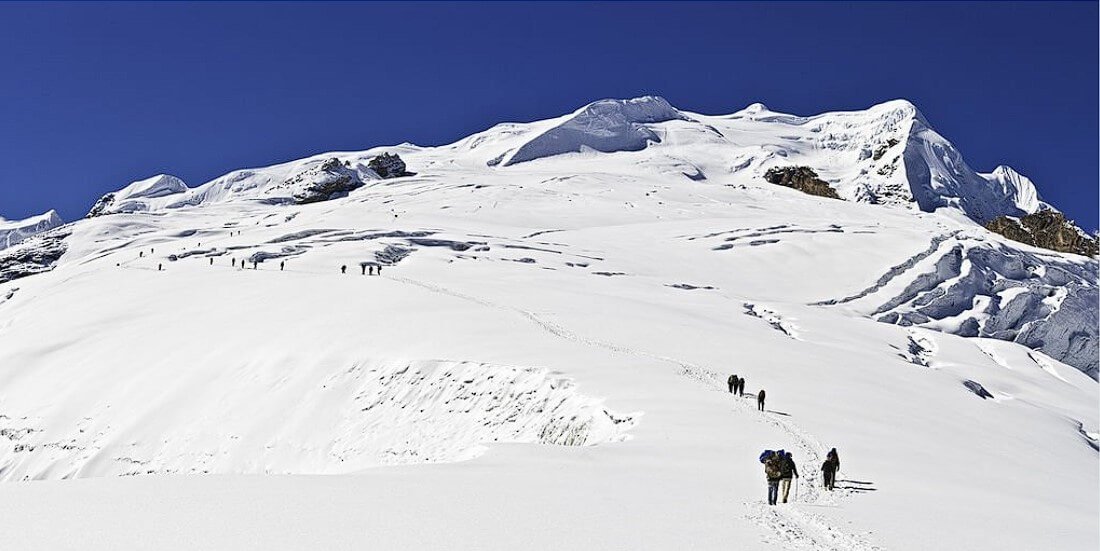
The Endless Snowfields of the Mera Glacier
The upper climbing route features a vast expanse of pure white snow and deep blue ice. The trail moves smoothly upward across open slopes, requiring teams to walk in synchronized lines linked by safety ropes.
The High Camp Rock Shelf
Pitched on an isolated rocky outcrop at 5,780 meters, this camp stands directly above the clouds. The bright yellow expedition tents sit precariously on the rock face, looking out at a massive wall of snow peaks.
The Final Summit Snow Dome
The last obstacle of the climb is a massive, rounded wall of hard-packed snow rising directly to the highest point. Climbers use mechanical ascenders on a single fixed line to climb the final steep section to reach the narrow summit.
Seasonal Analysis and Budget Dataset
Climbing to 6,476 meters requires highly stable high-altitude weather and predictable snow packing. The table below outlines the primary costs and conditions across the operational climbing year.
| Expedition Window | Weather Patterns & Trail Conditions | Budget Range (USD) |
| Spring (March – May) | Deep winter snowpack melts slowly; clear, bright mornings with excellent climbing snow. | $3,400 – $3,900 |
| Monsoon (June – August) | Heavy rainfall, cloud-covered peaks, high risk of landslides and avalanches (Closed). | Not Feasible |
| Autumn (Sept – Nov) | Sharp, crisp air with unmatched visual clarity; very stable wind conditions on the summit. | $3,500 – $4,100 |
| Winter (Dec – Feb) | Sub-zero temperatures below -25 degree celcius on the summit; extreme winds and dangerous ice glaze. | $2,900 – $3,300 |
FAQS
To assist travelers seeking immediate, factual information, this section provides concise, data-verified answers regarding the logistics of this dual-adventure expedition.
How hard is the climb to Mera Peak?
Mera Peak is graded as Alpine Grade F (Facile/Easy). While it is technically straightforward and consists primarily of a gradual glacier walk without vertical ice walls, it is physically demanding. It requires excellent physical stamina to endure the extreme altitude of 6,476 meters and the stamina needed for a 27-day expedition.
What mountains can you see from the summit of Mera Peak?
The summit of Mera Peak offers one of the finest panoramic views in the world. On a clear day, you can see five of the planet’s six highest mountains simultaneously: Mount Everest (8,848 m), Lhotse (8,516 m), Cho Oyu (8,188 m), Makalu (8,485 m), and Kanchenjunga (8,586 m).
Do you need previous climbing experience for Mera Peak?
No, previous technical mountaineering experience is not strictly mandatory for Mera Peak due to its non-technical glacier paths. However, excellent physical conditioning and pre-trip cardio training are vital. Mountain Treks Nepal includes a dedicated technical gear training day at Khare to ensure you are comfortable using crampons and ropes.
Why is the Mera Peak itinerary 27 days long?
The 27-day length is designed to ensure maximum safety and proper acclimatization. By trekking through Everest Base Camp and climbing Kala Patthar first, your body naturally adapts to high elevations over 12 days. This slow, deliberate approach significantly reduces the risk of acute mountain sickness (AMS) before your summit bid.
Can you see Everest from Mera Peak High Camp?
Yes, Mount Everest is clearly visible from Mera Peak High Camp (5,780 meters). The high camp sits on an open rock shelf that offers an unobstructed view across the valleys to the dark summit pyramid of Everest rising above the Nuptse-Lhotse wall.
Mandatory Booking Protocol
For mountaineers ready to secure their place on this multi-week Himalayan expedition with Mountain Treks Nepal, executing this booking sequence ensures all logistics are prepared.
1.Initiate Heavy Endurance Training:8 Months Before Launch.
Begin a rigorous training program focused on long-distance running, swimming, and multi-hour weekend hikes with a weighted backpack to prepare your legs and lungs for 27 days of constant exertion.
2.Register Permits & Secure Flights:5 Months Before Launch.
Submit your passport copies and booking deposit to Mountain Treks Nepal. The office will immediately begin the process of securing your NMA climbing permits and booking your internal Lukla flights.
3.Acquire Extreme Altitude Insurance:3 Months Before Launch.
Purchase a specialized high-altitude travel insurance policy. The terms must explicitly cover technical mountain climbing and emergency helicopter evacuation up to an elevation of 6,500 meters.
4.Final Equipment Check in Thamel:Day 2 of Itinerary.
Meet with your lead climbing guide in Kathmandu to conduct a thorough gear check. Ensure your extreme-cold sleeping bag, down parka, and alpine mountaineering gear meet the safety standards for the sub-zero temperatures of High Camp.
Conclusion: The Ultimate Himalayan Accomplishment
Completing the 27-day Everest Base Camp Trek with Mera Peak Climbing is an extraordinary achievement that combines the best of Himalayan trekking with a true high-altitude mountaineering victory. By trusting a deeply professional, slow-paced acclimatization route and the local expertise of Mountain Treks Nepal, you can minimize the risks of high elevation. This comprehensive journey ensures you can safely navigate the remote valleys of the Hinku, stand at the foot of Mount Everest, and experience the unparalleled joy of standing on a 6,476 meter summit looking out at the highest peaks on earth.