


Everest Three Passes Trek - 18 Days
-
Duration:
18 days -
Max Altitude:
5545m -
Difficulty Level:
Challenging -
Group Size:
1- 15 People -
Destination:
Khumbu / Mt. Everest -
Accommodation:
Hotel/Lodges -
Transportation:
Flight -
Best Season:
March to May and September to November
Trip Overview
The Everest Three Passes Trek is one of the most complete and adventurous trekking experiences in Nepal. This classic high-altitude circuit takes you beyond the standard Everest Base Camp trail and leads you across the three legendary passes of the Khumbu region: Kongma La Pass (5,545 m), Cho La Pass (5,420 m), and Renjo La Pass (5,360 m). Along the way, trekkers enjoy spectacular views of Mount Everest, Lhotse, Makalu, Cho Oyu, Ama Dablam, Nuptse, Pumori, and many other Himalayan peaks. Your current package already presents this trek as a challenging and highly rewarding journey through Sherpa villages, monasteries, and dramatic mountain scenery, which is exactly how it should be positioned for SEO and conversion.
What makes the Everest Three Passes Trek truly special is that it combines several iconic experiences into one itinerary. Instead of only reaching Everest Base Camp, trekkers also explore the breathtaking Gokyo Lakes region, cross remote alpine terrain, visit major viewpoints like Kala Patthar, and pass through culturally rich settlements such as Namche Bazaar, Tengboche, Dingboche, Chhukung, Lobuche, Dzongla, Thangnak, Gokyo, and Thame. The result is a trek that feels far more varied, scenic, and adventurous than the standard Everest route. The competitor reference also highlights that this trek is often called the “Three Passes Three Peaks Trek” because it naturally connects major viewpoints such as Kala Patthar, Gokyo Ri, and Chhukung Ri.
This trek is ideal for trekkers who want the ultimate Everest region adventure. It is physically demanding and requires strong fitness, but in return it offers incredible mountain views, genuine Sherpa culture, remote trails, glacial valleys, turquoise lakes, and a real sense of accomplishment. For many trekkers, this is the most scenic and satisfying trek in the Khumbu.
Preparation for the Everest Three Passes Trek – 18 Days
Guides and Porters
The Everest Three Passes Trek 18 Days is one of the most challenging treks in Nepal and it is highly important to find a guide for an effective and secure journey. First, the guides make certain that you do not encounter any problems by guiding you through trails. Furthermore, they enhance the journeys by explaining the Sherpa people’s lifestyle, Buddhism, and the surroundings. They are trained to deal with any medical incident including high altitude sickness, which allows them to make strategic choices regarding tempo, proper acclimatization, or evacuation if required. They have also command experience on traversing glaciers and changing weather which are normal in high altitudes.
Carrying heavy equipment on this challenging Everest Three Passes Trek is itself a challenging job. Here, porters come with a great help. Above the height of 5,500 meters, it is very important to save energy, and porters make it possible for trekkers to direct their energy on the tough terrain and breathtaking scenery. So with porters carrying your backpacks, it will create an environment for you to enjoy the natural beauty and sceneries. Together with guides and porters, the 18 Days Everest Three Passes Trek becomes a beautiful experience and breathtaking adventure that none will ever forget.
Permits and Licenses for Everest Three Passes Trek
If you are trekking in the Everest region which includes the Three Passes Trek, then the Sagarmatha National Park Entry Permit is a must. This permit allows entrance into the protected area of the park Sagarmatha National Park which is a part of the UNESCO World Heritage Site circled around beautiful sceneries, rich flora and fauna and famous peak of Everest. This costs NPR 3000 for foreigners and NPR 1000 for SAARC national. This can be easily purchased at the Nepal Tourism Board office in Kathmandu or at Monjo Check post enroute to Namche Bazar.
The Khumbu Pasang Lhamu Municipality Entry Permit is the other permit that all the trekkers in the Khumbu region must have. This was created to assist in improving and maintaining the local facilities; it costs NPR 3000 for trekkers regardless of nationality. Usually, it can be obtained in Lukla or other designated points on the trail.
Best Time for Everest Three Passes Trek
The best time for the Everest Three Passes Trek is during spring (March to May) and autumn (September to November). Your current package states March to May and September to November as the main trekking season, while the competitor reference also highlights spring and autumn as the preferred windows.
Spring (March to May)
Spring offers stable weather, longer days, and blooming rhododendron forests at lower elevations. Visibility is often very good, and temperatures are more moderate than in winter. This is one of the best times for trekkers who want clear views and lively trail conditions.
Autumn (September to November)
Autumn is often considered the best overall season because the weather is usually dry and visibility is excellent after the monsoon. The mountain views are exceptionally sharp, and the trails are usually in good condition.
Winter (December to February)
Winter trekking is possible for strong trekkers, but snow and ice can make the passes significantly harder. Very cold temperatures and weather delays are common.
Monsoon (June to August)
Monsoon is generally less ideal due to rain, cloud cover, muddy trails, possible flight disruptions, and lower visibility.
Altitude Chart

This altitude chart shows the Everest Three Passes Trek route over 18 days, starting from Kathmandu at 1,400 meters and gradually climbing through Phakding, Namche Bazaar, and the Everest View Hotel area. The trek continues higher toward Chhukung Ri at 5,546 meters, then moves through major Everest region highlights including Everest Base Camp at 5,365 meters and Kalapatthar at 5,644 meters, which is the highest point shown on the chart. After this, the route maintains a high-altitude level around 4,750 meters before reaching Gokyo Ri at 5,357 meters and Renjo La Pass at 5,360 meters. From there, the chart shows a steady descent through lower elevations, dropping to 3,440 meters, then 2,840 meters, and finally returning to Kathmandu at 1,400 meters. Overall, this chart represents a challenging high-altitude trek with multiple major viewpoints, steep climbs, high passes, and a gradual descent after completing the main Everest region highlights.
Communications and Internet
Limited means of communication characterize the Everest Three Passes Trek. People can connect through Wi-Fi and mobile networks in more advanced centers such as Namche Bazaar, although such services can be expensive and unreliable. Besides, the coverage is poor, and trekkers may have to use satellite phones in emergencies. We recommend purchasing Ncell or NTC SIM cards to enjoy the data and voice packs during your journey.
Travel Insurance
It is advisable for trekkers going on the trek to Everest Three Passes to obtain travel insurance since there is a possibility of many issues arising during the hike. The trek has high altitude passes, which places the risk of suffering from altitude sickness, injury and other medical problems.
So it would help if you bought a comprehensive insurance policy that caters to emergency evacuation, cancellation of the trip, medical expenses, loss and delay of baggage coverage. You can purchase these insurances from companies such as Allianz, World Trips, InsureandGo, Europ Assistance, and others.
Drinking Water
During the Everest Three Passes Trek, it is important to drink water often and although there is clean water available, it is good to be careful. Bottled water is available for purchase in villages along the trail. Trekkers are encouraged to use purifiers, water purification tablets, filters, or UV sterilizers to reduce plastic pollution.
In higher altitudes where water sources are scarce, trekkers must make sure that they have sufficient clean water or make use of safe refill points provided in teahouses. Also, boiled water is provided in teahouses, although one has to pay some charges.
Accommodation and Food during Everest Three Passes Trek
Accommodation along the route of the trail consists of mostly simple but comfortable bedding accommodations in teahouses; rooms are usually dormitory style, providing a bed, some blankets and sometimes a small heater. As charts show how facilities can become elementary at higher altitudes, Sherpa’s warm hospitality makes it comfortable.
Food is abundant and includes both local and international cuisine, with the popular being dal bhat (lentil soup), momo (dumplings), pancakes, etc. But because of the vigorous nature of the trek, it is advisable to stick to simple, fresh food and locally prepared meals to prevent food poisoning.
The Three Passes Explained
Kongma La Pass
Kongma La Pass is the highest of the three passes and often considered the toughest. It connects the Chhukung side with the Lobuche side and involves a long climb over rugged high-altitude terrain. The reward is magnificent mountain scenery and an unforgettable sense of achievement. Your itinerary places Kongma La at 5,545 meters, making it one of the key highlights of the trek.
Cho La Pass
Cho La Pass is famous for its dramatic alpine scenery and its connection between the Everest Base Camp side and the Gokyo Valley. This pass can be icy and requires care, especially early in the day. It is one of the most visually dramatic points on the route because of the surrounding peaks, rock, and snow-covered terrain. Both your content and the reference place Cho La above 5,400 meters, making it one of the most exciting days of the trip.
Renjo La Pass
Renjo La Pass is often considered the most scenic of the three. It offers remarkable views over the Gokyo Lakes, Everest, Lhotse, Makalu, and Cho Oyu. Many trekkers describe Renjo La as one of the most photogenic places in the entire Khumbu region. Your itinerary presents it as the final pass and a fitting climax before the descent back toward Namche.
Why Mountain Treks Nepal?
Mountain Treks Nepal is committed to delivering a safe, well-organized, and memorable Everest Three Passes Trek with experienced local guides, personalized service, and transparent planning. Our team has extensive experience in the Everest region and understands the importance of pace, acclimatization, safety, and strong local support on a challenging high-altitude route like this. We also work alongside our sister companies, Everest Flight Nepal and Mountain Vehicle Nepal, allowing us to support our guests with scenic mountain flights, helicopter options, airport transfers, and private transportation across Nepal. From arrival in Kathmandu to the completion of your trek, we aim to provide complete travel support under one reliable local group.
Everest Three Passes Trek Difficulty
The Everest Three Passes Trek difficulty is generally rated as challenging. This is not a beginner-friendly short trek. It is a demanding route designed for trekkers with good physical fitness, strong endurance, and a positive mindset for multi-day walking at high altitude. Your own package already describes it as one of Nepal’s more challenging treks, especially because of the three passes, glacier terrain, altitude, and long days. The competitor reference adds that the trek is moderate to difficult, with snow and ice often present on the passes, and a total walking distance of roughly 148 km.
Why is the trek difficult?
1. High Altitude
The trek regularly climbs above 5,000 meters and includes multiple high passes. Your itinerary mentions Kongma La at 5,545 meters, while the competitor content notes the passes and nearby viewpoints all rise well above 5,300 meters. At this elevation, oxygen is thinner and every climb becomes harder.
2. Long Trekking Days
Most days involve between 5 and 8 hours of trekking, and some pass-crossing days are longer and more tiring. The route includes repeated ascents and descents, so trekkers need stamina rather than just speed.
3. Rough Terrain
Expect rocky trails, glacial moraines, steep climbs, snow-covered or icy sections, narrow tracks, and exposed mountain terrain. Cho La and Kongma La can feel especially demanding when weather changes.
4. Cold Conditions
Temperatures drop sharply at higher altitudes, especially in the early morning, at night, and around the passes. Cold wind, snow, and basic lodge conditions can add to the physical challenge.
Who is this trek suitable for?
This trek is best for:
- trekkers with previous high-altitude trekking experience
- fit adventure travelers
- Everest Base Camp return trekkers wanting a bigger challenge
- strong beginners who have trained properly and are mentally prepared
Major Packing List for Everest Three Passes Trek
- Hiking Boots: Comfortable, waterproof, and well-broken-in.
- Thermal Layers: Essential for warmth in cold nights and higher altitudes.
- Sleeping Bag: Rated for at least -10°C for chilly Himalayan nights.
- Down Jacket: Lightweight yet warm for evening use.
- Daypack: 20–30L capacity for carrying essentials.
- Trekking Poles: Reduce strain on knees and improve balance.
- Water Purification Tablets: For clean drinking water throughout the trek.
- Headlamp: Necessary for early starts and evening use.
- First Aid Kit: Include blister treatments and altitude sickness medication.
- Snacks: High-energy bars and electrolyte powders for a quick energy boost.
Conclusion
The Everest Three Passes Trek is an unforgettable experience that combines adventure, cultures, and nature together to make a unique journey. The trail passes through the Renjo La, Cho La, and Kongma La Passes and offers stunning views of the mountains, glacial lakes and untouched valleys of the Everest region.
On the journey, the hospitable Sherpas and the Buddhist culture add more richness to the experience. Everest Three Passes Trek, though challenging, promotes strength and appreciation of nature.
Book your journey now with Mountain Treks Nepal to experience this lively trek in the Everest Region. You can also check our 14 Days Everest Base Camp Trek package for more stay in typical community of Everest Region. Everest Three Passes Trek offers adventurous and unforgettable trek in this area of Nepal.
Trip Highlights
- Panoramic views of Mount Everest, Lhotse, Makalu, and other Himalayan peaks.
- Cultural encounters with the Sherpa people and visits to traditional villages.
- Opportunities to spot rare wildlife such as Himalayan thar and musk deer.
- Crossing three challenging mountain passes Renjo La, Cho La, and Kongma La.
- Trekking through remote Himalayan valleys and serene mountain lakes like Gokyo Lake.
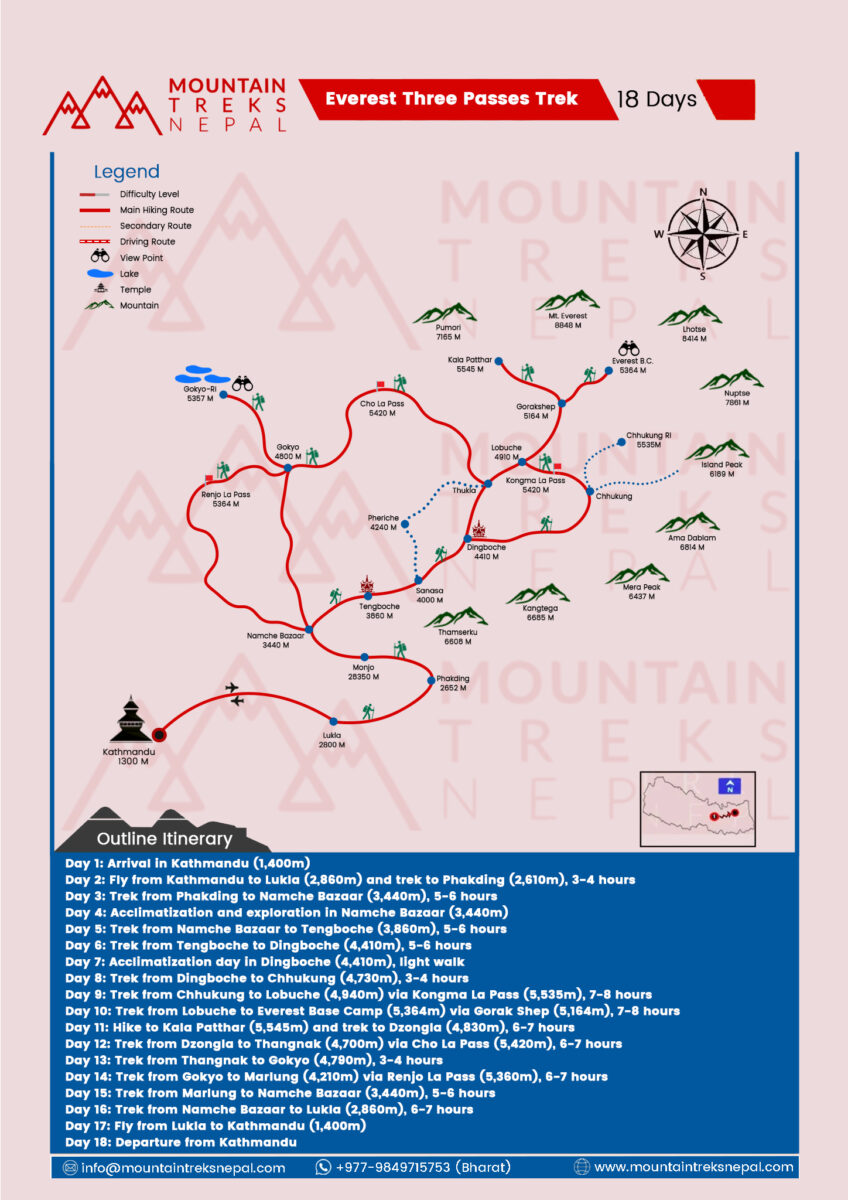
Trip Route
Have a Question? Inquire Now
Why Mountain Treks Nepal?
- Expert Team for Unparalleled Experience
- Best Price Guarantee
- Safety is the first Priority
- Easy Booking & Secure Online Payment
- Flexible And Personalized Service
- 24/7 Support
- Highest Satisfaction Guaranteed
- Highly Experienced Guides
- Your Satisfaction is Our Guarantee
- One-time Deposit, Assured for a Life Time
Detailed Itinerary
After arriving at the Tribhuvan International Airport, you will be received by a Mountain Treks Nepal representative. He holds a signboard with your name on it just outside the arrival terminal. This friendly escort will ensure your smooth transfer to your hotel in Kathmandu.
You also will be provided with a detailed briefing about the Everest Three Passes Trek.
Kathmandu is a vibrant city rich in history and culture. You can explore the busy streets of Thamel, tasting the local street food stalls or stay at a hotel resting. Overnight at Kathmandu.
The journey begins with an early morning flight from Kathmandu to Tenzing Norgay Airport at Lukla. It is the starting point of every trek in the Everest region. Located within the hug of the snow-covered peaks, you can have the beautiful scenery of the snow-capped peaks from Lukla. Here, you will meet your trekking crew and begin the trek to Phakding.
The trail passes through evergreen pine forests, follows the Dudh-Koshi River, and local Sherpa villages. Colourful prayer flags hang on the suspension bridges that both excite and provide wonderful photo opportunities. As you ascend towards Phakding, the peaceful mountaintops welcome you with the snowy ambience. Overnight in Phakding.
On the third day of the 18 Days Everest Three Passes Trek, you will start your hike from Phakding to Namche Bazaar. Starting the trek, you must follow the Dudh Koshi River and head towards Monjo. En route, you’ll cross suspension bridges, visit a few small settlements like Bengkar and Larja Doban, and arrive at the entrance to Sagarmatha National Park. From this point onward, the trail becomes steeper, yielding views of Everest, Lhotse, and Nuptse on clear days.
The last climb leads directly to Namche Bazaar, the innermost city of the Everest region. This small, lively town sits heavenly and is a historic trade route that possesses all sorts of shops, bakeries, and cafes. You can enjoy the lively and diverse cultural aspects as well as hop into stores and bars for shopping. Overnight in Namche Bazaar.
This day is for acclimatization and exploring the beautifully charming town of Namche Bazaar. Namche is amidst towering peaks and has so much to offer. The place is a must-visit for the Sherpa culture museum, where one can study the region’s unique heritage and a short hike to enjoy the panoramic sights of Everest and other surrounding mountains.
Resting at a cafe in town or merely exploring the great many souvenir shops and trekking gear shops will keep visitors entertained. The importance of such a day is so that the human body adapts to whatever altitude one is to face and offers a fine combination of rest and exploration in Namche. Overnight stay in Namche Bazaar.
It is a wonderful trek from Namche to Tengboche on the fifth day of the Everest Three Passes Trek. You will go trekking through rhododendrons, juniper, and fir forests, with views of Everest, Ama Dablam, and Lhotse decorating the sight. You will pass through the Sherpa settlements, such as Kyangjuma and Phunke Tenga, before reaching culturally rich Tengboche.
Tengboche is where myth meets reality in the famous Tengboche Monastery, the biggest in the whole of Khumbu. If you visit in the afternoon, you may be greeted by a fantastic sunset over Everest and Ama Dablam. There, you will find yourself in the most spiritual environment while enjoying the sensational view – surreal! Overnight in Tengboche.
The day starts with a warm breakfast at Tengboche, enjoying the magnificent sunrise over the Himalayas. You will then follow up with a steep descent through lush rhododendron forests before making its way to Debuche and crossing the substantial Imja Khola by a sturdy bridge. The trail climbs along with winding mani walls and chortens until it reaches Pangboche- the highest permanently inhabited settlement in the valley.
Then, the journey to Dingboche starts. A very green settlement within the fantastic surroundings of the striking Ama Dablam, Lhotse, and Island Peak will mesmerize your hike today. A bit more hike and you will finally reach Dingboche, where you will stay overnight.
The seventh day is set for another round of acclimatization during the Everest Three Passes Trek. Besides, this day also will allow you to roam around Dingboche and its countryside. You can take a hike to Nangkartshang Peak, where views of Makalu, Lhotse, and Cho Oyu are rewarding, or you may just explore the village, meet its people, and begin charming yourself to Sherpa culture.
The slower pace of today lets the body acclimatize to the great height. It is very crucial to focus on hydration, nutrition, and proper rest for proper acclimatization. Overnight stay at Dingboche.
Today, you will hike from Dingboche, following a nice trail along the height of the moraine of the Khumbu Glacier. The trek of the day is shorter, but each view of Ama Dablam adds to the view, making your day more enjoyable.
A wooden footbridge will take you into Chhukung, a little settlement perfectly located beneath the south face of Lhotse. The Chhukung area is what climbers love most as far as the Island Peak ascent preparation is concerned. During the afternoon, you may explore around or enjoy soaking up the peaceful mountain ambience. Spent the night in Chhukung.
On the ninth day, we will reach one of the Three Passes Of Everest, Kongma La Pass (5,545 meters). Today’s hike will be challenging as we will traverse through the trail featuring glacial moraine and steep landscapes. But the views of Mt. Makalu, Ama Dablam, and the other giants in the Himalayas can be seen from the Kongma La Pass.
You will then trace back your way to the valley after crossing the pass and head towards Lobuche, situated in the magnificent landscapes of Nuptse and the Khumbu Glacier. We will end our day at Lobuche with a warm dinner at a local tea house.
You will start your hike to Everest Base Camp today. But first, you must traverse Gorak Shep village, the last settlement in the Khumbu valley. As you step into the Everest Base Camp, you will be welcomed with a wide-range view of the Giant Mt. Everest, followed up by other peaks like Nuptse and Lhotse.
You can also have an amazing view of the Khumbu Icefall from Everest Base Camp. Once you finish exploring the base camp, you can return to Gorak Shep for some rest. Overnight in Gorakshep.
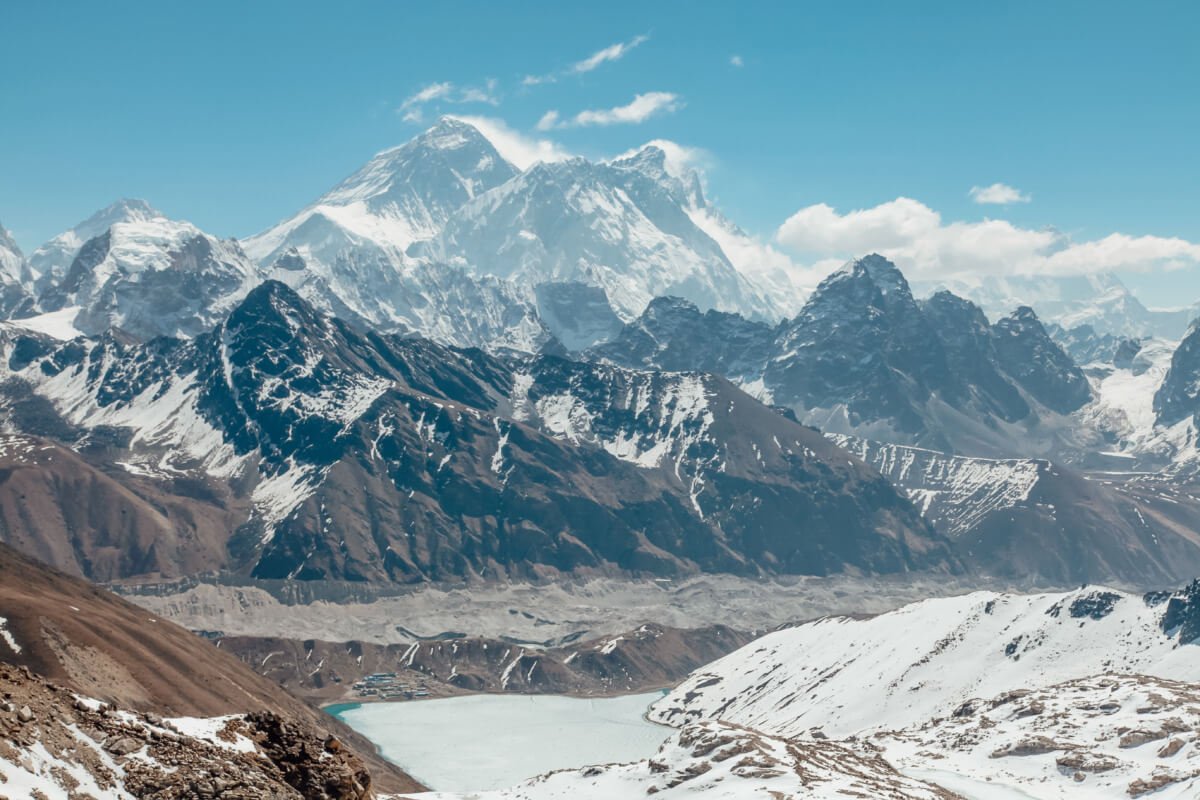
Today, we will wake up early in the morning and then set off on a journey to Kala Patthar (5,644 m) for a sunrise view. From Kala Patthar, you’ll witness a spectacular sunrise over Everest, Lhotse, and Nuptse and a 360-degree view of the surroundings. Kala Patthar is also known as the world’s highest webcam or viewpoint.
After exploring Kala Patthar, we will make our way back to Gorak Shep and then set off on a journey towards Dzongla. It takes the next few hours to reach Dzongla. From here, you also can have incredible views of nearby peaks. Overnight stay in Dzongla.
Today, you will pass the Cho La Pass (5,420 m) which is another pass on the Everest Three Pass Trek. It is yet another challenging but very satisfying walk from Dzongla to the Cho La Pass as. This time, the peaks of the Mahalangur Range will accompany you on your way across to the Pass.
After the pass, you will head down to Thangnak, a village located just below the Ngozumpa Glacier. Here, you will have a chance to relax after what has been a long and exciting hike. Overnight at Thangnak.
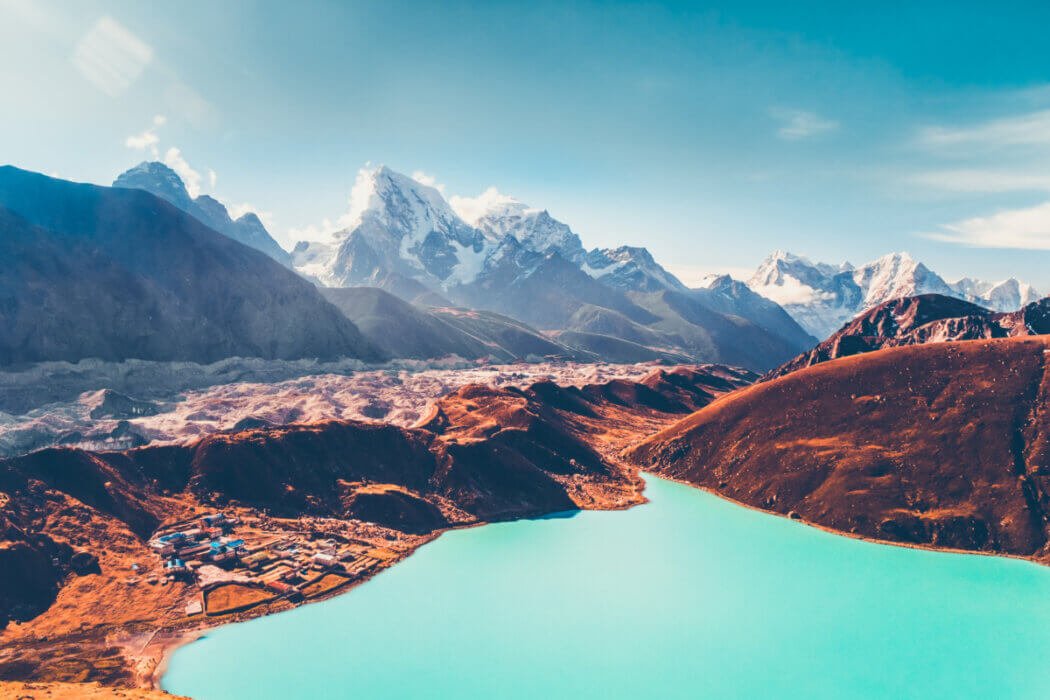
Today’s hike will take you to the tranquil village of Gokyo from Thangnak. You will hike through the Ngozumpa Glacier, one of the largest glaciers in Nepal. In the afternoon, you can either explore the beautiful Gokyo Lakes or explore the area of Gokyo Ri, with views of Mount Everest, Lhotse, Makalu, and Cho Oyu on the horizon.
The combination of calmness offered by the pristine natural lakes and the surrounding mountains is a perfect, mesmerizing combination. Overnight stay at Gokyo village.
Today, we will finally cross the last step of the Everest Three Passes Trek which is Renjo La (5,360 m). The trek is difficult but has breathtaking views of Everest, Lhotse, Makalu and Cho Oyu. This part of the trek is also dangerous to one’s health due high altitudes, so it is proper to be able to take the necessary precautions.
After the Renjo La Pass, you will descend to Marlung village. Rest for now, and enjoy the sights and sounds of the incredible journey that you have just finished. Night in Marlung.
The trekking trail from Namche Bazaar passes through the beautiful Sherpa village of Thame. Also, you will cross the Sherpa settlements of Thamo and Phurte along the way. Not to forget, you will get splendid views of Thamserku and Ama Dablam peak on your way back to Namche.
On reaching Namche Bazaar, trekkers can enjoy a good meal and a hot shower. The warmth of the people of Namche is something to cherish always. You will stay overnight in Namche Bazaar hoping into bars and enjoying local music and culture.
On the sixteenth day of the Everest Three Pass Trek, the trail descends through rhododendron deciduous forests and pine forests, and you will cross the suspension bridges over the Dudh Koshi River. You will walk through the well-known Sherpaa towns of Khumjung, and Chheplung and Nurning Sherpa villages as you take in the last sights of the Khumbu Valley.
After finishing lunch in Lukla, return to the hotel and rest as you contemplate your remarkable adventure in the Himalayas.
Today, we will set back on a flight back to Kathmandu. After an early morning flight, you will arrive back in the city of Kathmandu and will transfer to your hotel. The rest of the day is free to relax, do some last-minute shopping, or see more of the interesting sights the city has to offer. Later in the evening, you can gather with our trekking group for a farewell dinner, reliving your wonderful journey.
Overnight stay will be in Kathmandu.
On the last day, a representative from Mountain Treks Nepal will escort you to the airport for your return journey. As you leave Nepal, you will take the fond memories of the majestic mountains, the colorful traditions, and the hospitality of the Sherpas with you. We wish you all the best in your future travels!
Trip Includes
- 18 days Trip, 16 of which include 3 meals a day.
- 2 nights of accommodation in Kathmandu, breakfast included.
- Round-trip airfare between Kathmandu and Lukla.
- Lodge accommodation during the trek.
- Airport transfers (Domestic and international).
- Everest trekking permit and TIMS (traveler security) Card.
- An experienced English-speaking Trek leader (Trekking guide), assistant leader (8trekkers:1 assistant guide) and porters to curry luggage (2trekkers:1 porter) including their salary, insurance, equipment, all transportations, food and accommodation.
- Porter service form lukla.
- Local and government taxes.
- Insurance for porter and guide.
- Sleeping bag, down jackets and duffel bag – if Necessary (Need to returned after the trek).
- Farewell Dinner with Nepali culture show
Trip Excludes
- Personal Travel insurance.
- International airfare.
- Nepal entry visa.
- Drinks (mineral water, Tea, coffee, whisky) or other snacks and any meals beside breakfast, lunch and dinner. Hot shower, battery. Changes, Wi-Fi charge etc.
- Tips for Guide and porter (Tipping is Expected).
- Personal expenses.
- Personal trekking equipment.
- Any others expenses which are not mentioned on the “Trip Includes” Section.
Trip Photo Gallery




Packing List For Everest Three Passes Trek

General
- Four-season (zero degree) sleeping bag
- Sleeping bag liner
- Puffy down jacket
- Daypack (35-45 liters) with rain cover

Upper Body
- Warm Hat
- Sunglasses
- Scarf/Neck Gaiter/Buff (highly recommended)

Torso
- Moisture-wicking base layers
- Insulating layers (fleece jacket)
- Puffy down jacket
- Waterproof and windproof outer shell jacket

Lower Body
- Quick-drying trekking pants
- Thermal leggings (for high altitudes)
- Waterproof and windproof pants
- Sturdy hiking boots
- Moisture-wicking trekking socks
- Shorts (for lower altitudes or warmer days)

Hands
- Insulated gloves or mittens
- Liner gloves (for added warmth or dexterity)
- Waterproof outer gloves or mittens
- Hand warmers (optional, for extra cold conditions)
- Sunscreen (for protecting your hands from sunburn at high altitudes)
- Hand sanitizer or wet wipes
- Small repair kit (including duct tape for any handwear repairs)
Feet
- Tough hiking boots
- Trekking socks that wick away moisture
- Optional liner socks for increased comfort
(To prevent snow and debris out of your boots) gaiters - Foot warmers—optional in very cold climates
extra laces - Supplies for treating blisters

Medicines and First Aid Kits
- Personalized first aid kit
- Bandages and adhesive tape
- Antiseptic wipes
- Pain relievers
- Anti-diarrheal medication
- Altitude sickness medication
- Sunburn relief cream
- Cough Syrup

Other Equipment
- Passport and Documents
- Trekking poles for stability
- Water bottles or hydration system
- Water purification tablets or filter
- Lightweight towel and toiletries
- Sunscreen and lip balm with SPF
- Insect repellent
- Portable charger or solar charger
Frequently Asked Questions
The Everest Three Passes Trek is a challenging high-altitude trek that requires good fitness, endurance, and mental preparation. It includes long walking days, multiple passes above 5,000 meters, and rugged terrain.
Most itineraries take around 17 to 18 days, depending on route design, acclimatization days, and travel arrangements. Your current package is 18 days, while the competitor reference uses 17 days.
The highest trekking pass in your package is Kongma La at 5,545 meters, while nearby viewpoints such as Kala Patthar also rise above 5,500 meters.
Yes. The Everest Three Passes Trek is more difficult than the standard Everest Base Camp Trek because it includes three high passes, longer route variation, and more physically demanding terrain.
The three passes are Kongma La, Cho La, and Renjo La. These are the main highlights of the trek and connect different valleys of the Everest region.
Yes. Most Everest Three Passes itineraries include a visit to Everest Base Camp as well as Kala Patthar. Your package includes both.
Yes. The route usually includes Gokyo and the beautiful Gokyo Lakes area, which is one of the biggest highlights of the trek.
Trekkers need the Sagarmatha National Park Entry Permit and the Khumbu Pasang Lhamu Municipality Entry Permit.
The best seasons are spring (March to May) and autumn (September to November) because of clearer skies, better visibility, and more stable weather.
A guide is strongly recommended because the trek is long, challenging, and includes high mountain passes where weather and trail conditions can change quickly.
Strong beginners can do it with proper preparation, but previous trekking experience is highly recommended because of the altitude and technical difficulty of the passes.
Accommodation is mainly in mountain lodges and teahouses with simple rooms and shared facilities, especially at higher elevations.
Common meals include dal bhat, momo, noodles, soups, pancakes, eggs, fried rice, and tea or coffee.
Yes. Travel insurance that covers high-altitude trekking and emergency evacuation is strongly recommended.
Yes. Since the trek goes above 5,000 meters several times, proper acclimatization and careful pacing are very important.
Daily trekking usually ranges from 5 to 8 hours, with some longer days on pass crossings and Everest Base Camp day.
Wi-Fi is available in some villages and lodges, especially lower down, but it can be slow, unreliable, and charged separately.
Yes, many teahouses offer charging for an extra fee, though availability becomes more limited at higher elevations.
Trekkers can see Everest, Lhotse, Makalu, Cho Oyu, Ama Dablam, Nuptse, Pumori, and many surrounding Himalayan peaks.
Yes. For trekkers seeking the most complete Everest trekking experience, it is one of the best and most rewarding treks in Nepal.
Sarah Thompson
May 25, 2026 at 12:08 pmGreat experience with MR Bharat
⭐⭐⭐⭐⭐
I had an unforgettable experience trekking the Everest Three Passes route. Our guide Deepak was professional, patient, and extremely experienced in the mountains. Porter Lakpa was amazing and always had a smile on his face. Special thanks to Mr. Bharat for arranging every detail flawlessly. Mountain Treks Nepal provided excellent service from start to finish.
David Miller
March 22, 2026 at 3:10 pmHight passes with Mr Everest
The Everest Three Passes Trek exceeded all my expectations. Guide Ram was outstanding and shared valuable knowledge about the Himalayas and local culture. Porter Bibek was incredibly reliable and helpful throughout the trek. Everything was well organized by Mountain Treks Nepal and Mr. Bharat. This was truly one of the best adventures of my life.