



Yala Peak Climbing - 14 Days
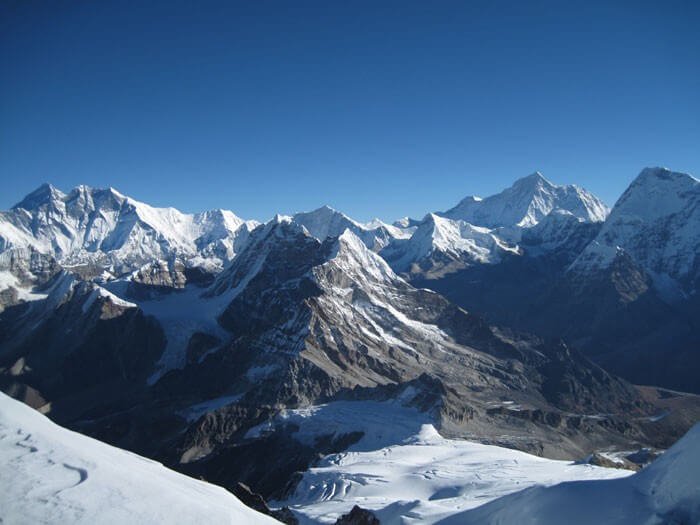
-
Duration:
14 days -
Max Altitude:
5500m -
Difficulty Level:
Challenging -
Best Season:
Spring and Autumn
Trip Overview
Yala Peak climbing is one of the most thrilling adventures offered in the Langtang region. It is famous for its spectacular views and rich culture. The peak is located at an altitude of 5500 meters and is classified as a trekking peak, thus perfect for climbers who want to summit a Himalayan peak without spending too much time preparing for their climb. The entire trek starts by driving from Kathmandu to Syabrubesi and continues through terrains of lush forests and alpine meadows to moraines and glacial paths. Beautiful villages, such as Langtang and Kyanjin Gompa, found along the route, reveal the Tibetan-influenced heritage of prayer flags and stone-built homes that dot the area.
The climb may not be a technical climb, but it involves exertion, good preparation and acclimatization. On the way up through the summits, trekkers will be awarded extraordinary views of high peaks, including Shishapangma, Langtang Lirung, and Dorje Lakpa, as well as brilliant vistas over the Langtang Valley. With experienced guides, delicious hearty meals, and the camaraderie of fellow climbers, this proves to be a unique combination of challenge and cultural immersion, making for a really interesting adventure in the Nepal Himalayas.
Additional Information
Permits and Regulations
The most important aspect before heading for the Yala Peak adventure is getting the necessary permits. First off, it includes the Langtang National Park Entrance Permit, which costs NPR 3,000 for an individual, considering that this trek would pass through a protected area. The Trekkers’ Information Management System (TIMS) card is also required which costs NPR 3,000 per person.
If you’re one of those who want to attempt to summit Yala Peak, then you will need a specific climbing permit that will cost about NPR 3,000 (approximately USD 30) for a one-month duration. It is issued by the Nepal Tourism Board in Kathmandu or Pokhara but can also be acquired through most trekking and climbing agencies. Its cost is relatively lower, making it a rather popular option among climbers who are looking for a lower Himalayan peak to climb. Booking the permits way ahead of time means starting a journey free of hassle, providing for the sustainable development and preservation of trekking and climbing areas in Nepal.
Communication and Internet
The communication facility while climbing Yala Peak is quite accessible but varies according to the locations. In Kathmandu and Syabrubesi, you can find reliable mobile network coverage and internet service, including wifi, in hotels and cafes. As you ascend into the Langtang Valley, the network signals become weaker and intermittent. Popular service providers like Ncell and NTC may limit connectivity at higher altitudes, such as Kyanjin Gompa.
However, many lodges and teahouses could allow wifi services for an additional cost; the speed may be quite slow. Satellite phones provide common backup connectivity in emergency communication during the climb.
Food and Accommodation
During the Yala Peak trek, food and accommodation are simple but decent. Teahouses and lodges along the way serve basic but hearty meals, from traditional Nepali dal bhat (rice with lentils) to momos (dumplings) and noodle soup. Dishes such as pasta, pancakes, and omelets can be ordered. These hot and freshly brewed teas and coffees are drinks in mountain lodges. The most modest accommodation available is two-room double-bedded sets with shared bathrooms and little else.
As you go higher and higher up, the facilities thin out; by the time you get to Yala Base Camp which will require you to sleep in tents, you’re lucky if you have a flush toilet in sight. With this in mind, you should take along more snacks and hydration provisions, as it will require extra energy.
Guides and Porters
Hiring experienced guides and porters truly makes your Yala peak climbing journey perfect. Guides are essential to your journey for helping you find the trail, making sure you are safe, and letting you in on local culture, flora, and fauna. An expert on altitude sickness can change the itinerary when required.
The porters carry the major burden of loads, allowing the trekkers to enjoy the trek once again rather than collapsing under the strain. Almost all guides and porters belong to the close-knit communities and staff and drudge themselves within a wealth of personal treasure regarding the Langtang region.
Best Time for Yala Peak Climbing
Reaching the summit of Yala Peak (5,500m) in the Langtang National Park requires clear skies, stable daytime temperatures, and firm snow conditions across the upper ridge and summit dome.
-
Spring Season (March to May): Spring features warming temperatures and stable weather patterns. The snow coverage on the upper slopes above Yala Base Camp is firm, providing reliable traction for crampons. Lower down, the Langtang Valley comes alive with blooming rhododendrons, bamboos, and lush alpine scenery.
-
Autumn Season (September to November) : Post-monsoon air provides crisp, long-range visibility. Climbers enjoy front-row panoramas of Shishapangma (8,013m in Tibet), Langtang Lirung (7,227m), Dorje Lakpa, and Gangchenpo.
-
Winter (December to February) & Monsoon (June to August) : Winter brings extreme cold (below -15° C at Base Camp) and heavy snow accumulation that can block high trails. Monsoon brings heavy rainfall, leeches, landslide risks along the Syabrubesi drive, and dense clouds obscuring mountain views.
Yala Peak Climbing Difficulty Level
Yala Peak (5,500m) is widely regarded as one of the best entry-level trekking peaks in Nepal. It offers a non-technical introduction to Himalayan summit pushes without extreme vertical walls.
-
Non-Technical Glacier / Snow Walk: The majority of the ascent from Yala Base Camp (4,600m) to the summit involves a steady walk across snowfields and gentle slopes.
-
The Final Ridge Push: The last 20 to 30 meters to the rocky summit narrow slightly and steepen. Depending on snow conditions, climbing Sherpas may attach a safety line to ensure secure footing.
-
Altitude Endurance: While non-technical, ascending to 5,500 meters involves walking in cold, thin air with about 50% less oxygen than sea level. Solid cardiovascular fitness and proper acclimatization in Kyanjin Gompa are mandatory.
Altitude Chart
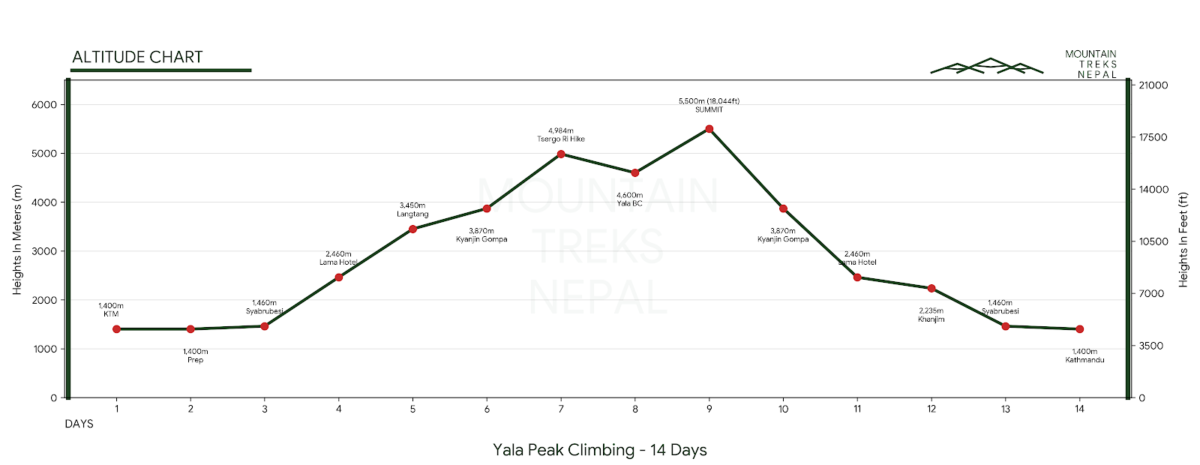
The Yala Peak Climbing – 14 Days altitude chart illustrates the elevation profile of the expedition through Nepal’s Langtang region using a dual-axis scale in both meters (m) and feet (ft) across a 14-day timeline. Starting with an initial drive from Kathmandu (1,400 m) to Syabrubesi (1,460 m), the trajectory steadily climbs through Lama Hotel (2,460 m) and Langtang Village (3,450 m) up to Kyanjin Gompa (3,870 m). Day 7 highlights an essential acclimatization hike up to Tsergo Ri (4,984 m) before moving to Yala Base Camp (4,600 m). The chart reaches its absolute highest point on Day 9 with the successful push to the Yala Peak Summit at 5,500 meters (18,044 feet), followed by a rapid descent back down to Kyanjin Gompa, Lama Hotel, Khanjim (2,235 m), and Syabrubesi for the return drive to Kathmandu.
Is the Yala Peak Climbing Expedition Your Next Great Adventure?
This 14-day trip is designed for fit trekkers, first-time climbers, and time-conscious adventurers who want a true Himalayan summit experience. Book this package if:
-
You want your first Himalayan summit without technical climbing: Yala Peak (5,500m) is one of the safest and most accessible peaks in Nepal, making it perfect for trekkers transitioning into high-altitude peak climbing.
-
You want views into Tibet and 8,000m giants: From the summit, you get direct views of Shishapangma (8,013m) across the Tibetan border, as well as Langtang Lirung, Dorje Lakpa, Naya Kang, and Gangchenpo.
-
You want a shorter, budget-friendly 14-day itinerary: Unlike 18 to 21-day expeditions in the Everest or Annapurna regions, Yala Peak offers a full trek and 5,500m summit experience in just two weeks starting right from Kathmandu.
Why Choose Mountain Treks Nepal for Your Yala Peak Adventure?
-
Certified Local Sherpa & Tamang Guides: Safety and local knowledge are paramount. Our climbing guides are certified veterans from the Langtang region who know the mountain, weather windows, and safety protocols intimately.
-
Pre-Summit Skills Refresher: At Yala Base Camp, our guides conduct a practical session covering crampon fitting, harness safety, ice axe positioning, and rope walking to ensure complete client confidence.
-
Full-Service Base Camp Logistics: We provide heavy-duty 4-season tents, warm, calorie-dense meals prepared by our mountain kitchen crew, and first-aid medical kits for Base Camp operations.
-
Hassle-Free Permit & Transport Setup: We handle all required permits Langtang National Park Entry, TIMS card, Yala Climbing Permit and arrange ground transport between Kathmandu and Syabrubesi.
Conclusion
Yala Peak Climbing isn’t just about climbing; it stretches wider than that-the experience encompasses fabulous sceneries and rich cultural heritage. Regardless of whether you are an aspiring or a pro climber, this adventure gives you a chance to explore untouched beauty in the Langtang region while also mingling with courageous local communities. Making the touchdown on Yala Peak with the magnificent Himalayas around marks a victorious and unforgettable moment, capturing the spirit of adventure and charms found in Nepal.
Trip Highlights
- Scenic drive from Kathmandu to Syabrubesi through Trishuli and Dhunche.
- Amazing views of peaks such as Shishapangma, Langtang Lirung, and Dorje Lakpa.
- Explore Langtang Valley, which was rebuilt after the 2015 earthquake.
- Conquer Yala Peak, which stands at 5500 meters above sea level.
- Visit Kyanjin Gompa, one of the cultural attractions of Langtang Region.
Trip Route

Have a Question? Inquire Now
Why Mountain Treks Nepal?
- Expert Team for Unparalleled Experience
- Best Price Guarantee
- Safety is the first Priority
- Easy Booking & Secure Online Payment
- Flexible And Personalized Service
- 24/7 Support
- Highest Satisfaction Guaranteed
- Highly Experienced Guides
- Your Satisfaction is Our Guarantee
- One-time Deposit, Assured for a Life Time
Detailed Itinerary
The adventurous Yala Peak Climbing starts upon your arrival at Tribhuvan International Airport in Kathmandu. Our representative from Mountain Treks Nepal will pick you up and escort you to your respective hotel. Nestled in a valley surrounded by hills, Kathmandu is a diverse cultural melting pot having an ancient flavor. This city is also the bearer of UNESCO World Heritage sites at 1,400 meters: Swayambhunath Stupa (Monkey Temple), Boudhanath Stupa, and Kathmandu Durbar Square, where old architecture gets merged with modern city life.
The first day is a good time to recuperate after a flight, cruise local markets, and munch on traditional Nepali cuisine. It is also perfect for embarking on the adventure with all the preparation necessary for the climb. Overnight stay at a hotel in Kathmandu.
The second day will be separated for sightseeing around Kathmandu and preparation for Yala Peak Climbing. This will be the best start to the day, guiding you through the cultural and spiritual heritage of Kathmandu. You will first visit Pashupatinath Temple, a revered Hindu temple, and Boudhanath Stupa, among the largest Buddhist stupas in the globe. These sites give a glimpse of the spiritual and diverse ethnic traditions that Nepal holds.
In the afternoon, you will meet your climbing guide and finalize all the permits required for the Yala Peak climbing, including the Langtang National Park entry permit as well as the TIMS (Trekkers’ Information Management System) card. Ensure that you double-check the climbing gear, buy anything else you need at the last minute, and attend a briefing for the trek.
On the third day of the Yala Peak Climbing, you will start your journey with a drive from Kathmandu to Syabrubesi. An 8-hour worth of scenic drive from MachhaPokhari Bus Park takes you to Syabrubesi from Kathmandu. Trishuli River is the spiraling road down which you can view pictures of terraced farmland up across hills and distant snow glutting in bright white peaks. It introduces you to fabulous beauties as well as the rural livelihood of Nepal.
The settlement of Syabrubesi, located among mountain slopes at 1,460 meters, is charming and the first step into trekking expeditions in the Langtang Valley. You can spend your time now taking an around stroll to discover the village, interacting with the locals, and preparing for your trek the next day.
The third day will take you from Syabrubesi to Lama Hotel. The trekking route starts with a hiking trail short of crossing the Bhote Koshi River to be followed upstream by the Langtang River. Along the way, you will pass through dense forests of rhododendron, bamboo, and oak, wherein wildlife may be spotted, such as the langur, red panda, and wild birds.
As you hike uphill, you will go through the uphill and downhill paths with many so-called suspension bridges. After about 6 hours of trekking, you will find yourself at the Lama Hotel, the most peaceful and greenest retreat at 2,460m. Overnight stay at a hotel.
The fifth day of the Yala Peak Climbing will take you deeper into the Langtang Valley. The thick forests start clearing as you start climbing up. Vast meadows are opening to expansive landscapes as you hike ahead. The Ghoda Tabela trail also gives you magnificent views of Langtang Lirung (7,227m) looming above.
Langtang Village, after 6 hours of trekking, greets your eyes with influences of Tibetan culture reflected in the prayer wheels, chortens, and traditional stone houses. The village was rebuilt after the earthquake in 2015 and stands as a testament to the resilience of the local Tamang community. Overnight stay at a local tea house at Langtang Village.
Today, we will hike from Langtang Village to Kyanjin Gompa, which takes around 4 to 5 hours. The trail between Langtang Village and Kyanjin Gompa represents a truly fine part of this journey. Upon getting to the end, the valley widens and presents some wonderful views of the snow-capped peaks, including those of Langtang Lirung (7,227m) and Dorje Lakpa (6,966m). Yak pastures and small alpine streams add to the ideal atmosphere of this trail.
At 3,870 meters, Kyanjin Gompa is a beautiful hill station surrounded by giants and glacial moraines. It houses an ancient monastery, and within the community is a cheese factory where you can sample fresh yak cheese, among other things. It’s a great place to enjoy the majestic surroundings and prepare for the next leg of your journey.
As we tend to conquuer high altitude destinations, priority to your health must be done. Here, acclimatization can be the best option. So, the seventh day of the Yala Peak Climbing is for acclimatization, and Kyanjin Gompa is the ideal base. You can spend the day hiking to Tsergo RI (4,984m), a famous viewpoint showcasing the splendid views of the Langtang Himalayas. The trek here is strenuous and will take hours, but it offers such views as Yala Peak, Langshisha Ri, and Shishapangma in Tibet.
Alternatively, you can visit nearby Langshisa Kharka or go to the glaciers surrounding the village. You will spend this day resting, acclimatizing to altitude, and mentally preparing for the arduous ascent. In the meantime, you also must focus on your nutrition, hydration, and enough rest.
Now, it’s time to think and prepare for the real summit that comes up the next day. So today, we will hike to Yala Peak Base Camp from Kyanjin Gompa, which goes straight up a rocky trail-slash-alpine-meadow trek. And the trail gives you magnificent views of the peaks like Ganchenpo (6,387m) and Naya Kang (5,846m).
On arrival at Yala Base Camp, at 4,600 meters, you will set up a tented camp to stay overnight among stunningly scenic Himalayan landscapes. Your guide will have a short briefing about climbing, and the rest of the day will involve preparations for its summit push the next day.
Today is the day when your dream comes true – it’s the day to conquer the Yala Peak, the major motive of this journey. The summit day commences as early as pre-dawn, taking advantage of the favorable weather conditions. The ascent will require climbing over snowy and icy features using crampons, ropes, and other mounts. The climb is difficult, but physical endurance and concentration are required to complete it.
It is breathtaking at 5,500 meters as you reach the top of Yala Peak; the view unfolds to include every peak of the Himalayas major, one of which includes Shishapangma-the highest of all peaks in Tibet. After enjoying the first sunshine and taking photos for memory, you will return to Yala Base Camp. From base camp, you will return to Kyanjin Gompa to stay overnight at a tea house.
The process of returning after the successful Yala Peak Climbing continues on the tenth day as well. You will travel back to Langtang village and lower down into the dense, lush forests from Kyanjin Gompa. The air feels warmer, and the vegetation grows denser as one descends, providing relief to the body from the high open environment.
This is a 6-7 hour trek to some time in solitude and self-reflection, where you can soak in the tranquil views of the Langtang Valley. You will spend the night at a local tea house, sitting in the arms of beautiful, tranquil forests surrounding you.
You will hike today from the Lama Hotel back to Khanjim; this is pretty much a shorter trek compared to others. The trekking route now goes on the less crowded path toward the beautiful village of Khanjim. It then catches up in thick forestry and traditional Tamang villages, where you will be mingling with the locals nearby and learning about their lifestyles.
It gives a very beautiful view of the hills and mountains surrounding Khanjim. It is quiet yet lovely, where you can spend a night to catch glimpses of rural life in the Langtang region.
The twelfth day of the Yala Peak Climbing is the last day of trekking, which will finally lead you back to Syabrubesi. The trail leads you through terraced fields, lush forests, and small communities and descends as you see the occasional wildlife and the river below.
You will reach Syabrubesi after a few hours of trek, and now you can rest and celebrate completing your trek. This lovely little village now will make the perfect setting for a relaxing evening. Overnight stay at a lodge at Syabrubesi.
Today, you will drive back to Kathmandu from Syabrubesi, which takes around 7 hours by local bus. You will catch an early morning bus from Syabrubesi which will take you through Dhunche, Battar, and Trishuli, some of the rural settlements in Rasuwa and Nuwakot District.
As you reach Kathmandu, you will check into your hotel and rest. In the evening, you will attend a farewell dinner organized by Mountain Treks Nepal.
On the fourteenth day, you will be led by our representative to Tribhuvan International Airport. As you bid farewell to Nepal, you will board a flight to your home country with full memories of the adventure you have had on previous days.
Trip Includes
- International and domestic airport transfers according to itinerary.
- 4 night’s hotel stay in Kathmandu under BB (Bed and Breakfast) with sharing twin beds.
- 3 meals per day (breakfast, lunch and dinner with tea or coffee) for the duration of the trek and Climbing
- Accommodation on twin bases of lodges and guest houses during the trek and tents are available during the Climbing.
- Guide and vehicle for Kathmandu sighseen.
- All camping equipment at Base Camp.
- Ground transfers are available according to the itinerary.
- Langtang National Park Trekking Permit (National Park Entry Fee)
- TIMS (Trekking Information Management System) card permit.
- Yala climbing permit.
- Experienced Climbing and trekking guide and porters during trekking and climbing.
- 2:1 and 5:2 experienced Government license holder Climbing guide during climbing period as per itinerary
- Facility to food, accommodations, wages, insurance, equipment, and medicine for all trekking personnel.
- Medical supplies (First aid kit will be provided)
- One tent at base camp can be used by 2 people.
- Altitude meals are available at base camp and all climbing teams.
- Both static and dynamic ropes must be used during climbing.
- Required kitchen staff available at base camp.
- All required documents. Office service fees and government taxes
- Complete pre-departure information, flight ticket reconfirmation and extend visa service (if necessary).
- Farewell dinner in Kathmandu before departure.
Trip Excludes
- International airfare and Nepal visa Fees.
- Lunch and dinner in Kathmandu.
- Travel insurance which covers emergency Rescue and Evacuation.
- All alcoholic and cold drinks.
- Personal trekking and climbing Equipment.
- Any others expenses which are not mentioned on ‘Price Includes’ section.
Packing List For Yala Peak Climbing


General
- Four-season (zero degree) sleeping bag
- Sleeping bag liner
- Puffy down jacket
- Daypack (35-45 liters) with rain cover

Upper Body
- Warm Hat
- Sunglasses
- Scarf/Neck Gaiter/Buff (highly recommended)

Torso
- Moisture-wicking base layers
- Insulating layers (fleece jacket)
- Puffy down jacket
- Waterproof and windproof outer shell jacket

Lower Body
- Quick-drying trekking pants
- Thermal leggings (for high altitudes)
- Waterproof and windproof pants
- Sturdy hiking boots
- Moisture-wicking trekking socks
- Shorts (for lower altitudes or warmer days)

Hands
- Insulated gloves or mittens
- Liner gloves (for added warmth or dexterity)
- Waterproof outer gloves or mittens
- Hand warmers (optional, for extra cold conditions)
- Sunscreen (for protecting your hands from sunburn at high altitudes)
- Hand sanitizer or wet wipes
- Small repair kit (including duct tape for any handwear repairs)

Feet
- Tough hiking boots
- Trekking socks that wick away moisture
- Optional liner socks for increased comfort
(To prevent snow and debris out of your boots) gaiters - Foot warmers—optional in very cold climates
extra laces - Supplies for treating blisters

Medicines and First Aid Kits
- Personalized first aid kit
- Bandages and adhesive tape
- Antiseptic wipes
- Pain relievers
- Anti-diarrheal medication
- Altitude sickness medication
- Sunburn relief cream
- Cough Syrup

Other Equipments
- Passport and Documents
- Trekking poles for stability
- Water bottles or hydration system
- Water purification tablets or filter
- Lightweight towel and toiletries
- Sunscreen and lip balm with SPF
- Insect repellent
- Portable charger or solar charger
Frequently Asked Questions
Spring and Autumn seasons have the most favorable climate conditions with moderate temperature and clear view of the surroundings. So they are considered the best time to go on Yala Peak Climbing.
During Yala Peak Climbing, you will reach the highest altitude of 5500 meters above sea level, which is the summit of Yala Peak itself.
It takes 14 days to complete the Yala Peak Climbing. We, at Mountain Treks Nepal, customize the package based on your preferences.
You must pack the trekking gears such as hiking boots, backpacks, thermal clothes, trekking poles, ice axes, and crampons for Yala Peak Climbing.
No prior technical mountaineering experience is required. Yala Peak is a non-technical trekking peak suitable for fit trekkers making their first 5,000m+ ascent. However, good cardiovascular stamina and a willingness to learn basic equipment use (crampons, harness, ice axe) during our Base Camp orientation are necessary.
Yala Peak (5,500m) is lower and significantly less technical than Island Peak (6,189m) or Lobuche East (6,145m). It does not feature steep vertical ice headwalls or high-exposure knife ridges, making it much more accessible for novice climbers.
Warm, stiff mountaineering boots or high-altitude single boots compatible with strap-on/semi-automatic crampons are required for summit day above Base Camp. Sturdy waterproof trekking boots are used for the trail walk between Syabrubesi and Kyanjin Gompa.
Yes. You can rent personal gear (mountaineering boots, crampons, ice axe, harness, helmet, and down jackets) in Thamel, Kathmandu, before driving to Syabrubesi. Our guide will inspect all rented gear to ensure a proper fit and high safety standards.
Our summit success rate for Yala Peak is over 90%. The moderate altitude, straightforward trail, gradual acclimatization in Kyanjin Gompa, and experienced Sherpa leadership contribute to this high success rate.
Trek Days (Syabrubesi to Kyanjin Gompa): You stay in local teahouses offering twin-share rooms and hot meals (Dal Bhat, momos, noodles, soups, Tibetan bread, and yak cheese).
Climb Days (Yala Base Camp): You stay in 4-season tented camps with fresh meals prepared by our mountain kitchen crew.
Mountain Treks Nepal covers all required permits:
Langtang National Park Entrance Permit
Yala Peak Climbing Permit
TIMS (Trekkers' Information Management System) Card
At Base Camp, our kitchen crew melts clean snow/glacier ice and boils all drinking water. You will fill your thermal water flasks each evening and morning. We recommend carrying insulated bottle sleeves so water does not freeze during the summit push.
Start training 2 to 4 months in advance. Focus on aerobic endurance and leg strength:
4 to 6-hour weekend hikes on hilly terrain carrying an 8–10 kg backpack
Stairmaster or incline treadmill workouts
Squats, lunges, leg presses, and core stability exercises
Running, swimming, or cycling 3 times per week
You must purchase specialized travel insurance that explicitly covers high-altitude trekking and peak climbing up to 6,000 meters, including emergency helicopter search and medical evacuation coverage.
Porters carry up to 15 kg (33 lbs) of your personal duffel bag during the trek and climb. You only need to carry a lightweight daypack (30L–40L) containing your warm layers, rain jacket, water, snacks, camera, and daily personal items.
Millan
May 22, 2025 at 11:21 amIncredible Yaka Peak Climbing Experience
I had an amazing experience climbing Yaka Peak with Mountain Treks Nepal. From the first day, everything was well organized, including permits, accommodation, meals, and climbing equipment. Our guide was highly experienced, patient, and always prioritized safety, giving us confidence throughout the expedition. Reaching the summit and enjoying the spectacular mountain views was truly rewarding. If you’re planning Yaka Peak Climbing in Nepal, I highly recommend Mountain Treks Nepal for their professional service, friendly team, and excellent organization.