



Annapurna Circuit Trek - 14 Days
-
Duration:
14 days -
Max Altitude:
5416m -
Difficulty Level:
Strenuous -
Group Size:
1- 15 People -
Destination:
Thorong la - Pass (5416m) -
Accommodation:
Hotel/Lodges -
Transportation:
Flight, Bus, Car, Jeep or Van -
Best Season:
March to May and September to November
Trip Overview
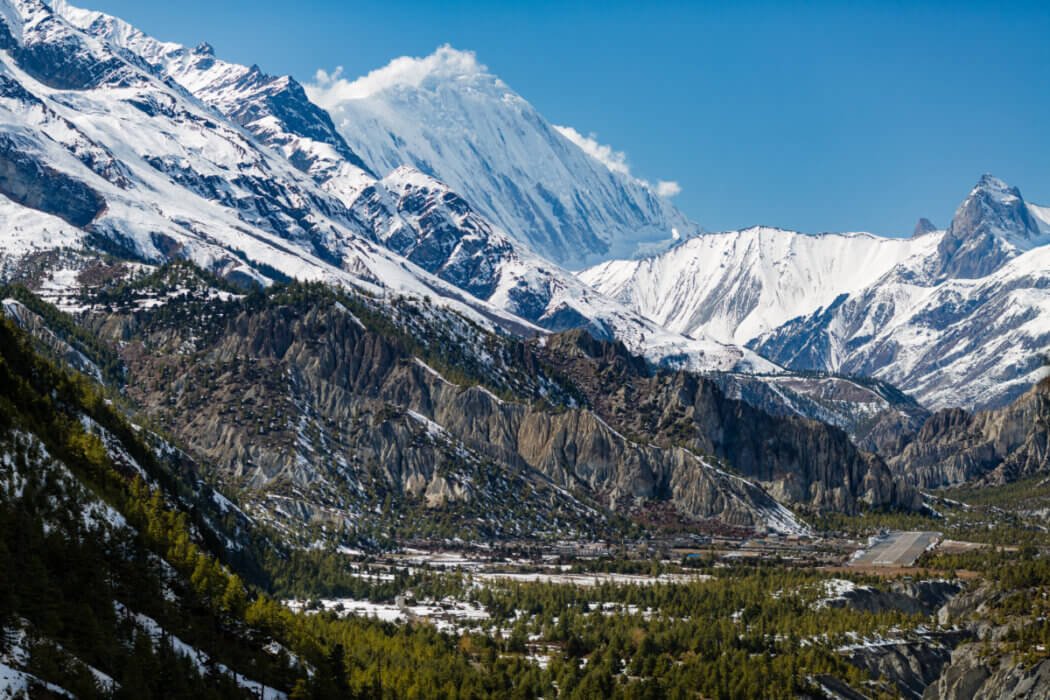
Annapurna Circuit Trek is one of the most renowned and completely diverse trekking routes in the heart of the Nepal Himalayas. The Annapurna Circuit Trek 14 Days passes through many different landscapes, from high-altitude deserts to snow-covered peaks and from subtropical forests and terraced fields. Along the way, trekkers pass by various ethnic villages where they can experience the culture and hospitality of the nation. The Annapurna Round Trek circles the Annapurna massif by crossing Thorong La Pass at an altitude of 5,416 meters, with mind-blowing views of Annapurna, Dhaulagiri, Machhapuchhre, and many other peaks surrounding it.
Annapurna Circuit Trek is not just an adventure but a life-changing experience for trekking enthusiasts. This is a journey through the nature and culture of Nepal, as in the deeper sceneries-from rich rhododendron forests over richly green valleys to rugged terrain. There is also an opportunity to experience the culture of the Gurungs, Manangi, and Thakalis, among other ethnic groups, and learn about their tradition and way of life. And it’s all wrapped into one trek: Annapurna Circuit Trek 14 Days.
Preparation for Annapurna Circuit Trek 14 Days
Permits and Regulations
To go to the Annapurna Circuit Trek, you must obtain two permits: Annapurna Conservation Area Project (ACAP), and Trekkers’ Information Management System (TIMS) Card.
Annapurna Conservation Area Project (ACAP) costs you NPR 3000 if you are travelling from foreign nations. Similarly, the cost of this permit is NPR 1000 and NPR 100 for SAARC Nationals and Nepalese trekkers, respectively.
On the other hand, Trekkers’ Information Management System (TIMS) Card costs you NPR 3000 per person. Both of these permits can be acquired from Nepal Tourism Board in Kathmandu.
Guides and Porters
It is very crucial to hire a guide and porter when you go for the Annapurna Circuit Trek 14 Days. Nepal Tourism Board has made it mandatory to hire a certified guide for any remote treks. And it is reasonable – a guide will enhance your experience as he gives an insight into the culture, history, and geography of the region, while a porter carries your heavy gear so you do not have to carry it when trekking.
Most importantly, they are local, so if you need them, you can often find them in Kathmandu or Pokhara. They are experienced with the intricacies of the circuit and can help for any medical issues or language barriers, ensuring safety and fun.
A guide, on average, charges you anywhere from USD 25 to 35 per person per day. Similarly, the cost of hiring porters can be around USD 20 to 30 per person per day.
Best seasons for Annapurna Circuit Trek
The suitable season for the Annapurna Circuit Trek 14 Days is Spring and Autumn. The days are sunny and warm with pre-eminent views. But the nights are cold and can fall to a freezing point. The trekking route has a lot of crowd during spring. However, during the Monsoon and Winter, the route does not have a lot of crowds and we can enjoy nature more. On this unbelievable trekking escapade, spend your time crossing rhododendron forests, lonely hamlets, and mountain villages.
Annapurna Circuit Trek Difficulty
The Annapurna Circuit Trek is a challenging trek because it involves long walking days, high-altitude conditions, steep ascents, downhill trails, and the crossing of Thorong La Pass at 5,416 meters. Trekkers need to walk for several hours each day through forests, villages, river valleys, rocky trails, and alpine landscapes. The most demanding part of the trek is the day from Thorong Phedi to Muktinath via Thorong La Pass, which requires an early start and strong physical endurance. This trek is suitable for physically fit beginners with preparation, as well as experienced trekkers looking for a classic Himalayan adventure.
Culture and Local Lifestyle on the Annapurna Circuit
The Annapurna Circuit Trek is not only famous for mountains but also for its rich cultural experience. Along the route, trekkers pass through villages influenced by Gurung, Manangi, Thakali, and Tibetan Buddhist traditions. Prayer flags, chortens, monasteries, mani walls, traditional houses, and local festivals reflect the spiritual and cultural identity of the region. Manang offers a deep cultural experience with its unique mountain lifestyle, while Muktinath is an important pilgrimage site for both Hindus and Buddhists. This cultural diversity makes the Annapurna Circuit Trek more meaningful than just a mountain walk.
Wildlife and Nature in the Annapurna Conservation Area
The Annapurna Circuit Trek passes through the Annapurna Conservation Area, one of Nepal’s most naturally diverse protected regions. Trekkers can experience forests, rivers, waterfalls, alpine meadows, dry valleys, and dramatic mountain landscapes throughout the journey. Depending on the season and location, the region may offer sightings of Himalayan birds, blue sheep, Himalayan tahrs, marmots, and other mountain wildlife. The trail also passes through rhododendron forests, pine forests, and high-altitude vegetation, making the trek rich in both scenery and biodiversity.
Transportation During Annapurna Circuit Trek
Transportation is an important part of the Annapurna Circuit Trek because the journey includes both road travel and trekking. The trip usually starts with a drive from Kathmandu to Besisahar or Syange, followed by trekking through the Annapurna region. After crossing Thorong La Pass and reaching the lower Mustang side, trekkers continue toward Jomsom and return to Pokhara by road or optional flight depending on weather, budget, and preference. Road conditions in mountain areas can be rough, so travelers should be prepared for bumpy drives, changing schedules, and possible delays.
Porter Service and Luggage During the Trek
Porter service is highly useful during the Annapurna Circuit Trek because the route includes long walking days and high-altitude sections. A porter helps carry your main trekking bag, allowing you to walk comfortably with only a small daypack containing water, snacks, camera, jacket, and personal essentials. Usually, one porter can carry the luggage of two trekkers within a fixed weight limit. Hiring a porter not only makes the trek easier but also supports the local mountain economy. Trekkers are advised to pack light and carry only necessary items for the journey.
Safety and Altitude Sickness on Annapurna Circuit Trek
Safety is one of the most important parts of the Annapurna Circuit Trek because the route reaches high altitude and crosses Thorong La Pass. Trekkers may experience symptoms of altitude sickness such as headache, tiredness, dizziness, loss of appetite, or difficulty sleeping. To reduce the risk, it is important to walk slowly, drink enough water, eat properly, avoid alcohol, and follow the guide’s advice. Mountain Treks Nepal plans the itinerary with an acclimatization day in Manang to help the body adjust before moving higher. Our guide will monitor the condition of trekkers and support them in case of any difficulty during the trek.
Altitude Chart

This altitude chart shows the day-by-day elevation profile of the Annapurna Circuit Trek. The journey starts from Kathmandu at 1,324 m and gradually moves toward the trekking route from Syange, Dharapani, Chame, Pisang, and Manang, with the altitude slowly increasing up to 3,540 m. The chart also includes an acclimatization day at Manang, helping trekkers adjust before moving higher. From there, the route climbs to Yak Kharka at 4,090 m and Thorong Phedi at 4,420 m, before reaching the highest point of the trek, Thorong La Pass at 5,416 m. After crossing the pass, the trail descends sharply to Muktinath at 3,800 m, then continues down to Jomsom at 2,670 m, Pokhara at 822 m, and finally returns to Kathmandu at 1,324 m. Overall, the chart clearly highlights the gradual ascent, the highest altitude challenge, and the major descent after Thorong La Pass.
Food and Accommodation during Annapurna Circuit Trek 14 Days
Throughout the Annapurna Circuit Trek 14 Days, the choice of food and lodging is highly determined by the altitudinal range. In the lower areas, guests are served in lodges and can enjoy splitting Nepali food such as dal bhat (rice and lentils), momos (dumplings) or anything from pasta to pancakes. The more you climb, the fewer the options available, however, there are still basic tea houses which will provide you nourishment for your trekking.
The accommodations are rather basic consisting of tea houses or cubicles inside lodges – single or dormitory style. Most tea houses offer you with basic amenities in the Annapurna Circuit Trek. But, you will have modern facilities like western style toilets and more touristy facilities in Manang and Jomsom.
Communication and Internet
The mobile and Wi-Fi networks can be accessed at lower heights, with connectivity in areas like Pokhara and Manang being more comfortable. But as one climbs it becomes less likely to enjoy the network and connectivity, especially above 3000 meters. To maintain communication, you can use local SIM cards like NCELL and NTC, that have reasonable coverage at some points around the circuit. You will find many tea houses on the way serving WIFI services, which can be slow due to high usage.
We advise trekkers to carry a satellite phone for instant communication, as well as for emergencies and other purposes.
Travel Insurance
Traveling insurance is highly recommended for trekkers who wish to go on the Annapurna Circuit Trek 14 Days. Insurance should be for medical emergencies, evacuation, lost baggage, and cancellation of trips. Because of the high altitude of the trek, it is good to include that the policy provides coverage for high-altitude trekking up to at least 5,416 meters (Thorong La Pass).
Many providers also have optional coverage for altitude sickness, helicopter evacuation, and search and rescue operations. Very carefully check your policy to have complete coverage during the trek. Although we do not sell or buy Travel insurance, it is always essential to get it from trusted platforms like Allianz and World Trips.
Major Packing List for Annapurna Circuit Trek
- Hiking Boots: Comfortable, waterproof, and well-broken-in.
- Thermal Layers: Essential for warmth in cold nights and higher altitudes.
- Sleeping Bag: Rated for at least -10°C for chilly Himalayan nights.
- Down Jacket: Lightweight yet warm for evening use.
- Daypack: 20–30L capacity for carrying essentials.
- Trekking Poles: Reduce strain on knees and improve balance.
- Water Purification Tablets: For clean drinking water throughout the trek.
- Headlamp: Necessary for early starts and evening use.
- First Aid Kit: Include blister treatments and altitude sickness medication.
- Snacks: High-energy bars and electrolyte powders for a quick energy boost.
Annapurna Circuit Trek Cost and Budget
The cost of the Annapurna Circuit Trek depends on the group size, transportation option, accommodation standard, porter service, and any additional customization requested by the traveler. Mountain Treks Nepal offers a transparent package that includes essential trekking services such as permits, guide support, accommodation, meals during trekking days, transportation, and government taxes. Travelers should also prepare some extra budget for personal expenses such as hot showers, battery charging, Wi-Fi, bottled water, snacks, tips, and optional upgrades. Having a clear budget before the trek helps trekkers manage expenses smoothly during the journey.
Fixed Departure and Private Trip Options
Mountain Treks Nepal offers both fixed departure and private trip options for the Annapurna Circuit Trek. Fixed departures are suitable for solo travelers or small groups who want to join other trekkers on a scheduled date, while private trips are ideal for couples, families, friends, or groups who prefer a flexible itinerary and personal pace. If your preferred travel date is not available in the fixed departure list, we can also arrange a private Annapurna Circuit Trek based on your schedule, group size, and travel preferences.
Why Book Annapurna Circuit Trek with Mountain Treks Nepal?
Choosing the right trekking company is very important for a challenging high-altitude journey like the Annapurna Circuit Trek. Mountain Treks Nepal provides a well-managed trekking experience with experienced local guides, reliable transportation, permit support, accommodation arrangements, and safety-focused planning throughout the route. From your arrival in Kathmandu to crossing Thorong La Pass and returning from Pokhara, our team takes care of the essential logistics so that you can focus on enjoying the mountains, culture, landscapes, and adventure. With local expertise, flexible service, and personal assistance, we make your Annapurna Circuit Trek more comfortable, organized, and memorable.
Conclusion
The Annapurna Circuit Trek is really great and it combines adventure with culture and nature. This trek offers travel enthusiasts an exciting and adventurous experience. It features captivating mountain views and unique cultural aspects. Whether you’re a professional trekker or visiting for the first time, this experience will become one of life’s most cherished memories. It is something you are unlikely to ever forget.
If you are down for getting all these experiences, book now with Mountain Treks Nepal. Contact us today to help you find the perfect itinerary and custom support for the Annapurna Circuit Trek 14 Days. Moreover, we have similar treks in Nepal within Annapurna Region that might be quite easier but almost all activities would be similar to, Ghorepani Poon Hill Trek, Annapurna Circuit Trek with Nar Phu Valley and Mardi Himal Trek.
Trip Highlights
- Visit around the Annapurna region
- Explore Muktinath temple
- Involve into the Manang settlement to know about their culture
- View of amazing world deepest gorge Kaligandaki
- Amazing views of Mt. Annapurna, Mt. Nilgiri, Mt. Hiunchuli, etc.
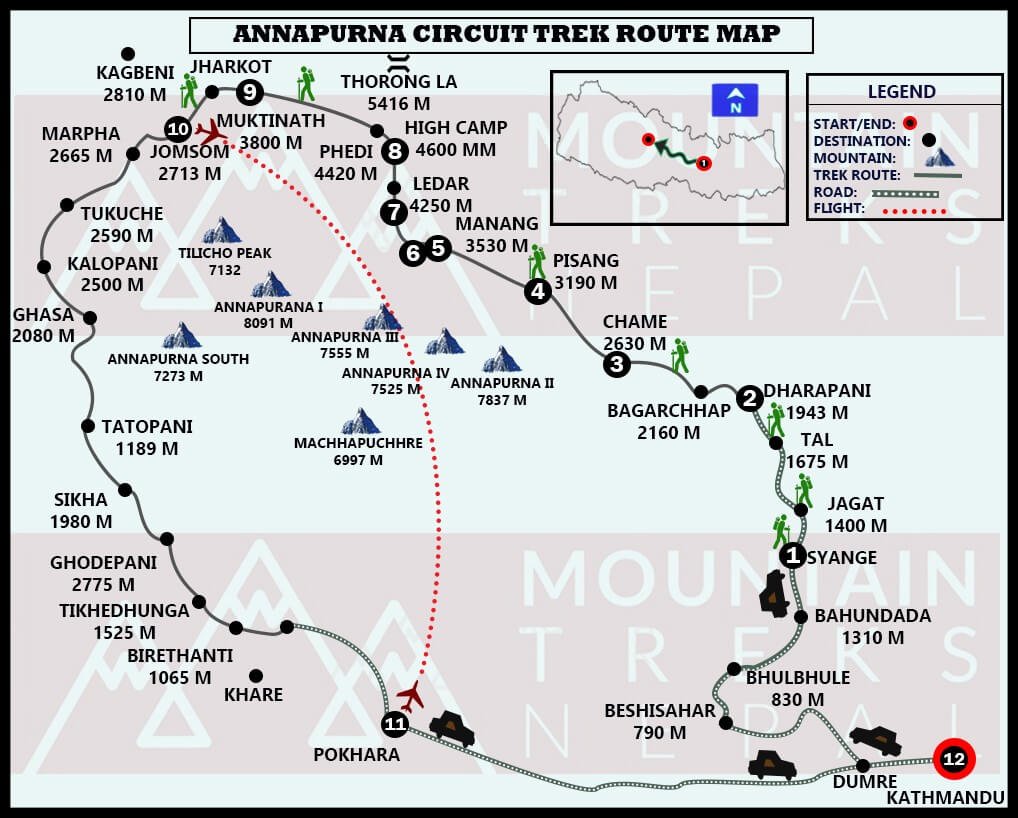
Trip Route
Have a Question? Inquire Now
Why Mountain Treks Nepal?
- Expert Team for Unparalleled Experience
- Best Price Guarantee
- Safety is the first Priority
- Easy Booking & Secure Online Payment
- Flexible And Personalized Service
- 24/7 Support
- Highest Satisfaction Guaranteed
- Highly Experienced Guides
- Your Satisfaction is Our Guarantee
- One-time Deposit, Assured for a Life Time
Detailed Itinerary
You will land in Kathmandu, the capital city of Nepal, and this would be where your journey really begins. On arrival, our representative will leave no space for your cordial welcome and then transfer to your hotel. Later in the evening, you will spend wandering around Thamel, the buzzing tourist hub with its variety of restaurants and shops and cultural charm.
Kathmandu is featured with amazing places such as the Swayambhunath Stupa (Monkey Temple) and Kathmandu Durbar Square. The city, which boasts both cultural and natural beauty, will be the first place to overnight today.
On the second day of the Annapurna Circuit Trek 14 Days, you will leave the crowds of Kathmandu and set on a journey to beautiful Besisahar. The journey cuts across the beautiful countryside featuring terraced farms, busy villages, and the Marsyangdi River. Besisahar, the headquarters town for the Lamjung district, is the point of beginning for many trekkers preparing to embark on the Annapurna Circuit. From here, a private vehicle takes you to Syange, your base for the night.
Located at the banks of the Marsyangdi River, Syange marks the beginning of your trek through rough trails and shady green landscapes. You will spend the night at a lodge, preparing for the trek.
Today begins early in the morning with a warm breakfast. After that, you will head towards Dharapani from Syange, which takes around 6 hours. The trek goes along rugged-style paths with suspension bridges to cross the Marsyangdi River. You are rewarded with spectacular views of the hills and valleys along the trail. You will come across the beautiful village of Tal, where we will have a big lunch. The trail climbs into pine forests and terraced fields that complete the slide into transitional shifts and beautiful scenery.
Signs of Buddhist prayer flags and chortens become more prominent near Dharapani, indicating your cultural move toward Tibetan-influenced lands. The village serves as a base for tonight’s stay.
The trek to Chame becomes more difficult but worth its effort because from Dharapani onwards. The trek through thick forests and also many streams before reaching Chame. The first major place is Bagarchap, a typical village where glimpses into hill culture can be appreciated. Further, the trail passes through Danakyu village, offering you the views of the Annapurna and Dhaulagiri peaks.
The hike continues to the Tamang village, where you can find a perfect lunch spot with a panoramic view of the Manaslu range. The last stretch brings you to Chame, the Headquarters District of Manang. There are natural hot springs to dip your tiredness away while basking in the glorious view of Annapurna II.
Chame to Pisang is a fascinating trek, where landscapes change offering you the diverse view of the Annapurna Circuit Trail. You will start with the crossing of the Marsyangdi River by a suspension bridge. The trail then cuts through dense pine forests and past apple orchards in the village of Bhratang. The climbing terrain becomes rather dramatic with the mighty peaks of the Annapurna above and with rocky cliffs dominating the horizon.
After crossing a series of suspension bridges, the trail opens into the expansive Pisang Valley. Pisang serves with the incredible views of the mountains, such as Annapurna II and Pisang Peak. You will stay overnight at Pisang at a tea house.
Climbing steadily up through the ridge, the trail leads you into today’s grand destination, Manang Valley. Deepening into the valley brings you into Hongde village. These settlements feature prayer flags and wheels that influence Tibetan culture.
Braga, the final phase of this trail, is a village with a historic monastery on top of a hill, and then, at the end of the trail, Manang will be reached. This village features several tea houses, where you can stay overnight and have the best views of the Annapurna range.
Acclimatization Day is essential once you are above 3500 meters, and hence this day will be spent discovering Manang and its nearby destinations as your body adjusts to this elevation. A short hike to nearby sites, like the Gangapurna Glacier or just a walk up to a viewpoint that gives an alluring glance of Gangapurna Lake shining waters, could be enjoyed.
Manang is also a cultural hub, providing some insight into the way of life and customs of the Gurung and Tibetan people. You will witness the serenity and get to interact with the locals. You stay overnight at a tea house, getting ready for the Thorong La Pass ascent.
From Manang, the trail leads to Yak Kharka and marks your entry into the high wilderness of the heavens. The trail carries on at a gradual pace and opens out to extensive views of barren landscapes and snow-covered mountain tops. From the small settlements, yaks graze as the locals carry on their daily routines, completely blended with the rugged surroundings.
The air begins to thin and the vegetation starts to dwindle as one approaches Yak Kharka, truly signifying the remoteness and beauty of this area. You will spend the night at a local tea house.
On the ninth day of the Annapurna Circuit Trek, the adventure from Yak Kharka to Thorong Phedi leads us closer to the lap of Thorong La Pass – Thorong Phedi. The ascent is gradual and marked by a few switchbacks and rocky patches and is laced with alpine meadows and far-off peaks. The place speaks volumes with its rugged beauty, where yaks and other livestock find limited pastures, thus ensuring a rural touch to the landscape.
Now, at Thorong Phedi, its snow-covered peaks are visible through its clear surroundings. Night at this altitude is more challenging due to freezing temperatures, so you must be prepared with your gear and equipment.
Today is the trip highlight of the Annapurna circuit, as you will reach the highest point of this trek – Thorong La Pass. You will wake up early to face the cold, crisp mountain dawn in order to move toward the pass. The well-defined trail leads to prayer flags and cairns that mark the summit-Thorong La, at 5,416 meters. As you reach the top of the pass, you will get rewarded with panoramic views of the Annapurna and Dhaulagiri ranges, which stretch as far as the eye can see.
From the pass, one can descend to Muktinath following the rugged trail. Muktinath is a sacred place for both Hindus and Buddhists. It is at this point that the Muktinath Temple, with its sacred 108 water spouts and a burning eternal flame, symbolizes the spiritual close of an expedition into the heights. This will be a lasting memory in its beautiful surroundings and that heavenly significance.
On the eleventh day of the Annapurna Circuit Trek, the trip will entail a journey toward Jomsom from Muktinath as a mostly downhill trek into incredible open landscapes. The surroundings are dominated by soaring views down to the Kali Gandaki River. As you descend, you will pass across the rural village of Kagbeni. Its Tibetan-influenced narrow alleys are lined with whitewashed houses against seemingly endless backdrops of the Nilgiri peaks. In this traditional village, Kagbeni, the old monastery brings an additional mystical touch to it all.
From Kagbeni onwards, the trail hugs the bank of the river, passing through beautiful scenery before arriving in Jomsom. Jomsom is a bigger town by the standards of most villages along the circuit and provides a good resting place to get back on the trail. Overnight stay at lodge in Jomsom.
Today, we will take a local jeep drive from Jomsom to Pokhara. The journey itself is a unique experience, passing through scenic landscapes, deep valleys, and beautiful Himalayan views.
Pokhara is a beautiful and natural place where a boat ride on Phewa Lake, Devi’s Fall and Gupteshwar Cave are some of the major attractions. Or maybe you want to explore through the colorful streets of Lakeside, which are filled with cafes, shops, and art galleries. Overnight stay at a hotel in Pokhara.
Today, you will wake up early in the morning, have a warm breakfast, and show up at a bus station for a 6 to 7 hours ride to Kathmandu.
The journey takes you through Tanahun and Dhading Districts, offering you to enjoy the natural sceneries of green terraced fields, lush forests, and ever-flowing Marsyangdi and Trishuli River.
As you reach Kathmandu, you will be escorted to your respective hotel where you can rest. Or you can go on an exploration journey in Thamel and celebrate your completion of the Annapurna Circuit Trek.
On your final day in Nepal, you’ll be transferred to Tribhuvan International Airport for your flight home. You will bid farewell to Nepal and Mountain Treks Nepal Team and then finalize your legal formalities before boarding on a plane. Although this journey is complete, you will have ever-lasting memories of the Annapurna Circuit Trek throughout your life.
Trip Includes
- Airport pick up and drop by private car / van (Depends on group size)
- 14 days Trip, 11 of which include 3 meals a day (Breakfast, lunch and dinner)
- Two night’s hotel in Kathmandu on the basis of bed and breakfast.
- Experienced English speaking trekking guide his salary / accommodation / insurance.
- Kathmandu – Beshishar drive by local bus, and Pokhara – Kathmandu drive by tourist bus.
- Beshisar to Syange and Jomsom to Pokhara by sharing jeep.
- All the necessary trekking entry permit. (Trekking permit / TIM’s card etc.)
- One night hotel in Pokhara city on the basis of bed and breakfast.
- All the government taxes and service charge
- Sleeping bag, down jackets and duffel bag – if Necessary (Need to returned after the trek)
- Farewell dinner with culture show.
Trip Excludes
- Personal Travel Insurance.
- Nepal entry visa.
- International airfare
- Drinks (mineral water, Tea, coffee, whisky) or other snacks and any meals beside breakfast, lunch and dinner. Hot shower, charge etc.
- Tips for Guide and potter.
- Snacks and other personal expenses.
- Personal trekking equipment.
- One Porter for 12 days USD 295 (Optional) – the porter can carry up to 25 kg)
- Flight cost from Jomsom to Pokhara is USD 170 per person (optional).
- Any other expenses which are not mentioned on the “Trip Includes” Section.
Packing List For Annapurna Circuit Trek


Clothing
- Thermal tops and bottoms
- Fleece jackets and pullovers
- Waterproof/windproof jackets and pants
- Warm hat/caps and gloves

Foot Wears
- Sturdy hiking boots
- Warm hiking socks
- Sandals/slippers for your use at tea houses

Trekking Items
- Trekking poles
- Daypack, Duffel Bags, and dry bags to carry your items

Other Items
- Sleeping pads and sleeping bags
- Hot Water Bottle
- Sunglasses for UV protection
- First aid kit
- Trek map and guidebooks
- Trek permits
Frequently Asked Questions
The best time to go to Annapurna Circuit Trek is Spring and Autumn. These seasons are best because of its weather favorability, clear views, and moderate temperatures.
During this trek, the highest altitude you reach is 5,416 meters above sea level at Thorong La Pass.
Annapurna Conservation Area Project (ACAP), and Trekkers’ Information Management System (TIMS) Card are essential for the Annapurna Circuit Trek.
Documents such as copies of your passport, photographs, travel insurance, and permit fees are required to obtain the required permits.
The Annapurna Circuit Trek with Mountain Treks Nepal is a 14-day journey that starts from Kathmandu and takes you through Syange, Dharapani, Chame, Pisang, Manang, Yak Kharka, Thorong Phedi, Thorong La Pass, Muktinath, Jomsom, Pokhara, and back to Kathmandu. This itinerary includes arrival, trekking days, acclimatization, transportation, and final departure.
The highest altitude of the Annapurna Circuit Trek is Thorong La Pass at 5,416 meters above sea level. This is the most challenging and rewarding point of the trek, offering panoramic views of the Annapurna, Dhaulagiri, Nilgiri, and surrounding Himalayan ranges.
The Annapurna Circuit Trek is a strenuous trek because it involves long walking days, high-altitude terrain, steep ascents, downhill trails, and crossing Thorong La Pass. Trekkers should have good physical fitness, strong stamina, and proper preparation before joining this trek.
Yes, beginners can do the Annapurna Circuit Trek if they are physically fit, mentally prepared, and follow the guide’s instructions carefully. However, this trek is more suitable for active travelers who can walk for several hours daily and handle high-altitude conditions.
The best time for the Annapurna Circuit Trek is spring, from March to May, and autumn, from September to November. These months usually offer clear skies, stable weather, beautiful mountain views, and safer trail conditions for crossing Thorong La Pass.
Yes, it is possible to do the Annapurna Circuit Trek in winter, but trekkers should be prepared for cold temperatures, snow, icy trails, and possible weather-related delays. Thorong La Pass may become more challenging during winter, so proper gear and guide support are very important.
Trekkers need the Annapurna Conservation Area Permit and other required trekking documentation to complete the Annapurna Circuit Trek. Mountain Treks Nepal helps arrange the necessary permits before the trek begins, making the process easier for travelers.
For trekking permits, travelers usually need a valid passport copy, Nepal visa details, passport-size photos or digital photos, and permit fees. It is better to send these details before the trek so that the permits can be prepared on time.
Yes, trekking with a licensed guide is highly recommended for the Annapurna Circuit Trek. A guide helps with route navigation, local communication, weather updates, altitude safety, accommodation arrangements, and cultural understanding throughout the journey.
A porter is highly recommended because the Annapurna Circuit Trek involves long walking days and high-altitude sections. A porter carries your main luggage, allowing you to walk comfortably with a small daypack. This makes the trek easier and helps you save energy for difficult sections like Thorong La Pass.
Accommodation during the Annapurna Circuit Trek is mostly in local teahouses and mountain lodges. Rooms are usually basic and may be twin-sharing or dormitory-style in some places. Facilities are better in places like Manang and Jomsom, while higher-altitude areas have simpler accommodation.
During the trek, trekkers can enjoy meals such as dal bhat, noodles, soup, fried rice, pasta, momos, pancakes, eggs, potatoes, tea, and coffee. Food choices are better in lower areas and become more limited as altitude increases, but teahouses provide enough meals to support trekking energy.
Yes, drinking water is available along the Annapurna Circuit route. Trekkers can buy bottled water, boiled water, or use water purification tablets. Carrying a reusable water bottle is recommended to reduce plastic waste and support responsible trekking.
Wi-Fi is available in many teahouses along the Annapurna Circuit route, especially in lower areas and larger villages. However, the connection may be slow or unreliable at higher altitudes. Some teahouses may charge an extra fee for Wi-Fi service.
Yes, phone and camera charging is available in many teahouses, but it usually comes with an extra charge. Electricity may be limited in higher-altitude areas, so carrying a power bank is highly recommended for backup.
Yes, travel insurance is strongly recommended for the Annapurna Circuit Trek. Your insurance should cover high-altitude trekking up to at least 5,416 meters, emergency medical treatment, helicopter evacuation, trip cancellation, lost baggage, and unexpected delays.
To reduce the risk of altitude sickness, trekkers should walk slowly, drink enough water, eat properly, avoid alcohol, get enough rest, and follow the guide’s advice. The acclimatization day in Manang helps the body adjust before moving toward higher altitude areas.
You should pack warm clothing, thermal layers, waterproof jacket and pants, hiking boots, trekking socks, gloves, warm hat, sunglasses, sunscreen, headlamp, water purification tablets, personal medicine, power bank, toiletries, and a comfortable daypack. A sleeping bag and down jacket are also useful for cold nights.
Yes, the Annapurna Circuit Trek itinerary can be customized according to your travel date, fitness level, group size, budget, and preferred comfort level. You can add extra acclimatization days, upgrade transportation, include Tilicho Lake, choose a private trip, or add sightseeing in Kathmandu and Pokhara.
You can book the Annapurna Circuit Trek by contacting Mountain Treks Nepal with your preferred travel date, number of travelers, service preference, and any special requirements. After confirmation, our team will help arrange permits, transportation, accommodation, guide support, porter service, and all necessary trekking logistics.
Anderson (USA)
March 10, 2026 at 11:13 pmExcellent Organization and Amazing Trek with Mountain Treks Nepal
I had a fantastic experience on the Annapurna Circuit Trek – 14 Days with Mountain Treks Nepal. Everything was very well organized from the beginning to the end. The itinerary, accommodations, transportation, and permits were all arranged perfectly.
A big thank you to Bharat for the excellent preparation and smooth management. Our guide Raju was friendly, experienced, and always looked after our safety, while our porter Lakpa worked incredibly hard with a smile every day.
I highly recommend Mountain Treks Nepal to anyone planning a trek in Nepal. Great service, excellent preparation, and an unforgettable adventure!
Michael Anderson (Australia)
December 22, 2025 at 12:05 amAn Unforgettable Annapurna Circuit Experience – Outstanding Guide Yeka!
I recently completed the Annapurna Circuit Trek 14 Days treks with Mountain treks Nepal and it was one of the most incredible experiences of my life. The breathtaking mountain scenery, beautiful villages, and rich local culture made every day of the trek unforgettable.
A huge thank you to our guide, Yeka who was knowledgeable, professional, friendly, and always made sure everyone was safe and comfortable. He shared fascinating insights about the region and kept the group motivated throughout the journey. His experience and positive attitude made the trek even more enjoyable.
I would also like to thank our porter, Krishna for his incredible hard work and kindness. He always had a smile on his face and went above and beyond to support us throughout the trek. His dedication was truly appreciated.
Everything was perfectly organized by Mountain Treks Nepal. From the transportation and accommodation to the permits and daily arrangements, everything ran smoothly and professionally. Their excellent service allowed us to fully enjoy the adventure without any worries.
I highly recommend Mountain Treks Nepal to anyone planning the Annapurna Circuit or any trekking adventure in Nepal. If you have the opportunity, ask for Yeka as your guide and Krishna as your porter—you’ll be in the best hands!
An amazing experience that I will never forget. Thank you, Mountain Treks Nepal, Yeka, and Krishna!
Philipes
April 11, 2024 at 1:54 pmMukthinath trek with Mountain treks Nepal
The entire trip was meticulously organized. From the initial communication to the logistics during the trek, everything ran smoothly. A big thanks to Mr. Bharat Magager for his professionalism and ensuring a seamless experience.
Our guide, Yeka, deserves special recognition. Their knowledge of the region, the trails, and the local culture was invaluable. Yeka’s expertise made the trek not just an adventure but also a learning experience. Their friendly and encouraging demeanor made the journey even more enjoyable.
Soben
March 31, 2024 at 7:47 pmAnnapurna Circuit Trek with Mountain Treks Nepal
My Annapurna Circuit Trek with Mountain Treks Nepal was simply unforgettable! The entire team, led by the wonderful Mr. Bharat, deserves high praise for their professionalism and dedication to making the trek a success.
A special shoutout to my guide, Yaka. Their expertise, knowledge of the region, and friendly demeanor made the challenging trek both enjoyable and safe.
From the breathtaking scenery to the unique culture, the trek exceeded all my expectations. [Optional: Briefly mention some highlights you experienced].
If you’re considering the Annapurna Circuit Trek, I highly recommend Mountain Treks Nepal. Their expertise and dedication will ensure an unforgettable experience.
Sullen
March 22, 2024 at 3:55 pmJomsom - Mukthinath trek
Overall, the Jomsom Muktinath Trek with Mountain Treks Nepal was an unforgettable adventure. The combination of stunning scenery, cultural exploration, and expert guidance made it truly exceptional. I highly recommend this trek to anyone seeking a challenging yet rewarding Himalayan experience.