



Everest Base Camp Trek by Road - 17 Days

-
Duration:
17 days -
Max Altitude:
5,545mm -
Difficulty Level:
Strenuous / Demanding -
Group Size:
1- 15 People -
Destination:
Everest Base Camp -
Start/End:
Kathmandu -
Accommodation:
Tea House and Hotel -
Transportation:
Flight, Bus, Car , Jeep or Van -
Best Season:
March to May (Spring) and September to December (Autumn)
Trip Overview
The Everest Base Camp Trek by Road 17 Days is a 100% flight-free Himalayan expedition designed for adventurers who want to experience the legendary trail to Mt. Everest without relying on domestic flights to Lukla. By traveling overland in a high-clearance 4×4 Jeep from Kathmandu through the scenic hills of Solukhumbu (Salleri and Paiya/Surke), this 17-day itinerary offers a reliable, stress-free route to the Khumbu region while providing a gradual elevation gain that aids natural acclimatization.
Following the footsteps of early Himalayan pioneers like Sir Edmund Hillary and Tenzing Norgay, this classical overland route bypasses Lukla flight delays and weather cancellations. The trek connects lower Sherpa farming villages with iconic Khumbu landmarks, taking you through Namche Bazaar, Tengboche Monastery, Dingboche, Lobuche, and Gorak Shep. You will reach Everest Base Camp (5,364m) on the Khumbu Glacier and ascend Kala Patthar (5,545m) for world-class panoramic views of Mt. Everest, Lhotse, Nuptse, and Ama Dablam. Guided by Mountain Treks Nepal’s veteran Sherpa team, this extended overland route delivers safety, cultural depth, and unmatched logistical peace of mind.
Preparation For Everest Base Camp Trek by Road
The 17-day road-based EBC trek involves 12 active days of walking over rugged alpine terrain, steep stone staircases, and glacial moraine. To build endurance, we recommend starting a training program 6 to 8 weeks before departure. Focus on leg strength (squats, lunges, step-ups) and cardiovascular fitness (running, cycling, swimming, stair-climbing with a 5–10 kg backpack). Prior hiking experience or high-altitude exposure above 3,000 meters is helpful, though not required, as built-in acclimatization days in Namche and Dingboche help your body adapt naturally.
Guides and Porters
A successful overland EBC expedition relies on experienced local leadership. Mountain Treks Nepal provides licensed, English-speaking Sherpa guides trained in high-altitude health and wilderness first aid. Your guide manages trail pacing, pulse oximeter health checks, lodge logistics, and cultural insights. To ensure you can trek unburdened with only a light daypack, our porters carry your main duffel bag (up to 12 kg per trekker) along the trail.
Permits for 17 Days EBC Trek by Road
Trekking into the Everest region requires two mandatory government permits, both handled directly by Mountain Treks Nepal:
-
Sagarmatha National Park Entry Permit: Required for entry into the protected UNESCO World Heritage site protecting Khumbu flora and fauna. The fee is NPR 3,000 for foreign nationals, NPR 1,500 for SAARC nationals, and NPR 100 for Nepali citizens (plus applicable local taxes).
-
Pasang Lhamu Municipality Entry Permit: A local government tax of NPR 3,000 per person for all foreign trekkers.
Best Time for EBC Trek by Road
-
Spring (March to May): Warm daytime temperatures, stable atmospheric conditions, and blooming rhododendron forests across the lower Solu hills. High-altitude temperatures range from 10°C in the daytime to -10°C at night at Gorak Shep.
-
Autumn (September to December): Crisp post-monsoon air with sharp mountain visibility and clear skies. Daytime temperatures range from 12°C in lower valleys down to -15°C at high camps.
-
Winter (December to February): Cloudless mornings and quiet trails, though nighttime temperatures at Gorak Shep drop to -20°C.
Altitude Chart
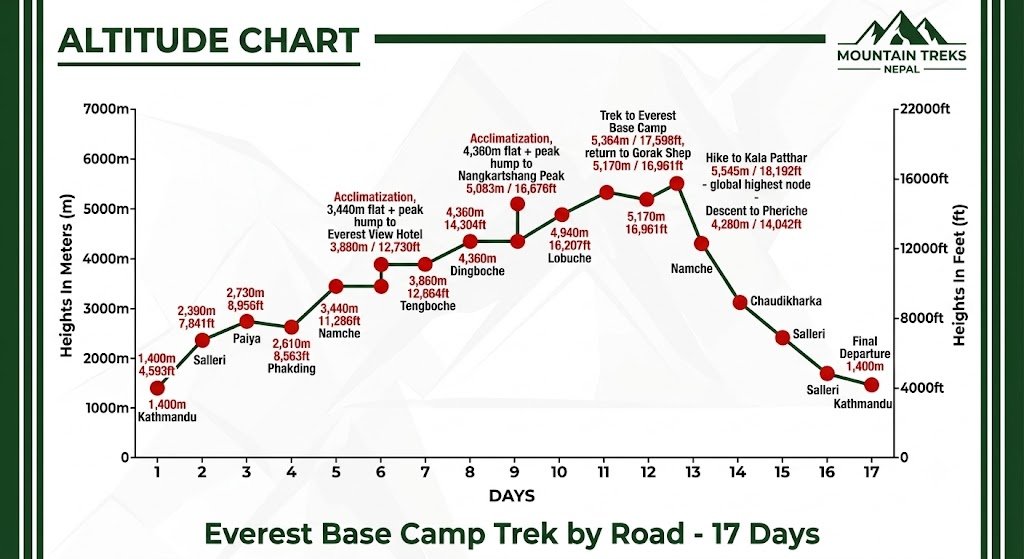
The Everest Base Camp Trek by Road is a comprehensive 17-day overland journey through the Khumbu region, offering a scenic alternative to flying directly into Lukla. Starting with an overland drive from Kathmandu (1,400 m / 4,593 ft) through Salleri (2,390 m / 7,841 ft) to Paiya (2,730 m / 8,956 ft), the trek moves through Phakding (2,610 m / 8,563 ft) before ascending to key hubs like Namche Bazaar (3,440 m / 11,286 ft) and Dingboche (4,360 m / 14,304 ft). Strategic acclimatization hikes up to Everest View Hotel (3,880 m / 12,729 ft) and Nangkartshang Peak (5,083 m / 16,676 ft) support a safe upward progression through Tengboche and Lobuche. The trail reaches Everest Base Camp (5,364 m / 17,598 ft) on Day 11 and peaks at its highest point on Day 12 atop Kala Patthar (5,545 m / 18,192 ft). The return leg features a steady downward descent through Pheriche (4,280 m / 14,042 ft), Namche, Chaudikharka, and Surke, concluding with an overland drive back from Salleri to Kathmandu on Day 17.
Accommodation During The Trek
Accommodation along the trail consists of local teahouses—family-run mountain lodges offering clean, twin-share rooms with wooden beds, mattresses, and blankets. Lower settlements like Salleri, Phakding, and Namche Bazaar offer lodges with attached bathrooms, hot showers, and Wi-Fi. In higher villages like Lobuche and Gorak Shep, accommodations become basic with shared facilities and communal dining halls warmed by central yak-dung stoves.
Drinking Water
Proper hydration is critical for high-altitude acclimatization. Sealed bottled water is available at teahouses, but prices rise with altitude. To minimize plastic waste inside Sagarmatha National Park, we encourage trekkers to carry two reusable, wide-mouth water bottles along with water purification tablets, Chlorine Dioxide drops, or a UV filter (Steripen) to treat tap or teahouse water safely.
Communication and Internet
Mobile network coverage (NTC and Ncell) is available across Solukhumbu up to Pangboche. In higher settlements like Lobuche and Gorak Shep, teahouses offer prepaid Everest Link Wi-Fi cards (approx. NPR 600–1000). Device charging is available in teahouse common areas for a small hourly fee.
Travel Insurance
Comprehensive travel insurance is mandatory for joining the EBC Trek by Road. Your policy must cover high-altitude trekking up to 6,000 meters and explicitly include emergency helicopter evacuation and medical repatriation.
Trip Difficulty
Graded as Strenuous / Demanding, this 17-day journey covers over 130 kilometers on foot over rough trails, loose moraine, steep ascents, and high-altitude terrain. However, because the journey begins by road and ascends gradually through the lower Solu valley, it provides a gentler acclimatization curve compared to direct flights into Lukla (2,860m).
Equipment and Trekking Kit Necessary For The Trek
-
Footwear: Waterproof high-ankle hiking boots, moisture-wicking wool socks, and camp shoes.
-
Outer Layers: Down jacket (rated to -15°C/0°F), windproof/waterproof hard shell jacket and pants.
-
Mid/Base Layers: Thermal merino wool base layers (top and bottom), grid fleece or fleece jacket.
-
Hardware & Gear: 35-45L daypack, 70-90L duffel bag (carried by porter), trekking poles with snow baskets.
-
Sleeping Gear: 4-season sleeping bag (rated -10°C to -15°C) and sleeping bag liner.
-
Personal Care: UV-400 polarized sunglasses, SPF 50+ sunscreen, lip balm, personal first aid kit (Diamox, ibuprofen, blister plasters), and a portable power bank.
Discover the Classic Pioneer Route with Mountain Treks Nepal
Experience Mount Everest the way early legendary explorers did—by land. The 17-Day Everest Base Camp Trek by Road offers a dependable alternative to Lukla flights. Mountain Treks Nepal manages all 4×4 Jeep transfers, lodge bookings, permits, and expert Sherpa leadership to ensure an authentic Himalayan journey.
The Road & Trail Experience: From Mid-Hills to High Glaciers
Your expedition begins with a 4×4 Jeep drive out of Kathmandu, winding through river valleys and hill ridges to Salleri and Paiya. Stepping onto the trail, you join the classic route at Phakding, ascending through Namche Bazaar, Tengboche Monastery, Dingboche, and Lobuche. Reaching Gorak Shep leads to the pinnacle moments: standing at Everest Base Camp (5,364m) on the Khumbu Glacier and watching sunrise illuminate Everest from Kala Patthar (5,545m) before returning overland via Chaudikharka and Salleri.
Everest Views from Kala Patthar
While reaching Everest Base Camp puts you beneath the Khumbu Icefall, the summit of Mt. Everest is obscured by Nuptse from base camp itself. The ultimate visual highlight occurs on the early morning climb up Kala Patthar (5,545m). From this rocky viewpoint, enjoy an unobstructed, 360-degree panorama of Mt. Everest, Lhotse, Nuptse, and Changtse lit by the morning sun.
Is the EBC Trek by Road Right For You?
If you prefer to avoid small mountain aircraft, have a flexible timeline, want to experience lower Solukhumbu cultural villages, and prefer a gradual acclimatization profile, this 17-day road-based trekking package is the ideal choice.
Why Choose Mountain Treks Nepal for Your Road-Based EBC Expedition?
-
No Flight Delays: 100% overland transport guarantees your itinerary remains on schedule regardless of Lukla weather.
-
Reliable 4×4 Vehicles: High-clearance Mahindra Scorpio / Toyota Land Cruiser 4WDs equipped for mountain roads.
-
Veteran Sherpa Guides: Licensed local guides trained in high-altitude safety and wilderness first aid.
-
Full Logistics & Permits: Complete coverage of transfers, teahouse lodging, meals, and park permits.
Trip Highlights
-
100% flight-free Everest Base Camp trek—avoid Lukla flight cancellations by traveling in comfortable 4×4 Jeeps.
-
Stand at Everest Base Camp (5,364m) directly on the Khumbu Glacier beneath the Khumbu Icefall.
-
Summit Kala Patthar (5,545m) for 360-degree views of Mt. Everest (8,848.86m), Lhotse, Nuptse, and Pumori.
-
Explore lower Solu and Khumbu Sherpa villages including Salleri, Paiya, Phakding, Namche Bazaar, and Dingboche.
-
Visit ancient monasteries including Tengboche Monastery, the spiritual heart of the Khumbu region.
-
Safer, more gradual elevation gain starting from lower altitude villages for natural acclimatization.
-
Cross high suspension bridges draped in prayer flags over the Dudh Koshi and Imja rivers.
Have a Question? Inquire Now
Why Mountain Treks Nepal?
- Expert Team for Unparalleled Experience
- Best Price Guarantee
- Safety is the first Priority
- Easy Booking & Secure Online Payment
- Flexible And Personalized Service
- 24/7 Support
- Highest Satisfaction Guaranteed
- Highly Experienced Guides
- Your Satisfaction is Our Guarantee
- One-time Deposit, Assured for a Life Time
Detailed Itinerary
Upon arrival at Tribhuvan International Airport (TIA) in Kathmandu, meet our Mountain Treks Nepal representative. Transfer by private vehicle to your hotel in Thamel. In the evening, attend a pre-trip briefing with your lead guide and complete gear checks. Overnight stay at a hotel in Kathmandu.
Depart Kathmandu early in the morning in a private 4×4 Jeep. Travel along the BP Highway through Sindhuli and Khurkot, following the Sunkoshi River valley. Ascend into the rolling green hills of Okhaldhunga and Solukhumbu districts, arriving at Salleri (the headquarters of Solukhumbu district) by late afternoon. Overnight stay at a lodge in Salleri.
After breakfast, board the 4×4 Jeep for a dirt road drive through mountain terrain. Pass through Sherpa and Rai farming villages, terraced fields, and rhododendron forests via Ringmo and Thamdanda towards Paiya (Chutok). Enjoy views of the surrounding Solu valleys. Overnight stay at a teahouse in Paiya.
Begin your trek on foot! Descend through bamboo and oak forests toward Surke. Cross wooden bridges and pass through traditional Sherpa hamlets like Chheplung and Lukla’s lower trail bypass. Join the main EBC trail, following the Dudh Koshi River valley into Phakding. Overnight stay at a teahouse in Phakding.
Follow the Dudh Koshi River, crossing high suspension bridges decorated with prayer flags, including the Hillary Suspension Bridge. Pass through Monjo to register permits at the Sagarmatha National Park entry point. Continue through Jorsalle before tackling the long, steep uphill climb through pine forests to Namche Bazaar. If weather permits, catch your first view of Mt. Everest through the trees. Overnight stay at a lodge in Namche Bazaar.
A dedicated acclimatization day. In the morning, hike up to the iconic Everest View Hotel (3,880m) in Syangboche for views of Mt. Everest, Ama Dablam, Lhotse, and Thamserku. Visit the Hillary School in Khumjung village and the local Sherpa Culture Museum before returning to Namche for the afternoon. Overnight stay in Namche Bazaar.
Trek along a contouring trail high above the Imja Khola River with views of Everest and Ama Dablam. Descend through rhododendron forests to the river crossing at Phunki Thenga for lunch. From here, begin a 2-to-3-hour climb through pine forests to Tengboche. Visit the historic Tengboche Monastery in the afternoon. Overnight stay at a teahouse in Tengboche.
Descend through forests to Deboche and cross the Imja Khola River. Rise above the tree line into alpine terrain, passing stone mani walls and the village of Pangboche. Continue up the Imja Valley into Dingboche, a Sherpa settlement enclosed by stone agricultural walls protecting crops from high winds. Overnight stay at a teahouse in Dingboche.
Your second vital acclimatization day. Take a morning acclimatization hike up Nangkartshang Peak (5,083m) directly behind Dingboche. Enjoy views of Makalu (8,463m), Lhotse, Chalotse, and the dramatic wall of Ama Dablam. Return to Dingboche for lunch and rest. Overnight stay in Dingboche.
Trek along the high glacial valley to Dughla (Thokla). Climb the steep Thokla Pass (4,830m), where stone memorials honor climbers and Sherpas who lost their lives on Everest. Continue along the lateral moraine of the Khumbu Glacier to Lobuche. Overnight stay at a teahouse in Lobuche.
Trek early along the rocky crest of the Khumbu Glacier moraine to Gorak Shep (5,170m). Drop main duffel bags, have lunch, and push onward across glacial moraine to Everest Base Camp (5,364m). Stand at the base of the Khumbu Icefall, take photos at the marker, and celebrate your milestone before returning to Gorak Shep. Overnight stay at Gorak Shep.
Begin before dawn for the steep 2-hour ascent up Kala Patthar (5,545m), the highest point of the trek. Watch the sunrise illuminate Mt. Everest, Lhotse, and Nuptse in golden light. Descend to Gorak Shep for breakfast, then trek down past Lobuche and Thokla to the windy alpine village of Pheriche. Overnight stay in Pheriche.
Descend down the Imja Valley through Pangboche and Tengboche, crossing the river at Phunki Thenga before climbing back up to Namche Bazaar. Enjoy hot showers, Wi-Fi, and fresh bakeries in Namche. Overnight stay in Namche Bazaar.
Descend the Namche hill, cross the Hillary Suspension Bridge, and exit Sagarmatha National Park at Monjo. Continue through Phakding, bypassing the Lukla trail turnoff and heading toward the quiet village of Chaudikharka/Surke. Overnight stay at a teahouse in Chaudikharka.
Take a short morning walk to the Jeep station at Surke or Thamdanda. Board your private 4×4 Jeep and drive back through Solu hill country to Salleri. Celebrate the completion of the trekking portion with your guide and crew. Overnight stay at a lodge in Salleri.
Board the private 4×4 Jeep early in the morning and retrace the scenic highway route along the Sunkoshi River back to Kathmandu. Upon arrival, transfer to your hotel. Overnight stay at a hotel in Kathmandu.
Enjoy breakfast at your hotel. A Mountain Treks Nepal representative transfers you to Tribhuvan International Airport for your flight home.
Trip Includes
-
Private 4×4 Jeep transport (Kathmandu – Salleri – Surke/Paiya & Return) including fuel and driver expenses.
-
Private airport-hotel transfers in Kathmandu.
-
2 Nights hotel accommodation in Kathmandu (Bed & Breakfast basis).
-
14 Nights teahouse/lodge accommodation during the drive and trek.
-
Full board meals during the trek (Breakfast, Lunch, and Dinner each day).
-
All required permits: Sagarmatha National Park Entry Permit and Pasang Lhamu Municipality Permit.
-
Government-licensed, English-speaking Sherpa guide and porters (1 porter per 2 trekkers, max 25 kg capacity).
-
Staff costs: Salary, insurance, equipment, food, accommodation, and transport for guides and porters.
-
Mountain Treks Nepal Duffel Bag, Down Jacket, and Sleeping Bag (available for use during the trek).
-
All applicable local and government taxes.
- Farewell Dinner
Trip Excludes
-
International airfare and Nepal entry visa fees ($30 for 15 days, $50 for 30 days).
-
Personal travel and medical evacuation insurance (Mandatory, covering up to 6,000m).
-
Meals in Kathmandu (except breakfast).
-
Personal expenses: Soft drinks, mineral water, alcohol, hot showers, Wi-Fi fees, device charging fees.
-
Tips for guide, porters, and driver (Tipping is expected in Nepalese tourism).
- Personal trekking equipment.
- Any others expenses which are not mentioned on the “Trip Includes” Section.
Packing List For Everest Base Camp Trek by Road


Upper & Lower Body
-
Thermal merino wool base layers (top and bottom)
-
Moisture-wicking long sleeve trekking shirts
-
Fleece jacket / mid-layer sweater
-
Heavyweight down jacket with hood
-
Waterproof & windproof outer shell jacket and pants
-
Quick-dry trekking pants (2 pairs)
-
Moisture-wicking wool trekking socks (4-5 pairs)
-
Waterproof, broken-in hiking boots

Hands & Head
-
Warm fleece beanie hat and sun hat
-
Polarized UV-400 sunglasses
-
Buff / Neck gaiter
-
Inner liner gloves & insulated waterproof heavy gloves

Health & Personal Care
-
Water purification tablets / UV Steripen
-
SPF 50+ Sunscreen and SPF lip balm
-
Personal first aid kit (Diamox, Ibuprofen, blister plasters)
-
Biodegradable wet wipes and hand sanitizer
-
Portable power bank (10,000–20,000 mAh)
Frequently Asked Questions
The overland route eliminates the risk of flight delays and cancellations due to bad weather at Lukla Airport. Additionally, starting at lower elevations (Salleri/Paiya) provides a gradual acclimatization profile and showcases authentic Sherpa and Rai cultures in lower Solukhumbu.
The drive from Kathmandu to Salleri is mostly paved along the BP and Mid-Hill Highways. The stretch from Salleri onward to Paiya/Surke consists of rough dirt roads where a high-clearance 4x4 Jeep is required.
A solid level of physical fitness and endurance is required. You will be walking 5 to 8 hours daily over 12 trekking days across high-altitude terrain.
Yes, starting from lower altitudes and walking up through lower Solu gives your body more time to adapt before reaching 3,000+ meters, though high-altitude precautions (hydration, slow pace, Diamox) are still essential above Namche.
Our guides carry first-aid kits and monitor oxygen levels daily. In case of severe altitude sickness or emergency, emergency helicopter evacuation is coordinated immediately through your travel insurance provider.
Michael Anderson – United States
April 25, 2026 at 10:10 amIncredible Everest Base Camp Trek by Road
Our Everest Base Camp Trek by Road with Mountain Treks Nepal was perfectly organized from beginning to end. The management was excellent, and the hospitality exceeded our expectations. Our guide, Ram, was knowledgeable, friendly, and always looked after our safety, while our porter worked incredibly hard throughout the trek. Everything was seamless, and I highly recommend Mountain Treks Nepal.