



Mera Peak Climbing - 17 Days

-
Duration:
17 days -
Max Altitude:
6476m -
Difficulty Level:
Moderate to Difficult -
Best Season:
March to May and September to December
Trip Overview
Mera Peak Climbing is a very special journey that brings one closer to the untouched landscape of the Himalayan mountains. Before the expedition, the journey takes you through the forests, green valleys, and icy landscapes. At the end, you will be climbing the Mera Peak, which is 6,476m high and politically located in the Makalu region of Nepal, about 70 km from Everest Base Camp. On this journey, you will be able to witness a spectacular view of not only Mera Peak but also the entire range of Everest, Makalu and Kanchenjunga.
It is a moderate climb and, therefore, probably well suited for trekkers with moderate climbing experience. And Mera Peak is one of the best climbing peaks in Nepal for the breathtaking views of the Himalayas. Mera Peak Climbing 17 Days provides you with a perfect mix of nature, adventure and culture as it takes you through the bustling city of Kathmandu to the secluded high-altitude landmark, making the journey very memorable.
Essential Information
Food and Accommodation During Mera Peak Climbing
During the Mera Peak Climbing 17 Days, choosing the right trekking agency is important. Mountain Treks Nepal makes sure that food and lodging provisions allow trekkers to remain comfortable. In Kathmandu, you will stay in hotels where Nepali, continental and other Asian food are available.
After the trek begins, the form of accommodation becomes basic teahouses that offer clean, warm beds and shared bathroom facilities. The food offered in these teahouses can be local dishes that include ‘dal bhat’ rice and lentil soup, several types of noodles, momos, soups, etc. Additionally, you can expect Western cuisines, including pasta, pancakes, and eggs, in Lukla.
At high altitudes, the types of food prepared for trekkers are limited but considered healthy. They also place considerations that pertain to easy transport of the items. Trekkers can also carry snack items such as energy bars or nuts.
Talking about accommodation, you will stay at a tented camp at high altitudes, such as Mera La or High Camp. The logistical facilities may be very limited and basic. However the experience of dining in such a setting against the backdrop of the Himalayan mountains cannot be replaced.
Communication and Internet
Communication is very limited, especially in some remote areas, during the Mera Peak Climb 17 Days. As one ascends, internet access becomes scarce and costly in teahouses. Trekkers can purchase local SIM cards like Ncell and Nepal Telecom for basic connectivity. However, coverage is often limited in the mountains.
Guides often use satellite phones for certain critical communications. These gadgets ensure a direct emergency link or connect to family back home.
Best Time for Mera Peak Climbing
Mera Peak (6,476m) is Nepal’s highest permitted trekking peak. Reaching its summit safely requires stable atmospheric conditions and manageable wind speeds across the open Hinku Valley and glaciated upper slopes.
-
Spring Season (March to May) : Spring brings mild daytime temperatures and stable weather patterns. The snow coverage across the Mera La Pass and up to High Camp is firm, making glacier walking and crampon movement efficient. Lower down, the Hinku Valley comes alive with blooming rhododendrons and wild alpine flora.
-
Autumn Season (September to November) : Autumn post-monsoon skies offer exceptional clarity. The atmospheric dust is washed clean, delivering crystal-clear views of five 8,000m giants (Everest, Lhotse, Makalu, Cho Oyu, and Kanchenjunga).
-
Winter (December to February) & Monsoon (June to August) : Winter brings bone-chilling cold (below -25°C at High Camp) and severe high-altitude jet-stream winds. Monsoon brings heavy rainfall, leech-infested lower trails, dense cloud cover, and serious crevasse risks on the upper glacier.
Mera Peak Climbing Difficulty Level
Mera Peak is often described as the highest non-technical climb in Nepal. However, its sheer altitude (6,476m) means it should never be taken lightly.
-
Glacier Navigation: Most of the climb involves sustained, high-altitude snow and glacier trekking while roped up with your team to safeguard against hidden crevasses.
-
The Final Summit Dome: The last 30 to 40 meters before the true summit steepens to around 30°–40°. Depending on snow conditions, climbing Sherpas will fix a safety rope here so you can use a mechanical ascender (Jumar) for the final push.
-
The Real Challenge (Altitude & Cold): The main test on Mera Peak is physical endurance. Climbing from High Camp (5,800m) to the summit (6,476m) involves 5 to 7 hours of continuous walking in sub-zero temperatures with roughly 45% less oxygen than at sea level.
Altitude Chart
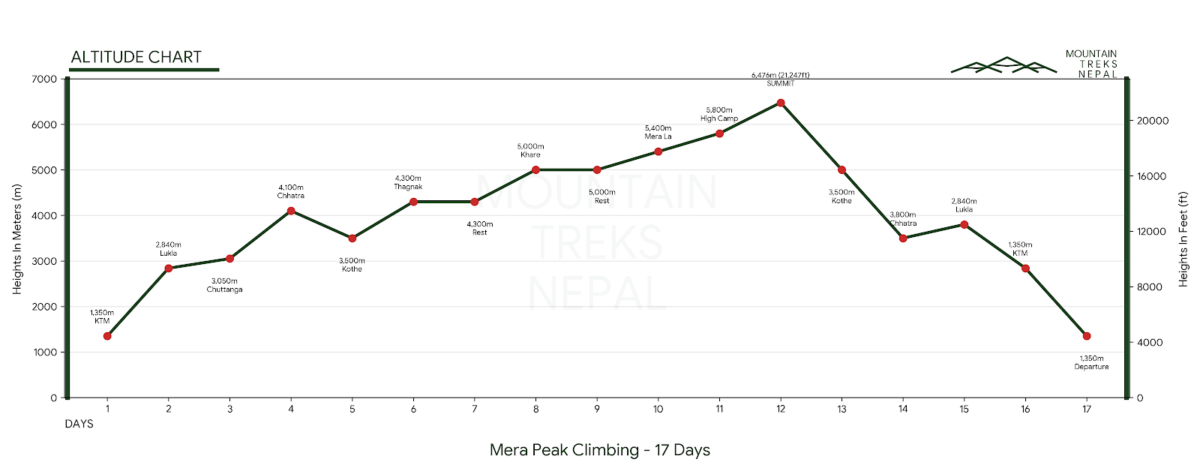
The 17-day Mera Peak Climbing altitude chart visually maps out the entire expedition through Nepal’s Hinku Valley, utilizing a dual-axis design that tracks elevation in both meters and feet across a clean 17-day timeline. Starting with a flight to Lukla (2,840m), the profile illustrates an initial trek over the Chhatra pass (4,100m) and down to Kothe (3,500m), followed by a steady upward trajectory toward Thagnak and Khare. Key acclimatization and training rest days at Thagnak (4,300m) and Khare (5,000m) are clearly marked as flat plateaus before the route continues up through Mera La (5,400m) and High Camp (5,800m). The chart reaches its absolute highest point on Day 12 at the Mera Peak Summit (6,476m / 21,247ft), followed by a steep descent back to Khare on the same day and a swift return trek through Kothe, Chhatra, and Lukla for the flight back to Kathmandu.
Why Should You Have Travel Insurance?
Travel insurance is an absolute necessity when it comes to Mera Peak Climbing. Though Mountain Treks Nepal does not deal with the sales of Travel Insurance, you can purchase it from other companies like Travelex, AXA Assistance, World Trips, and Allianz.
The policy must cover high-altitude trekking (to a height of 6,500 meters) and include cover for emergency medical evacuation, cancellation or interruption of the trip, and loss of items. Weather in the mountains is hazardous, and the chances of altitude sickness are very high, so you must have travel insurance for Mera Peak Climbing 17 Days.
Importance of Guides and Porters
It is not possible to have a very successful and safe Mera Peak Expedition without guides and porters. Experienced guides offer safe navigation, culture awareness, and first aid knowledge that well coordinates the journey. They keep an eye on your health, especially the signs of altitude sickness, and make sound decisions regarding pacing and rest days. Their local knowledge enhances the experience, offering insights into the flora, fauna, and traditions of the region.
Porters carry your heavy gear so that you can concentrate on the climb and hike. They help your load feel lighter and keep your energy for the challenging sections of the climb.
Required Permits for Mera Peak Climbing
The necessary permits for Mera Peak Climbing includes the climbing permit issued by the NMA (Nepal Mountaineering Association). The cost during the months of Spring which is from (March to May) is 250 USD, the Autumn months which range from (September to November) will cost 125 USD and the other two seasons of Winter (December to February) and Summer which is (June to August) will cost 70 USD.
You can get this permit at the NMA (Nepal Mountaineering Association). You will require several documents such as a couple of passport-sized photos, photocopies of passport, application forms, documents of travel insurance, and permit fees.
Is the Mera Peak Climbing Expedition Your Next Great Adventure?
This 17-day journey is the ultimate stepping stone for fit trekkers wanting to break into high-altitude Himalayan mountaineering. Book this package if:
-
You want to stand on Nepal’s highest trekking peak: Standing at 6,476 meters, Mera Peak takes you higher than Island Peak (6,189m) or Lobuche East (6,145m) without requiring steep, technical rock-climbing moves.
-
You want the best mountain panorama in the world: From the summit, you get a uninterrupted front-row view of five of the world’s six highest mountains: Mount Everest (8,848.86m), Lhotse (8,516m), Cho Oyu (8,188m), Makalu (8,485m), and Kanchenjunga (8,586m).
-
You prefer remote, less-crowded trails: Unlike the heavily trafficked main Everest Base Camp highway, the trek through the Hinku Valley offers quiet wilderness, untouched forests, and traditional Sherpa hospitality.
Why Choose Mountain Treks Nepal for Your Mera Peak Expedition?
-
Certified High-Altitude Sherpa Guides: Safety on glaciated peaks is paramount. Our climbing Sherpas are experienced veterans who manage rope setups, weather checks, pace control, and high-altitude safety.
-
Dedicated Skills Clinic in Khare: Before stepping onto the ice, our guides conduct a comprehensive training session on Day 09 at Khare to ensure everyone feels 100% confident using crampons, harnesses, ice axes, and fixed-line ascenders.
-
High-Camp Operations & Nutrition: We provide 4-season mountain tents, warm, calorie-dense meals prepared by our expedition cooks at Mera La and High Camp, and emergency medical oxygen.
-
Transparent Permit & Flight Management: We handle your NMA Mera Peak Climbing Permit, Makalu Barun / Sagarmatha National Park permits, local municipal fees, and Lukla flight bookings seamlessly.
Conclusion
Mera Peak Climbing is not only an expedition but also a daring and limit-testing experience with breathtaking views of the Himalayas combined with a cultural ambiance. From the excitement of being at the highest point to the cultural splendor of the days-long trek, any person in search of a challenge coupled with mesmerizing calmness will find this climb the perfect region for exploration. With the combination of adequate planning, guides, porters and a sense of adventure, Mera Peak Climbing 17 days will provide you with the greatest of memories and a delightful experience of the Himalayas. You can go through our Short Manaslu Circuit Trek of 8 Days and Everest Base Camp Trek 14 Days packages and plan for your next treks in Nepal with Mountain Treks Nepal.
Trip Highlights
- Conquer Mera Peak: Scale the majestic summit of Mera Peak, standing at 6,476 meters, for breathtaking views of the Himalayas.
- Remote Wilderness: Traverse the pristine wilderness of the Khumbu region, immersing in untouched beauty.
- Technical Challenge: Experience thrilling technical climbing amidst crevasses, ice walls, and steep slopes guided by Sherpa experts.
- Cultural Immersion: Engage with local Sherpa communities, gaining insight into their rich culture amidst towering peaks.
- Stunning Scenery: Marvel at snow-capped peaks, glacial valleys, and lush forests in the Everest region.
Trip Route
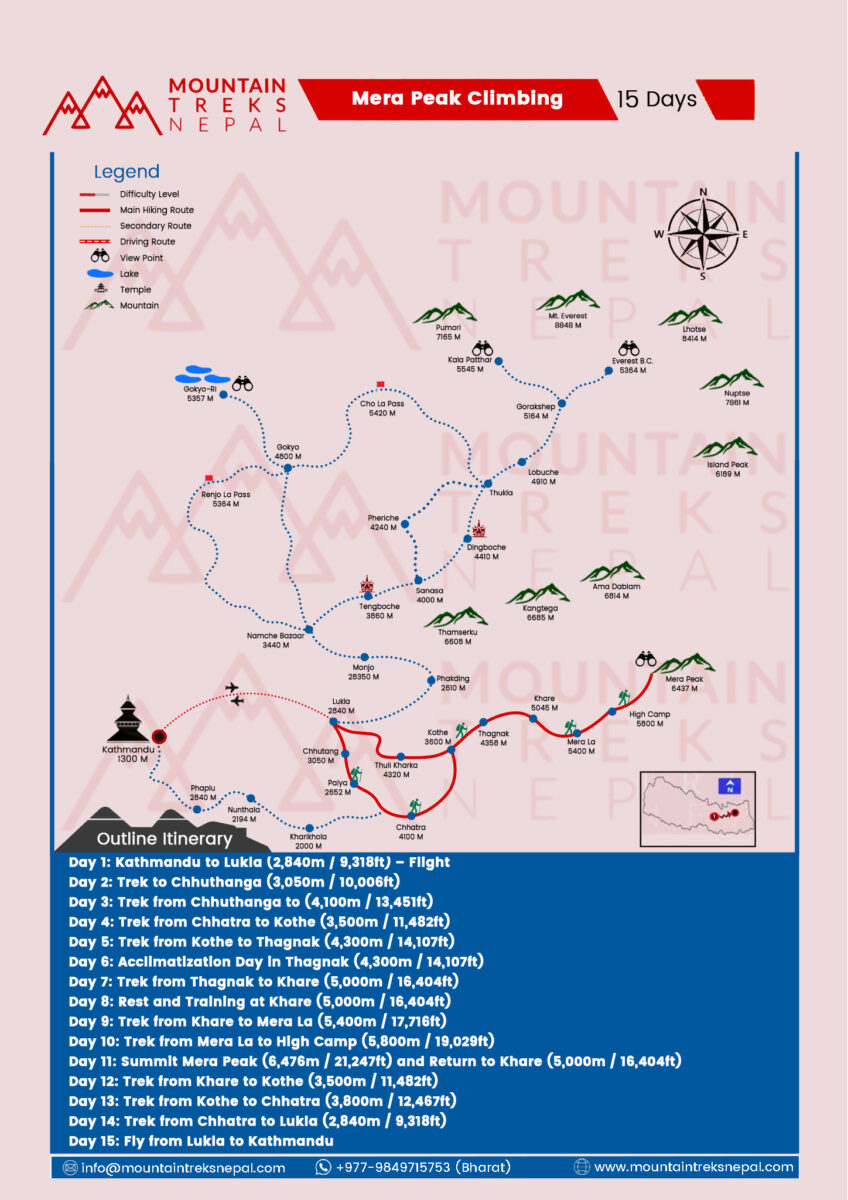
Have a Question? Inquire Now
Why Mountain Treks Nepal?
- Expert Team for Unparalleled Experience
- Best Price Guarantee
- Safety is the first Priority
- Easy Booking & Secure Online Payment
- Flexible And Personalized Service
- 24/7 Support
- Highest Satisfaction Guaranteed
- Highly Experienced Guides
- Your Satisfaction is Our Guarantee
- One-time Deposit, Assured for a Life Time
Detailed Itinerary
Upon landing at Kathmandu’s airport, a representative from Mountain Treks Nepal will meet you and transfer you to your hotel. You can either take a rest at your hotel or explore the cultural heritage and modern charm of the capital city. You can explore the UNESCO World Heritage Sites in the city, such as Pashupatinath Temple and Boudhanath Stupa.
In the evening, you can stroll around the city and taste traditional Nepalese food and local markets in Thamel. Overnight stay at a hotel in Kathmandu.
On the second day of the Mera Peak Climbing, you will fly to Tenzing Norgay Airport from Kathmandu. A flight of 30 minutes from Kathmandu brings you to Lukla, where the majestic heights of the Himalayas wait to be conquered at 2840 meters. This flight offers to take the traveler in full view and experience the vastness of snow-covered summits, the green valleys and the fascinating farmlands suspended in terraces.
Lukla is a small, busy town whose major purpose is to be the link to the Everest region. In the evening, you will stay at your lodge in Lukla.
Today, we will trek from Lukla to Chuttanga, which can be completed in around 5 to 6 hours. The trek begins with a smooth approach into the pine and rhododendron forests. The journey goes over a distance of approximately 8 kilometers and an elevation difference of about 200 meters.
You will pass through small Sherpa settlements, where one can observe the traditional way of living by the locals. A transition to tougher terrain signals that one has ascended to greater altitudes on their approach to Chuttanga. Chuttanga is that gentle, serene patch, quietly enveloped by forested hills, perfect for acclimatization.
Day 4 of the Mera Peak Climbing 17 Days will bring you to Chhatra from Chattanga. This section of the trek is a challenging climb through thick alpine forests leading to the Zatrwa La Pass. It’s a very long pass, taking about 6-7 hours. You can see very scenic views of the surrounding peaks, including the Kusum Kanguru highlight of the day’s walk.
Chhatra, the last destination of the trek, generally has a cool evening, and the temperatures even go below freezing at night. The village has superb scenic views of the Hinku Valley and is a very important acclimatization station.
The journey entails a continuous 6-hour ascend into the enchanting Hinku Valley. The trail stretches through lush alpine meadows, through the rhododendron forests, along the banks of Inkhu Khola. The hike reveals initial views of Mera Peak’s south face and surrounding snow-capped high peaks.
Kothe is a vibrant Sherpa settlement with a Tibetan Buddhism ambiance. The village sits at the bank of the river and provides several spaces for discovery of local traditions. You will stay overnight at a tea house in Kothe.
Today’s hike is fairly easy, taking about four to five hours. This is a trail that runs on the west bank of the Inkhu Khola and takes you up to the high-altitude zone. It will be offering views of both Kusum Kanguru and the south face of Mera Peak throughout the day. While passing small settlements and grazing pastures, you will also see a monastery hewn in the rock, adding a spiritual aspect to the day.
The village of Thagnak serves as an important acclimatization point, giving you clear views of the Sabai Glacier and the nearby peaks. Overnight stay at Thagnak.
The seventh day of the Mera Peak Climbing is set for acclimatization. In the meantime, you can also take a short hike to Sabal Tsho Lake or go to a nearby ridge, which ascends to around 5000m. The lake actually reflects the surrounding peaks, a perfect spot for taking some pictures and relaxing in the sun.
Thagnak ‘s exposure is really good for viewing Kusum Kanguru and other peaks pertaining to the Hinku region. The cold temperature reminds you that you are high up, thus requiring good gear to survive. Take this time to rest and mentally prepare yourself for the more challenging days to come.
Today, you will hike to Khare, which introduces you to glacial terrains. The gradual ascent goes through an open valley with stunning views of the Sabai Glacier and Hinku Nup Glacier’s north faces. Along the way, you will also have beautiful sights of the tranquil Tama Pokhari Lake as you cross some parts of moraine and icy patches.
Khare is the base where you can acclimatize and prepare for Mera Peak. The view here dazzles everyone who comes here as the majestic peak rises above the skyline. Nights here are cold, and temperatures fall way below the freezing point. Today, you will prepare your climbing gear and relax before the final ascent at night.
It is acclimatization and practice day today, which is planned for the summit. As you prepare and acclimatize, you also enjoy the clear views of Mera Peak and nearby ranges. Here, the climbing guide will demonstrate the basic techniques of using crampons, ice axes, ropes and other climbing gear, which are crucial for Mera Peak Climbing.
Khare has very frosty and crisp weather because night temperatures drop below -10 degrees C. This extra day will not only acclimatize but build confidence into that very grueling climb. Short exploration walks around Khare can be made to experience the beauty of high altitudes.
Trek to Mera La is a very steep 4-5 hour trek that passes through glacial terrain. During the journey, the views of the towering peaks such as Everest, Lhotse, and Nuptse become even more stunning.
Mera La gives great views over the snowfields and peaks surrounding it, but it is also pretty unpredictable, with sharp winds and temperatures. Today, you will camp at Mera La and spend the evening preparing for the following day’s climb.
This journey from Mera La to High Camp takes less than 4 hours but is quite challenging. The path begins to steepen while you are going up and gives way to ice paths and rocky ridges. Though climbing requires concentration and endurance, the enchantment of stunning views of Makalu, Kanchenjunga, and Baruntse will fuel your spirit.
High Camp is located on a rocky outcrop and is said to offer one of its best panoramic Himalayan views. The conditions can be harsh, with temperatures that often go as low as -15 degrees or below. You will stay at a tented camp.
The summit day of Mera Peak Climbing commences early in the morning. The headlamps are used to enlighten the way through the icy terrain. Climbing the Mera Peak summit takes around five to six hours. As a summit reward, you can enjoy a 360-degree view of Everest, Makalu, Kanchenjunga, and other giants of the Himalayas.
After relishing the moment, one will revert to High Camp for a quick rest and then proceed to descend to Khare. This is one long day, a challenging trek, but it is highly satisfying. By evening, you’ll be back in Khare, ready for some warm food and a place to rest.
Today, we will descend to Kothe from Khare following the same track through glacial terrains and alpine meadows. Descending is much more effortless than ascending, with the drop in altitude. You will cross Hinku Valley once again, and the lower you go, the clearer the view of the surrounding peaks becomes.
It is quite warm in these regions after the difficulties of crossing mountains. It is, in fact, very calming here because of the Inkhu Khola river. You will stay overnight at a tea house enjoying a warm dinner.
Trek from Kothe to Chatra takes about six hours, going back through the forests of rhododendron and pine. The hike is moderately challenging, with ups and downs, which becomes more scenic as the heights are reached because the views of the Hinku Valley and other tall peaks come back.
Now you are in Chhatra, where the temperature begins to cool again, especially at night. So, here is a good place to reflect on your journey so far: stay in a teahouse and prepare for the final steps of returning to Lukla.
It’s a long trek from Chhatra to Lukla and at least seven to eight hours long. You will pass through the Zatrwa La Pass one last time and take in the panoramic views of the Dudh Koshi Valley and the peaks like Kusum Kanguru. The trail gradually descends, and it becomes easier as one approaches Lukla.
Lukla is where all trekkers come for the final celebration of their treks. You will spend the evening tasting the local food and resting at a tea house.
Today, we will fly back to Kathmandu from Lukla. The flight takes about 30 minutes, allowing one to have a thrilling feeling. You will reach Kathmandu, and spend the rest of your day relaxing, shopping for souvenirs, or visiting parts of the city you have not yet experienced.
In the evening, you will enjoy a grand farewell dinner organized by Mountain Treks Nepal. Overnight stay at a hotel.
On the last day in Nepal, we will transfer you to Tribhuvan International Airport for your flight home. After completing this beautiful Mera Peak expedition, you will bid farewell to the country and Mountain Treks Nepal Team.
Trip Includes
- All necessary climbing guides, Sherpa and support staff for climbing
- One Experience Trekking Guide, Necessary Porter (1 per 2 trekkers from lukla)
- All the wages, expenses and insurance of Nepalese Crew Members
- 17 Days Trip, 14 of which include 3 meals a day (Breakfast, lunch & Dinner) with
- Cup of tea/coffee in the morning.
- Twin Shared Local Teahouse Accommodation during trekking and tents
- during climbing
- All necessary National Park/Conservation Area Permit, Climbing Permit and
- necessary paperwork
- Three nights Standard Accommodation in Kathmandu (Twin Sharing )
- All necessary climbing gears and equipments for successful climb
- Roundtrip flight (Kathmandu – Lukla – Kathmandu) with airport taxes
- Airport Arrival and Departure Transfers
- Sleeping Bag and Down Jacket (need to return after use)
- Our Duffel Bag (Return after the trip) .
- First Aid Medical Kit
- Farewell Nepalese Cultural Dinner
- All applicable fees and Government taxes
Trip Excludes
- Nepal Visa Fee and International Airfare
- Other Trekking Expenses like Drinking Water, Soft & Hard Drinks, Juice, Phone
- Calls, Internet Use, Battery Charging, Laundry, Hot Shower, Donation, Additional
- Porter etc
- Personal Trekking and Climbing Gears and Equipments
- Any Kinds of Health or Travel Insurance (It is mandatory to reduce the possible
- Expense in case of emergency evacuation)
- Extra night accommodation in Kathmandu/Manthali due any reason like early
- arrival or late departure than scheduled itinerary (also in case of early arrival
- from trekking)
- Cost arises due to obstruction and delays in the program itinerary due to weather
- or any social or political problems
- Tipping to Crew Members (Expected)
- Any other expenses or activities besides “Service Provided Above”
Trip Photo Gallery


Packing List For Mera Peak Climbing

General
- Four-season (zero degree) sleeping bag
- Sleeping bag liner
- Puffy down jacket
- Daypack (35-45 liters) with rain cover

Upper Body
- Warm Hat
- Sunglasses
- Scarf/Neck Gaiter/Buff (highly recommended)

Torso
- Moisture-wicking base layers
- Insulating layers (fleece jacket)
- Puffy down jacket
- Waterproof and windproof outer shell jacket

Lower Body
- Quick-drying trekking pants
- Thermal leggings (for high altitudes)
- Waterproof and windproof pants
- Sturdy hiking boots
- Moisture-wicking trekking socks
- Shorts (for lower altitudes or warmer days)

Hands
- Insulated gloves or mittens
- Liner gloves (for added warmth or dexterity)
- Waterproof outer gloves or mittens
- Hand warmers (optional, for extra cold conditions)
- Sunscreen (for protecting your hands from sunburn at high altitudes)
- Hand sanitizer or wet wipes
- Small repair kit (including duct tape for any handwear repairs)

Feet
- Tough hiking boots
- Trekking socks that wick away moisture
- Optional liner socks for increased comfort
(To prevent snow and debris out of your boots) gaiters - Foot warmers—optional in very cold climates
extra laces - Supplies for treating blisters

Medicines and First Aid Kits
- Personalized first aid kit
- Bandages and adhesive tape
- Antiseptic wipes
- Pain relievers
- Anti-diarrheal medication
- Altitude sickness medication
- Sunburn relief cream
- Cough Syrup

Other Equipments
- Passport and Documents
- Trekking poles for stability
- Water bottles or hydration system
- Water purification tablets or filter
- Lightweight towel and toiletries
- Sunscreen and lip balm with SPF
- Insect repellent
- Portable charger or solar charger
Frequently Asked Questions
The difficulty level of Mera Peak Climbing is moderate to difficult as it takes you to over 6000 meters above sea level. The trek time is around 6 hours, which requires good physical condition and preparation with technical climbing gears.
Since Spring (March to May) and Autumn (September to November) feature the most favorable weather conditions, they are the ideal time to go for this expedition. The trails are dry and crisp, making your navigation more easy and safe.
During the Mera Peak Climbing, the common form of accommodation you will find is a tea house, which comes with a shared bedroom, bathroom, and sometimes hot showers. At Mera Peak Base Camp, you will stay in a tent since there are no lodges around.
The altitude of Mera peak is 6,476 meters above sea level.
No technical mountaineering experience is required. Mera Peak is technically straightforward and classified as a non-technical glacier walk. However, you must have strong physical stamina, prior high-altitude trekking experience, and a willingness to learn basic gear usage (crampons, harness, ice axe, Jumar) during our pre-climb training day at Khare.
The summit of Mera Peak offers arguably the finest panoramic mountain view in the entire Himalaya. You will clearly see five 8,000-meter peaks: Mt. Everest, Lhotse, Makalu, Cho Oyu, and Kanchenjunga, alongside Ama Dablam, Chamlang, and Baruntse.
You need insulated double mountaineering boots (e.g., La Sportiva G2 SM, Scarpa Phantom 6000, or similar double boots). Standard hiking boots are great for the trek up to Khare, but rigid double boots are mandatory for glacier walking above 5,000m to prevent frostbite and fit crampons securely.
Yes. If you do not own double boots, crampons, an ice axe, or a climbing harness, you can easily rent them in Kathmandu or at the gear rental shops in Khare. Our lead guide will personally inspect all rented gear for proper sizing and safety before heading up to Mera La.
On Day 12, the summit push starts around 2:00 AM to 3:00 AM from High Camp. Moving early allows the team to reach the summit around sunrise, enjoy clear morning visibility, and descend safely back across the glacier before the midday sun softens the snow.
For 90% of the climb from Mera La to High Camp and across the upper glacier, the incline is a gentle to moderate 15° to 25° snow slope. Only the final 30–40 meter summit dome steepens to around 30°–40°, where a fixed rope and ascender (Jumar) are used for safety.
Trek Days (Lukla to Khare): You stay in local teahouses offering twin-share rooms and hot meals (Dal Bhat, soups, noodles, pasta, porridge).
Climb Days (Mera La & High Camp): You stay in heavy-duty 4-season tented camps with fresh meals prepared by our mountain kitchen crew.
Mountain Treks Nepal takes care of all required permits:
NMA Mera Peak Climbing Permit
Local Area / Rural Municipality Entry Permit
Makalu Barun / Sagarmatha National Park Entry Permit
At Base Camp and High Camp, our kitchen crew melts clean glacier snow and boils all drinking water. You will fill your thermal water flasks each evening and morning. We recommend carrying insulated water bottle sleeves so water doesn't freeze in your pack during the summit push.
Start training 3 to 6 months in advance. Focus on cardiovascular endurance and leg strength:
5 to 7-hour weekend hikes on hills carrying a 10–12 kg backpack
Stairmaster or incline treadmill workouts
Squats, lunges, leg presses, and core stability exercises
Running, swimming, or cycling 3–4 times per week
You must purchase specialized travel insurance that explicitly covers high-altitude trekking and peak climbing up to 6,500 meters, including emergency helicopter search and medical evacuation coverage.
Robert
December 26, 2025 at 1:16 pmAmazing Mera Peak Summit Experience
Summiting Mera Peak was one of the greatest achievements of my life, thanks to Mountain Treks Nepal. The guides were experienced, motivating, and always prioritized safety. The organization, food, accommodation, and logistics were excellent throughout the journey. If you’re planning Mera Peak Climbing in Nepal, this company is the perfect choice.
Kelley
November 16, 2024 at 10:37 pmMy Mera Peak climb was an unforgettable experience, made even more special by the exceptional service of Mountain Treks Nepal. Our guide, Rakesh, and Sherpa guide, pasang were incredibly knowledgeable, supportive, and ensured our safety throughout the journey. They were always available to answer our questions, offer guidance, and create a fun and engaging atmosphere. The entire trip, organized by Bharat, was seamless, with well-planned itineraries and top-notch accommodations. From the breathtaking landscapes to the warm hospitality of the Sherpa people, this adventure exceeded all expectations. I highly recommend Mountain Treks Nepal for anyone seeking a challenging yet rewarding Himalayan experience.
Debika
October 22, 2024 at 1:39 pmUnforgettable trip
My Mera Peak Climbing and trek with Mountain Treks Nepal was an unforgettable experience. The entire trip, from planning to execution, was flawlessly organized by Bharat. Our guide, Rakesh, and Sherpa guide, Purna, were exceptional. Their knowledge, expertise, and dedication made the journey safe and enjoyable. They went above and beyond to ensure our comfort and well-being. I highly recommend Mountain Treks Nepal for anyone seeking an authentic and memorable Himalayan adventure.
lisa
November 6, 2023 at 3:12 pmIt was a amazing trip of a lifetime for me at Mera Peak. Bharat arranged the trip responsively and promptly answered my many questions. I was well taken care of throughout the trip by lakpa shrepa, and appreciated the extra effort he had taken in arranging my itinerary when weather changed rapidly and unpredictably. Truly amazing experience when we summited. Thank you lakpa for the unforgettable experience!
NAMASTE!!
Edward C
May 8, 2023 at 11:32 pmMountain Treks Nepal Makes Your Himalayan Dream a Reality
My son and I enjoyed the Himalayan adventure of a lifetime with Mountain Treks Nepal in May 2023. We did an incredible Everest Base Camp and Mera Peak trek. The staff of Mountain Treks Nepal were expert on trekking in Nepal, and they were always so courteous, friendly and helpful to my son and I. They also provide their great services at a reasonable price
Elaine S
May 20, 2019 at 11:48 pmAwesome trekking experience in Nepal
I did my trek to Everest base camp and mera peak climbing with Mountain Treks Nepal. From asking for information till I arrived in Kathmandu, everything was well arranged and queries were answered promptly via emails by Mr Bharat . Guide purna was patient and helpful. Bharat is very helpful and supportive when i needed assistance in Lukla. Everything was arranged without worries, no question asked! And I truly appreciate his kindness and understanding. I will strongly recommend my friends to join any treks or holiday with this company in Nepal.
They treat you as a family members.
Thanks everyone for your warm hospitality