



Lower Dolpa Trek - 18 Days

-
Duration:
18 days -
Max Altitude:
5310m -
Difficulty Level:
Moderate -
Group Size:
1- 15 people -
Destination:
Lower Dolpo -
Accommodation:
Basic Lodge and Camping -
Transportation:
Flight, Bus, Car , Jeep or Van -
Best Season:
March to May and September to November
Trip Overview
Lower Dolpa Trek is one such journey that takes one into one of the most remote and traditionally rich regions of Nepal. It is in the northwest Himalaya Region called Dolpa: a rugged landscape where deep valleys, snow peaks impart the unscathed experience of Himalayan trekking. Lower Dolpa Trek passes through pristine landscapes, from green forests and dry high-altitude deserts up to the colors of Phoksundo Lake, one jewel of natural beauty. Here trekkers encounter old towns, age-old monasteries, and other signs of the singular Bon and Tibetan Buddhist cultures of the region.
This is not only a physical trek but also a spiritual and cultural trek, as trekkers cross high-altitude passes like Numa La and Baga La and get rewarded with marvelous panoramas of the Himalayas. The isolation and tranquility of Dolpa create a sense of adventure that cannot be found anywhere else in a world of more popular trekking routes. More suited to the seasoned trekker in search of solitude and real experience: Lower Dolpa Trek 18 Days guarantees as much in the way of landscapes as well as connections with the natural and cultural heritage of Nepal.
Preparation for Lower Dolpa Trek 18 Days
Permits and Regulations
There are two required permits to obtain before going on Lower Dolpa Trek. They are:
- Lower Dolpa Restricted Area Entry Permit
- Shey Phoksundo National Park Entrance Fee
The Lower Dolpa Restricted Area Entry Permit is specifically for this remote territory, costing USD $20 per person for the first week, then USD $5 for each subsequent day. You can get this permit at the migration office.
Besides, entrance fees are levied for Shey Phoksundo National Park. Since parts of Lower Dolpa are within that park, the fee for this park must be paid. The fee is NPR 3,000 for foreigners, while it costs NPR 1,500 for SAARC nationals. Children below 10 years of age are exempted. Therefore, this is great for family trips to visit this amazing place.
Guides and Porters
Guides and Porters are the essential partners for any successful and enjoyable Lower Dolpa Trek 18 Days. Indeed, they are versed guides not only in the trails but also in culture, history, and geography. They keep track of trekkers’ acclimatization and aid in providing solutions through challenges like bad weather.
Porters are very important with heavy carriage of camping materials, food, and personal belongings. This gives trekkers the ease of walking with a very small amount of weight. Porters know the terrain well and have acclimatized to the high altitudes. Their expertise and his work form the engine of a successful journey through this very arduous but rewarding region.
Best Months for Lower Dolpa Trek
Lower Dolpa sits behind the main Himalayan ridge of the Dhaulagiri and Annapurna massifs, placing a large portion of the trek in a unique Trans-Himalayan rain shadow.
-
Spring Season (March to May) — Blooming Valleys & Open Passes: Spring brings warming daytime temperatures, clearing high passes like Numa La (5,310m) and Baga La (5,170m). Wildflowers begin blooming along the riverbanks, and local trade routes open up.
-
Autumn Season (September to November) — Crystal Clear Mountain Views: Post-monsoon months offer the clearest skies and crispest atmospheric conditions. The turquoise waters of Phoksundo Lake reflect surrounding snow peaks perfectly, and golden autumn colors fill the lower valleys.
-
Monsoon Season (June to August) — Rain Shadow Advantage: Because Lower Dolpo lies in a rain shadow, it receives significantly less rainfall than the rest of Nepal. Summer is an excellent time for trekking here without heavy monsoon downpours, although domestic flight transfers to Jhuphal via Nepalgunj can experience weather delays.
-
Winter (December to February) — Not Recommended: Winter brings extreme sub-zero cold (-15°C at night) and heavy snow that completely seals off Numa La and Baga La passes.
Lower Dolpa Trek Difficulty Level
Trek Grade: Strenuous & Challenging Wilderness
Highest Points: Numa La Pass (5,310m) & Baga La Pass (5,170m)
Physical Requirement: High Physical Stamina & High-Altitude Endurance
The Lower Dolpa Trek is a demanding high-altitude wilderness trek that requires good physical conditioning and mental resilience.
-
Double High-Pass Crossings: Crossing Numa La Pass (5,310m) and Baga La Pass (5,170m) on consecutive days involves walking steep, narrow, wind-exposed scree trails above 5,000 meters in thin air.
-
Remote River Gorges & Canyon Trails: Trails through the Tarap Khola gorge involve dramatic cliffside paths, suspension bridge crossings, and rocky terrain that require surefooted stability.
-
Basic Infrastructure & Camping: While teahouses exist in lower villages like Dunai and Tarakot, high sections near Do Tarap, Numa La Base Camp, and Pelung Tang rely on expedition camping.
Altitude Profile & Progression Chart
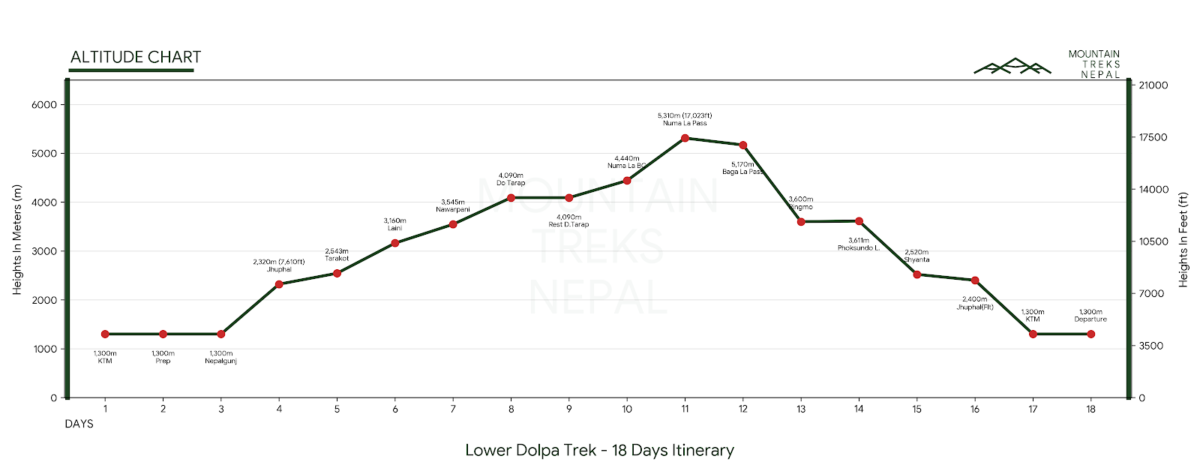
The Lower Dolpa Trek is a classic 18-day circuit through the hidden, rain-shadow landscapes of western Nepal, featuring sustained high-altitude walking and twin mountain pass crossings. Starting with flights from Kathmandu (1,300 m / 4,265 ft) via Nepalgunj to Jhuphal (2,320 m / 7,612 ft), the trail ascends steadily through river valleys via Tarakot (2,543 m / 8,343 ft) and Nawarpani (3,545 m / 11,631 ft) to reach an acclimatization plateau at Do Tarap (4,090 m / 13,419 ft). Pushing past Numa La Base Camp (4,440 m / 14,567 ft), the expedition hits its absolute apex on Day 11 at Numa La Pass (5,310 m / 17,023 ft), followed immediately by a second high-altitude traverse over Baga La Pass (5,170 m / 16,962 ft) on Day 12. The trajectory then drops into Ringmo on the shores of Phoksundo Lake (3,611 m / 11,847 ft) before following a downward path back to Jhuphal for return flights to Kathmandu.
Accommodation and Food
Accommodation facilities during the Lower Dolpa Trek will be in teahouses or campsites-presumably depending on how remote the place is. Here, in Dunai and Tarakot, you will find tea houses-which have quite simple yet comfortable lodgings; some would be sharing rooms and dining spaces. In higher altitudes, the facilities may become rudimentary because there is little electricity or hot water. Trekkers sleep in strong tents during camping where trekking organizers provide sleeping bags fit for cold conditions.
Trekkers at tea houses can feast over the simple, healthy dishes such as dal bhat (lentil soup and rice), noodles, and potato-based items. A few international options of pasta or pancakes are sometimes on the menu. During camping days, people cook using a mix of local and international dishes. At higher altitudes, they rely on dried or preserved supplies due to the unavailability of fresh ingredients.
Communication and Internet during Lower Dolpa Trek 18 Days
The Lower Dolpa Trek is a remote region, so communication becomes a bit difficult due to sparse and unreliable cellular connections, especially in high parts like Numa La and Baga La passes. Villages like Dunai and Ringmo will have some connectivity, however it is not advisable to depend on calls or messages for continuous access.
Wi-Fi might be available in teahouses of larger villages; however, the speed is slow and will normally require an extra charge. Satellite phones work for urgent communications but are costly and you have to arrange for them before using.
Travel Insurance
Travel insurance should be a core requirement for Lower Dolpa Trek 18 Days because it is very remote and not easy to come with at high altitudes. The rugged terrain and unpredictable weather of the Lower Dolpa Trek result from altitude changes. Therefore, ensure you have detailed coverage for the trek. It must include an emergency medical treatment and helicopter evacuation for a trip canceled due to reasons beyond the control of a person, for example, severe weather conditions or health-related issues. Most insurance companies, however, have an altitude limit, so ensure your policy covers heights above 5,000 meters, since you will cross such high passes like Numa La and Baga La.
Always carry both physical and digital copies of your insurance documents with you, and be sure that the guide or trekking agency has the policy specifics in case of emergencies. The right travel insurance gives security and relief, underlining a much more enjoyable and safer adventure.
Major Packing List for Lower Dolpa Trek
- Hiking Boots: Comfortable, waterproof, and well-broken-in.
- Thermal Layers: Essential for warmth in cold nights and higher altitudes.
- Sleeping Bag: Rated for at least -10°C for chilly Himalayan nights.
- Down Jacket: Lightweight yet warm for evening use.
- Daypack: 20–30L capacity for carrying essentials.
- Trekking Poles: Reduce strain on knees and improve balance.
- Water Purification Tablets: For clean drinking water throughout the trek.
- Headlamp: Necessary for early starts and evening use.
- First Aid Kit: Include blister treatments and altitude sickness medication.
- Snacks: High-energy bars and electrolyte powders for a quick energy boost.
Is the Lower Dolpa Trek Your Next Great Adventure?
This 18-day expedition is designed for trekkers seeking an authentic, off-the-beaten-path Himalayan circuit that combines high passes, deep culture, and alpine lakes. Book this package if:
-
You want to visit turquoise Phoksundo Lake: Experiencing the deep, glass-like turquoise waters of Phoksundo Lake (3,600m) framed by vertical rock cliffs is a world-class natural highlight.
-
You want to cross two iconic 5,000m+ Himalayan passes: Crossing both Numa La (5,310m) and Baga La (5,170m) offers an incredible high-altitude achievement with uninterrupted panoramas of Dhaulagiri and Kanjirowa.
-
You want an authentic Tibetan & Bon Po cultural experience: Exploring Do Tarap and Ringmo village offers a rare opportunity to visit ancient Bon and Buddhist monasteries and witness age-old salt caravan traditions.
Why Choose Mountain Treks Nepal for Your Lower Dolpo Trek?
-
Certified Wilderness Guides: Navigating remote high-pass trails requires experienced leadership. Our certified guides carry pulse oximeters, wilderness first-aid kits, and satellite communication devices.
-
Full Expedition Camping Support: In high pass sections (Numa La and Baga La), our team sets up heavy-duty 4-season tents, kitchen setups, and provides hot, high-calorie meals.
-
Hassle-Free Permit Management: We handle your Lower Dolpo Restricted Area Permit ($20/week) and Shey Phoksundo National Park entry permit seamlessly before you depart.
-
Smooth Flight Connections: We coordinate all domestic flight transfers (Kathmandu–Nepalgunj–Jhuphal and return) to ensure reliable transit in and out of Dolpa.
Conclusion
The Lower Dolpa Trek is indeed once in a lifetime and would be unmatchable in terms of its beauty, culture, and physical challenge. It brings the trekker away from everything toward a remoteness in wilderness where every step becomes a discovery. From the calm shores of the magnificent Phoksundo Lake, right up to the windswept passes of Numa La and Baga La, this trek reveals the Himalayas’ fiercely raw beauty. On the other hand, of course, the people of Dolpa bring life to the experience through their ancient culture, unique warm hospitality, and thus add a human dimension to the trek, transforming it into as much a cultural feast for the eyes.
Mountain Treks Nepal Pvt. Ltd. welcomes all of you with a thankful heart as we have created a systematic schedule for the Lower Dolpa Trek 9 Days with Itinerary. Moreover, we have similar treks in Nepal as of Lower Dolpa, for your energizing stay.
If you are looking for any other regions to trek in Nepal, you can also check our Manaslu Circuit Trek 14 Days, Everest Base Camp Trek 14 Days, Short Annapurna Base Camp Trek for more stay in typical community of Nepal.
Trip Highlights
- Remote Exploration: Venture into the untouched wilderness of Lower Dolpa, away from tourist crowds.
- Shey-Phoksundo National Park: Discover the mesmerizing beauty of crystal-clear lakes and diverse wildlife.
- Historic Trade Route: Follow the ancient Nepal-Tibet trade route, steeped in centuries of cultural significance.
- Stunning Landscapes: Marvel at the rugged terrain, majestic snow-capped peaks, and unique rain shadow landscapes.
- Cultural Immersion: Engage with local communities and experience the traditional Bon Po religious practices.
- Wildlife Sightings: Encounter rare Himalayan fauna, including snow leopards, blue sheep, and a variety of bird species.
Trip Route

Have a Question? Inquire Now
Why Mountain Treks Nepal?
- Expert Team for Unparalleled Experience
- Best Price Guarantee
- Safety is the first Priority
- Easy Booking & Secure Online Payment
- Flexible And Personalized Service
- 24/7 Support
- Highest Satisfaction Guaranteed
- Highly Experienced Guides
- Your Satisfaction is Our Guarantee
- One-time Deposit, Assured for a Life Time
Detailed Itinerary
The Lower Dolpa Trek 18 Days kicks off in Kathmandu, the capital city of Nepal, home to an emerald valley of magnificent historical temples, and charming little winding streets. As you land at Tribhuvan International Airport, one of our representatives will welcome you and escort you to your respective hotels.
You can spend the day acclimatizing to the high altitude and absorbing the dazzling energy of the city. You can take your time to walk through Thamel, Kathmandu’s buzzing hub for trekkers, or even visit the Garden of Dreams for some much-needed peace. Get some good rest, for tomorrow will be the start of trekking preparations.
Day 2 is the day to be spent for trek preparation activities along with sightseeing. So today, you can do a guided tour of Kathmandu’s cultural landmarks; UNESCO listed world heritage sites. You will start from the beautiful Pashupatinath Temple which may well be the sacred place for Hindus devotees. After that, you will visit the Swayambhunath Stupa, known as the Monkey Temple, as one of the popular local attractions with its panoramic views of the valley.
To finish off your journey, you must see Kathmandu Durbar Square, an important historical bearing witness to the glory that was once the city. In the afternoons, you will meet your trek guide for a briefing. Ensure your gear checks and last-minute preparations to bring you up to date for this high-altitude adventure ahead.
Today, we will seek to start our trek to Lower Dolpa. We will take a morning flight from Kathmandu to Nepalgunj which makes the way to remote areas in western Nepal. As you onboard a flight, you will be engulfed by aerial views of the terrain of Nepal: terraced hillsides and snowy peaks in the distance.
Nepalgunj is completely different from Kathmandu; it is so hot and humid because of its subtropical climate and really nudges one into the Indian border. So use the rest of the day to either rest or wander in the local markets and experience the different cultures of the Terai.
Day 4: Fly from Nepalgunj to Jhupal (2,320m/7,610ft) and Trek to Dunai (2,850m/9,348ft)
An early flight from Nepalgunj to Jhupal offers some of the most beautiful mountain and verdant views of the Himalayan foothills. You will enter Jhupal, which beholds the awesome landforms that stretch into Dolpa region.
Upon landing at Jhupal, our adventure officially begins. A short trekking route leads to Dunai, the administrative center of Dolpa District. We will catch a trail which takes you through the amazing little towns and terraced fields, a glimpse of how life once was for the people who still live an old way in this almost isolated world.
The route leaves behind Dunai and winds into a wonderful valley of the Bheri River. It will take you through deep green hills, with turquoise waters of the river shining the way. The walking path goes through traditional villages where sweet people would welcome you with many sweet smiles along the way.
After a few hours of trekking, you will reach Tarakot, an old city in Nepal known for old fort ruins. When you arrive, you can take a moment to enjoy the magnificent view of the green hills and distant mountain peaks. Overnight stay at a tea house in Tarakot.
As you trek from Tarakot to Laini, the landscapes become rugged as you will ascend to high altitudes. A series of suspension bridges crosses the Tarap River, which snakes along wound-filling gorges below.
The deeper you move closer to Laini, the more high and dramatic the high-altitude scene becomes. This last stretch has quite the cool mountain breeze and very attractive scenery. You will spend an evening enjoying the characteristic of pristine Dolpa skies. Overnight stay at a tea house in Laini.
The Laini to Nawarpani trek is undoubtedly the fascinating journey as it passes through the incredibly rugged topography and high and grand mountain passes. The trail runs through deep gorges, the very loud Tarap River close to one-sided neck. You will have to step on very narrow paths cut through steep cliffs, which are exciting but threaten to a great extent as they show you a wonderful view of the valley below.
The small settlement of Nawarpani, wrapped in high cliffs and alpine pastures, is a perfect resting place. The air is crisp and cool and the surroundings peaceful would offer a sense of isolation from the world to add to the wilderness experience.
The eighth day of the Lower Dolpa Trek is an exciting but tiring day hike to Do Tarap – a high valley that is famous for its exceptional Tibetan culture. The uphill-long trail gradually grows more beautiful: it has magnificent views of snow-capped peaks and rolling alpine landscapes. You will see a few grazing yaks and nomadic herders, indicating the traditional livelihood of this region.
Do Tarap is a beautiful village in the lap of mountains, cultural and spiritual highlight of this trek. The village has several monasteries and chortens, with people well known for warm hospitality. You can spend this time to spend some leisurely moments around and absorb the peaceful beauty of this Tibetan-influenced area.
Today is set solely for acclimatization and rest but the mesmerizing views surround and hold you while you acclimatize at Do Tarap. You can spend this day in this beautiful village, meeting some of the friendliest people who live their lives according to old Bon and Buddhist traditions. You can visit local monasteries and understand their spiritual significance.
Aside from being very beautiful in its ruggedness and having clear mountain air, the sights around you invite quiet contemplation and photography. This rest day is not only good for body acclimatization to altitude but also strengthens your understanding of Dolpa’s rich cultural heritage.
As you leave Do Tarap today, the trail leads uphill to the Numa La Base Camp, which has even more magnificent views of surrounding peaks as one travels along the trek. The scenery is barren but striking; the high-altitude terrain consists of rocky outcrops with scanty vegetation.
The Base Camp is at the foot of the Numa La Pass, surrounded by towering peaks. This place brings a peaceful atmosphere to rest before an early rise for the next hardy, yet rewarding, leg of the trek.
The climb to Numa La Pass is steep and grueling; however, the rewards are beyond any bargained-for expectation. The panoramic view is unusual and mouth-opening, startling trekkers from the summit as one gazes upon the vastness of Dhaulagiri and the Kanjiroba mountain range.
After enjoying the stunning views, descend to Pelung Tang, while getting dramatic high-altitude scenery. This campsite is surrounded by rugged peaks and a nice silence in which to recuperate from that day’s exertion. Overnight stay at Pelung Tang in a tea house.
Today, we will push uphill and come cross at Baga La Pass, a rather strenuous hike which gives trekkers a breathtaking view of the Himalayas. Rocky paths and snow-covered sections bring the element of adventure to the trek but you must be both physically and mentally prepared to be at such high altitude.
Coming down steep from the pass, you reach Dajok Tang-a campsite nestled among lush forests and alpine meadows. It strikingly contrasts with the barren landscapes of the high passes against a backdrop of green where the stunning geographical diversity of Dolpa can be fully appreciated.
The road from Syangboche to Ringmo trail leads through thick pine and juniper forests with snow-capped peaks intermittently revealed. Gradually Ringmo transforms this landscape into a peaceful setting of typical traditional Tibetan houses and chortens.
Here, at Ringmo, the scenery of the beautiful Phoksundo Lake starts to get in view. It is the deepest lake of Nepal, which sits at 3,589 meters above sea level. The peacefulness of the Ringmo village, coupled with cultural sufficiency, becomes a paradise where you can rest before heading out for the last stretch of your trek. You can explore the beautiful and stay overnight at a nearby tea house.
The short trek from Ringmo to Shey Phoksundo lake is what we will do today. Phoksundo Lake, with its turquoise waters and dramatic cliffs, is a natural wonder that leaves visitors spellbound. As you push yourself towards this beautiful lake, every single step brings one face to face with the surrounding peaks, offering views that are truly breathtaking.
You can spend a day exploring around the lake’s shores and admiring its beauty. The reflections of snow-encrusted mountains above on the water’s surface create a surreal ambiance. This is a pure, intimate engagement with all nature and it is undoubtedly one of the “highlights” of the entire trek.
On the fifteenth day of the Lower Dolpa Trek, you will hike from Phoksundo Lake to Shyanta. It is alluring during the descent from Phoksundo Lake to Shyanta where the rainforest and jumping waterfalls come around. Consequently, the trail descends to lower altitudes, while warmer temperatures affect a change of refreshing temperatures.
Shyanta is mild and cool, with trees and hills establishing a place of rest after the daily slog of trekking. After spending this day exhibiting regional diversity beyond it, travelers can find it to be one such interesting traversing to spot all sorts of birds and wildlife along the journey.
It is your last trekking day to Jhupal, which has you retracing down the steps from Shyanta via the landscapes you are used to. The relatively easy trek will let you take a last, proper look around the sights and sounds of Dolpa’s nature.
From there onwards, upon returning to Jhupal, you can celebrate the end of the trek and reflect on a journey complete with unforgettable moments in amazingly scenic landscapes now two weeks gone. Overnight stay at a tea house in Jhupal.
The seventeenth day of the Lower Dolpa Trek will take you to Kathmandu. You will first take a scenic flight back to Nepalgunj from Jhupal and again take a flight to Kathmandu. As you soar above the mountains, you can take one last look at the awe-inspiring Himalayas.
Upon reaching Kathmandu, you can get a well-deserved rest or explore the city some more as a fitting tribute to your journey. Overnight stay at a hotel in Kathmandu.
Today, you will bid farewell to Nepal and return to your home country after completing the Lower Dolpa Trek 18 Days. One of our representatives from Mountain Treks Nepal will lead you to Tribhuvan International Airport from where you will fly back home.
Packing List For Lower Dolpa Trek


Clothing
- Thermal tops and bottoms
- Fleece jackets and pullovers
- Waterproof/windproof jackets and pants
- Warm hat/caps and gloves

Foot Wears
- Sturdy hiking boots
- Warm hiking socks
- Sandals/slippers for your use at tea houses

Trekking Items
- Trekking poles
- Daypack, Duffel Bags, and dry bags to carry your items

Other Items
- Sleeping pads and sleeping bags
- Hot Water Bottle
- Sunglasses for UV protection
- First aid kit
- Trek map and guidebooks
- Trek permits
Frequently Asked Questions
The difficulty level of this trek is moderate to challenging as this trek takes to high altitude locations like Numa La Pass and Baga La Pass. Also, the trail is rugged and the average trekking time is around 5 to 6 hrs.
The best time to go for Lower Dolpa Trek is the Spring and Autumn seasons, when the weather condition is favorable.
Yes, since this trek takes to high altitude landmarks like Numa La and Baga La Pass, you must be very concerned about altitude sickness.
The major highlights of this trek is Shey Phoksundo Lake, Numa La Pass, and Baga La Pass.
Mountain Treks Nepal covers all mandatory permits:
Lower Dolpo Restricted Area Permit (USD 20 per person per week)
Shey Phoksundo National Park Entry Permit (NPR 3,000 per foreign national)
Lower Dolpo (18 Days): Lower in average elevation, shorter duration, less expensive permits, and includes crossing Numa La and Baga La passes to reach Phoksundo Lake.
Upper Dolpo (28 Days): Higher average elevation, longer duration, involves a higher Restricted Area Permit fee ($500+), and ventures deeper north to Shey Gompa and Saldang near the Tibetan border.
Lower Elevations (Dunai, Tarakot, Ringmo, Jhuphal): You stay in local teahouses offering basic twin-share rooms and home-cooked meals.
High Pass Sections (Numa La Base Camp, Pelung Tang, Dajok Tang): Accommodation consists of 4-season tented camping set up by our expedition crew.
Phoksundo Lake is an alpine Y-shaped lake located at 3,600m in Shey Phoksundo National Park. It is famous for its deep blue-turquoise color, complete lack of aquatic life (making the water crystal clear), dramatic surrounding cliffs, and its prominent feature in the Oscar-nominated movie Himalaya.
Yes. Lower Dolpo lies behind the Dhaulagiri rain shadow and receives very little rain compared to the rest of Nepal, making monsoon trekking viable. However, low-elevation flight transfers between Nepalgunj and Jhuphal can occasionally face weather delays.
Yes. Prior experience with high-altitude trekking (above 4,000m) and multiple days of walking 6 to 8 hours over uneven, steep mountain terrain is strongly recommended due to the double 5,000m+ pass crossings.
Bon is the ancient indigenous spiritual tradition of Tibet that predates Buddhism. In Do Tarap and Ringmo village, Bon culture flourishes alongside Tibetan Buddhism. You will visit ancient Bon monasteries like Tshowa Gompa at Phoksundo Lake, where chortens are walked counter-clockwise.
Mobile signal (Ncell / NTC) is available in lower hubs like Dunai, Jhuphal, and occasionally near Ringmo. There is no mobile signal or Wi-Fi near Do Tarap, Numa La, or Baga La passes. Guides carry satellite phones for emergency communication.
During camping days, our kitchen crew melts snow or collects fresh water from mountain streams and boils it thoroughly for drinking and filling thermal flasks. Bringing water purification tablets or UV purifiers for daytime refills is recommended.
Start training 3 to 6 months in advance. Focus on cardiovascular endurance and leg strength:
5 to 7-hour weekend hikes carrying a 10–12 kg backpack
Incline treadmill and stairmaster workouts
Squats, lunges, leg presses, and core stability exercises
Running, swimming, or cycling 3–4 times a week
Our porters or pack mules carry up to 15 kg (33 lbs) of your personal duffel bag. You carry a lightweight daypack (30L–40L) containing daily essentials like warm layers, rain gear, camera, water flasks, and personal items.
Our guides carry pulse oximeters and first-aid kits. If severe AMS symptoms occur, immediate descent to a lower elevation is enforced. In critical cases, emergency medical helicopter evacuations are coordinated via satellite phone with dispatch in Kathmandu.
You must carry specialized travel insurance that explicitly covers high-altitude trekking up to 5,500 meters, medical treatment, and emergency helicopter rescue operations in remote areas of Nepal.