


Everest Base Camp Tibet Tour from Nepal - 8 Days
-
Duration:
8 days -
Max Altitude:
5,150 m / 16,900 ftm -
Difficulty Level:
Moderate to Challenging (Overland Tour with High Altitude) -
Best Season:
Spring (March to May) & Autumn (September to November)
Trip Overview
The Everest Base Camp Tibet Tour from Nepal 8 Days is a trans-Himalayan journey connecting the spiritual heritage of Lhasa with the rugged north face of Mount Everest. Starting with a trans-Himalayan flight from Kathmandu over the world’s highest mountain chain, the tour lands directly in Lhasa (3,650m) the historic center of Tibetan Buddhism.
Over the next week, you will explore UNESCO World Heritage sites, including the Potala Palace, Jokhang Temple, and the monastic universities of Drepung and Sera. The journey transitions into an overland expedition along the Friendship Highway, crossing high mountain passes like Kamba La (4,794m) and Gawula Pass (5,250m), skirting the turquoise waters of Yamdrok Lake, and visiting the historic fortress cities of Gyantse and Shigatse.
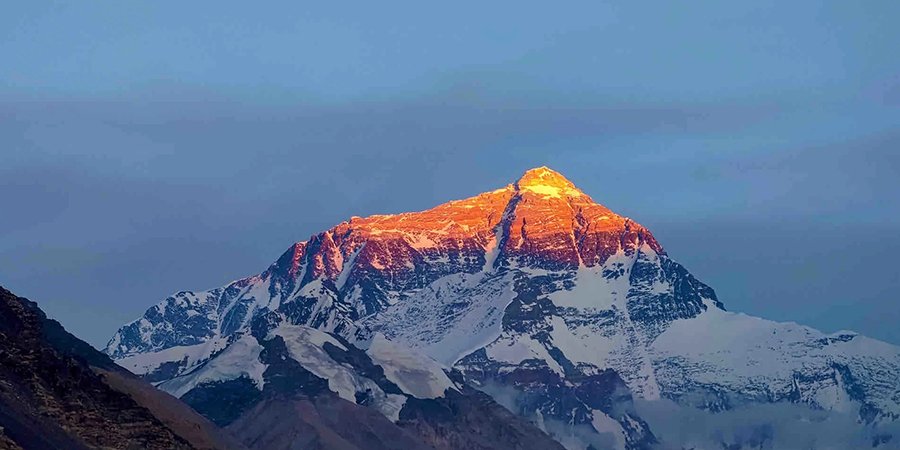
The highlight of the route is standing at North Everest Base Camp (5,150m) and visiting Rongbuk Monastery (4,980m) the highest monastery on Earth where the north face of Mt. Everest rises unobstructed. Finally, the tour descends from the Tibetan Plateau through the border gorges of Nyalam and Zhangmu/Gyirong, driving back into the lush Kathmandu Valley.
Best Time for Everest Base Camp Tibet Tour
High-altitude overland travel across the Tibetan Plateau requires clear visibility, dry road passes, and manageable temperatures.
-
Spring Season (March to May) — Clear Skies & Mountaineering Season: Spring offers rising daytime temperatures and clear morning visibility. As the climbing season begins, the atmosphere around Rongbuk and North EBC is lively with international mountaineering teams preparing for their north-face summit pushes.
-
Autumn Season (September to November) — Prime Mountain Clarity: Post-monsoon autumn is considered the premier season for viewing Mount Everest from the north side. The air is crisp, cloud cover is minimal, and travelers enjoy razor-sharp views of Everest, Lhotse, Makalu, and Cho Oyu.
-
Summer / Monsoon Season (June to August) — Rain-Shadow Advantage: While the Nepal side receives monsoon rainfall, the high Tibetan plateau sits in the rain shadow of the Himalayas and remains mostly dry with greener grazing landscapes.
-
Winter Season (December to February) — Crisp Vistas with Extreme Cold: Winter brings bright sunshine and clear mountain views, but night temperatures at Rongbuk and EBC drop to between -15 degree Celcius and -25 degree Celcius.
Tour Difficulty & Altitude Guidelines
Tour Grade: Moderate to Challenging (Overland Cultural & High-Altitude Driving Tour)
Highest Points: North Everest Base Camp (5,150 m) & Gawula Pass (5,250 m)
Physical Requirement: Moderate Stamina & Altitude Resilience
While this trip involves traveling in comfortable private tourist vans rather than multi-day trekking, altitude management is critical.
-
Rapid Altitude Jump on Day 1: Flying directly from Kathmandu (1,400 m) to Lhasa (3,650 m) requires strict adherence to hydration and rest on your arrival day.
-
High-Altitude Nights at Rongbuk: Sleeping at Rongbuk/EBC (4,980 m – 5,150 m) exposes travelers to thin air with roughly 50% less oxygen than sea level.
-
Overland Distance: Driving 5 to 7 hours per day across high mountain passes involves winding roads and variable gravel terrain near the base camp and border gorges.
Altitude Chart
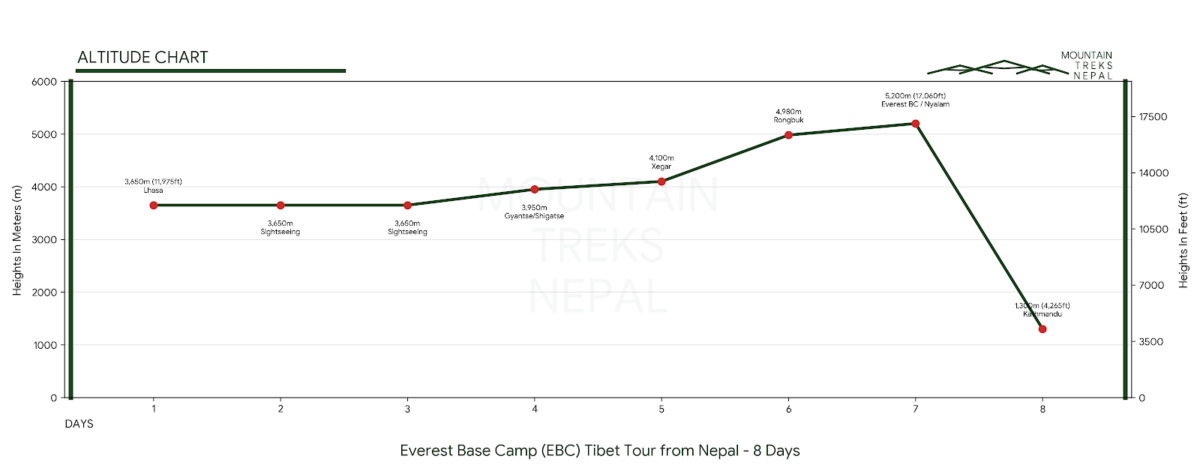
The Everest Base Camp (EBC) Tibet Tour from Nepal is an 8-day high-altitude overland expedition connecting Tibet’s cultural heartland with the northern face of Mount Everest. Arriving in Lhasa (3,650 m / 11,975 ft) on Day 1, the elevation holds flat across Days 2 and 3 to allow for natural acclimatization while exploring iconic heritage sites. The overland route begins its steady ascent on Day 4, traveling through Gyantse and Shigatse (3,950 m / 12,959 ft) to reach Xegar (4,100 m / 13,451 ft) on Day 5 and the historic Rongbuk Monastery (4,980 m / 16,338 ft) on Day 6. The journey hits its peak altitude on Day 7 at the North Everest Base Camp at 5,200 m (17,060 ft) before starting a descent to Nyalam (3,700 m / 12,139 ft). The itinerary finishes on Day 8 with a steep downhill drive crossing the border back to Kathmandu (1,300 m / 4,265 ft).
Preparation for Everest Base Camp Tibet Tour 8 Days
-
Physical Conditioning: Although this is primarily an overland driving tour rather than a multi-day hike, high altitude places substantial demand on the cardiovascular system. Build aerobic stamina through regular jogging, swimming, cycling, or brisk walking 4 to 6 weeks before your trip.
-
Health Check & Pre-Trip Consultation: Consult your physician regarding high-altitude travel (>5,000 m) and carry a prescription for altitude medications such as Acetazolamide (Diamox). Ensure routine vaccinations are up to date.
-
Kathmandu Arrival Buffer: Plan your arrival in Kathmandu at least 3 to 4 working days before departure to allow sufficient time for physical passport submission and China Group Visa processing at the Chinese Embassy.
Guides and Porters for Everest Base Camp Tibet Tour
-
Licensed Native Tibetan Guides: Government regulations mandate that all international travelers in Tibet are accompanied by an authorized, English-speaking native Tibetan guide. Your guide handles monument access, checkpoints, local customs briefings, and daily health assessments.
-
Professional High-Altitude Drivers: Travel across the Tibetan plateau is conducted by experienced local drivers skilled in mountain passes, high-altitude road conditions, and border transit.
-
Porters: Because this journey is conducted via private tourist vehicles with luggage transported directly in the vehicle, dedicated trekking porters are not required.
Accommodation during Everest Base Camp Tibet Tour
-
Lhasa & Shigatse (Days 1–3, Day 4): Comfortable 3-star standard tourist hotels featuring twin-share rooms, private en-suite bathrooms, 24-hour hot water, heating, and daily breakfast.
-
Xegar / Tingri (Day 5): Standard local guesthouses or 2-to-3-star hotels offering basic private rooms, central dining, and electric blankets.
-
Rongbuk Monastery & North EBC (Day 6): Basic multi-bed dormitory accommodations in the Rongbuk Monastery Guesthouse or traditional yak-hair tent camps. Facilities include shared dry/eco-toilets, central yak-dung heating stoves, and electric blankets; running hot water is unavailable at this altitude.
-
Nyalam (Day 7): Simple, rustic mountain lodge/guesthouse with basic shared or private twin rooms and shared washing facilities.
Drinking Water
-
Bottled Mineral Water: Sealed bottled water is widely available for purchase at grocery shops, restaurants, and hotels in Lhasa, Gyantse, and Shigatse.
-
Boiled Water at High Camps: Guesthouses and tent camps at Rongbuk and Nyalam provide large thermoses of boiled drinking water suitable for refilling insulated water bottles.
-
Hydration Protocol: Maintain a daily fluid intake of 3 to 4 liters (warm water, herbal teas, or electrolyte fluids) to assist the acclimatization process and prevent altitude-induced dehydration.
Communication and Internet
-
Mobile Network Coverage: China Mobile and China Unicom provide reliable 4G/5G coverage in major urban centers like Lhasa, Gyantse, and Shigatse. Signal strength becomes weak or intermittent between Gawula Pass, Rongbuk, and high mountain gorges.
-
Hotel Wi-Fi: Complimentary Wi-Fi is available in hotels across Lhasa and Shigatse, though speeds may vary. Wi-Fi is generally unavailable at high camps like Rongbuk and Nyalam.
-
Internet Regulations & Access: Standard Chinese internet firewalls restrict access to services such as Google, WhatsApp, Instagram, Facebook, and YouTube. Travelers should set up international roaming or install a functional Virtual Private Network (VPN) prior to arrival.
Travel Insurance
-
Mandatory High-Altitude Coverage: Travel insurance is strictly required for this tour. Your policy must explicitly cover overland travel and emergency medical care up to 5,500 meters (18,045 feet).
-
Emergency Medical Evacuation: Ensure your coverage includes overland emergency transport and emergency medical repatriation from remote regions of Tibet.
-
Trip Interruption & Delays: Policies should cover unforeseen expenses arising from weather-related road closures, landslides, or administrative border delays.
Is the Everest Base Camp Tibet Tour Your Next Great Adventure?
This 8-day package is built for culture enthusiasts, photographers, and adventurers wanting to experience the north side of Mt. Everest without trekking for two weeks. Book this package if:
-
You want a direct, close-up view of the North Face of Mount Everest: Unlike the South Base Camp in Nepal (where Nuptse hides Everest’s summit), the North Everest Base Camp in Tibet provides a direct view of Everest’s pyramid peak.
-
You want to visit the highest monastery in the world: Rongbuk Monastery (4,980 m) sits directly in front of Everest’s ice fields, offering an unmatched spiritual atmosphere.
-
You want an all-in-one Fly-In / Drive-Out itinerary: Flying into Lhasa avoids the initial rough overland drive, while driving back through Gyantse, Shigatse, EBC, and the border gorge covers all major highlights of Central and Western Tibet.
Why Choose Mountain Treks Nepal for Your EBC Tibet Adventure?
-
Authorized Native Tibetan Guides & Professional Drivers: All ground operations in Tibet are managed by licensed, English-speaking native Tibetan guides and experienced high-altitude drivers.
-
Complete China Group Visa & Permit Processing: We manage the China Group Tourist Visa at the Chinese Embassy in Kathmandu, along with your Tibet Travel Permit (TTP), Alien’s Travel Permit, and EBC National Nature Reserve entry.
-
Emergency Oxygen & Health Support: All vehicles carry onboard oxygen cylinders, and our guides monitor guest acclimatization daily.
-
Smooth Border & Transfer Logistics: From airport drop-off in Kathmandu to private jeep pickups at the Nepal-China border on Day 8, every transfer is managed end-to-end.
Trip Highlights
-
Scenic Trans-Himalayan Flight: Experience views of Mount Everest, Kanchenjunga, Makalu, and Lhotse on the flight from Kathmandu to Lhasa.
-
UNESCO World Heritage Landmarks in Lhasa: Tour the Potala Palace, the sacred Jokhang Temple, and the pilgrimage circuit of Barkhor Street.
-
Centuries-Old Monastic Centers: Explore Drepung Monastery and observe the traditional philosophical monk debates at Sera Monastery.
-
Sacred Lakes & Glaciers: Overlook the waters of Yamdrok Lake from Kamba La Pass (4,794 m / 15,728 ft) and view the Karo La Glacier.
-
Historic Cultural Cities: Visit the multi-tiered Kumbum Stupa in Gyantse and the seat of the Panchen Lama at Tashilhunpo Monastery in Shigatse.
-
Gawula Pass Panorama (5,250 m / 17,224 ft): Take in a 180-degree vista of five 8,000-meter peaks: Everest, Lhotse, Makalu, Cho Oyu, and Shishapangma.
-
North Face of Mt. Everest: Stand at North Everest Base Camp (5,150 m / 16,896 ft) and visit the high-altitude Rongbuk Monastery (4,980 m / 16,338 ft).
-
Trans-Himalayan Descent: Travel from the arid Tibetan Plateau through river gorges back down to Kathmandu.
Have a Question? Inquire Now
Why Mountain Treks Nepal?
- Expert Team for Unparalleled Experience
- Best Price Guarantee
- Safety is the first Priority
- Easy Booking & Secure Online Payment
- Flexible And Personalized Service
- 24/7 Support
- Highest Satisfaction Guaranteed
- Highly Experienced Guides
- Your Satisfaction is Our Guarantee
- One-time Deposit, Assured for a Life Time
Detailed Itinerary
Transfer to Tribhuvan International Airport for your morning trans-Himalayan flight to Lhasa Gonggar Airport. On clear days, the flight offers views of Mount Everest, Kanchenjunga, and Makalu. Meet your Tibetan guide, receive a welcoming white silk scarf (Hada), and transfer 1 hour to your hotel in Lhasa. Spend the rest of the day resting to acclimatize to the altitude. Overnight at a 3-star hotel in Lhasa.
Begin the morning exploring the Potala Palace, the 13-story former winter residence of the Dalai Lamas filled with golden stupas, ancient chapels, and murals. In the afternoon, visit the Jokhang Temple, the spiritual heart of Tibetan Buddhism housing the sacred Jowo Shakyamuni statue. End the day walking the holy kora circuit along bustling Barkhor Street. Overnight at a 3-star hotel in Lhasa.
In the morning, tour Drepung Monastery, once the largest monastery in the world housing over 10,000 monks. After lunch, visit Sera Monastery to witness the daily philosophical monk debates held in the courtyard, where monks clap, gesture, and debate Buddhist scripture. Overnight at a 3-star hotel in Lhasa.
Drive south along the Friendship Highway, ascending to Kamba La Pass (4,794m) for views of turquoise Yamdrok Lake. Continue past the hanging ice mass of Karo La Glacier (5,010m) to Gyantse. Visit the multi-tiered Kumbum Stupa and Palcho Monastery, then drive 1.5 hours across the flat valley to Shigatse, Tibet’s second-largest city. Overnight at a 3-star hotel in Shigatse.
In the morning, tour Tashilhunpo Monastery, the seat of the Panchen Lama, home to a 26-meter gilded bronze statue of Maitreya Buddha. Afterwards, drive westward across high desert plateaus and over Gyatchu La Pass (5,220m) the highest pass on the Friendship Highway before arriving at the frontier town of Xegar (New Tingri). Overnight at a hotel/guesthouse in Xegar.
Turn off the main highway and climb through switchbacks to Gawula Pass (5,250m), which offers a 180-degree view of five 8,000m giants: Everest, Lhotse, Makalu, Cho Oyu, and Shishapangma. Descend into the Rongbuk Valley to explore Rongbuk Monastery, then proceed to North Everest Base Camp (5,150m). Watch the sunset illuminate the north face of Mt. Everest. Overnight at a guesthouse or seasonal tent camp at Rongbuk/EBC.
Wake early for sunrise over Mount Everest. After breakfast, start the westward drive toward the Nepal border, crossing Lalung La Pass (5,050m) with views of Mt. Shishapangma (8,013m) and Peiku Tso Lake. Descend from the high arid plateau into the rugged mountain gorge of Nyalam. Overnight at a local guesthouse in Nyalam.
Descend through the gorge to the border checkpoint (Zhangmu/Gyirong Port). Complete Chinese customs and immigration exit formalities, cross the border bridge, and meet your Nepalese driver. Drive through the mid-hill valleys and villages back to Kathmandu, arriving in the evening for your hotel check-in.
Trip Includes
-
One-way flight ticket from Kathmandu to Lhasa (including airport tax).
-
Private tourist vehicle with experienced driver for all sightseeing and overland transfers in Tibet.
-
Tibet Travel Permit (TTP), Alien’s Travel Permit, and Everest National Nature Reserve entry fees.
-
All monastery and monument entrance fees as specified in the itinerary.
-
Professional English-speaking local Tibetan guide throughout the tour in Tibet.
-
3-Star hotel accommodations in Lhasa and Shigatse with daily breakfast.
-
Basic guesthouse / tented camp accommodations at Rongbuk/EBC and Nyalam.
-
Emergency bottled oxygen supply in the vehicle.
-
Private vehicle transfer from the Nepal-China border to your hotel in Kathmandu.
Trip Excludes
-
China Group Tourist Visa fee (processed at the Chinese Embassy in Kathmandu).
-
Lunches and dinners throughout Tibet and Nepal (approx. $10–$15 per meal).
-
Personal expenses (beverages, phone calls, laundry, Wi-Fi fees, battery charging).
-
International flights to/from Kathmandu and Nepal re-entry visa fee.
-
Personal travel and high-altitude medical evacuation insurance.
-
Gratuities/tips for Tibetan tour guides and drivers.
Frequently Asked Questions

You need two primary documents:
China Group Tourist Visa: Issued by the Chinese Embassy in Kathmandu.
Tibet Travel Permit (TTP) & Alien's Travel Permit: Issued by the Tibet Tourism Bureau in Lhasa.
Mountain Treks Nepal manages all applications and permits on your behalf.
You must arrive in Kathmandu at least 3 to 4 working days prior to Day 1. The Chinese Embassy in Kathmandu requires your physical passport to issue the official China Group Visa.
The highest point reached is North Everest Base Camp at 5,150 meters (16,900 feet), along with Gawula Pass at 5,250 meters.
Yes. North Everest Base Camp in Tibet provides a direct, close-up view of the complete north face and summit pyramid of Mount Everest, without obstruction by other ridges.
Nepal EBC (South): Requires an 8 to 12-day trek on foot; the summit of Everest is hidden by Mt. Nuptse at base camp (visible from Kala Patthar).
Tibet EBC (North): Accessible by paved road and eco-bus; provides a direct, head-on view of Mt. Everest's summit directly from the campsite and Rongbuk Monastery.
Yes. Flying into Lhasa (3,650 m) and ascending to 5,150 m exposes you to thin air. We schedule two full acclimatization days in Lhasa and carry medical oxygen cylinders in our vehicles for emergency support.
Accommodations at Rongbuk/EBC and Nyalam are basic. You stay in multi-bed dormitory rooms in local guesthouses or seasonal yak-hair tent camps with shared eco-pit toilets, electric blankets or wood stoves, and no running hot water.
In Lhasa and Shigatse, restaurants serve Tibetan, Chinese, Nepali, Indian, and Western dishes. In remote towns like Xegar, Rongbuk, and Nyalam, meals consist of simple staples: noodles, fried rice, potato dishes, momos, eggs, and butter tea.
No. Independent travel for foreign tourists is strictly prohibited in the Tibet Autonomous Region. All travelers must be part of an organized tour with a pre-arranged itinerary, licensed Tibetan guide, and private tourist vehicle.
The official currency is the Chinese Yuan / Renminbi (RMB / CNY). US Dollars and Nepalese Rupees are not accepted in local markets or guesthouses. You must exchange currency into RMB in Kathmandu or at border points before traveling.
Mobile data (China Mobile/China Unicom) works well in Lhasa, Gyantse, and Shigatse. Remote areas like Rongbuk and Nyalam have limited connectivity. Major Western websites and apps (Google, WhatsApp, Instagram, Facebook) are blocked in China; using an international roaming plan or pre-installed VPN is necessary for access.
Yes, provided they are in good health and consult their physician regarding high-altitude travel. Because the trip is overland and involves driving rather than trekking, it is physically accessible for various age groups.
You must purchase travel insurance that explicitly covers high-altitude travel up to 5,500 meters, emergency medical expenses, trip delays/cancellations, and emergency medical repatriation.