


Share This:
Complete Kanchenjunga Circuit Trek Guide: Conquering Nepal’s Wild East
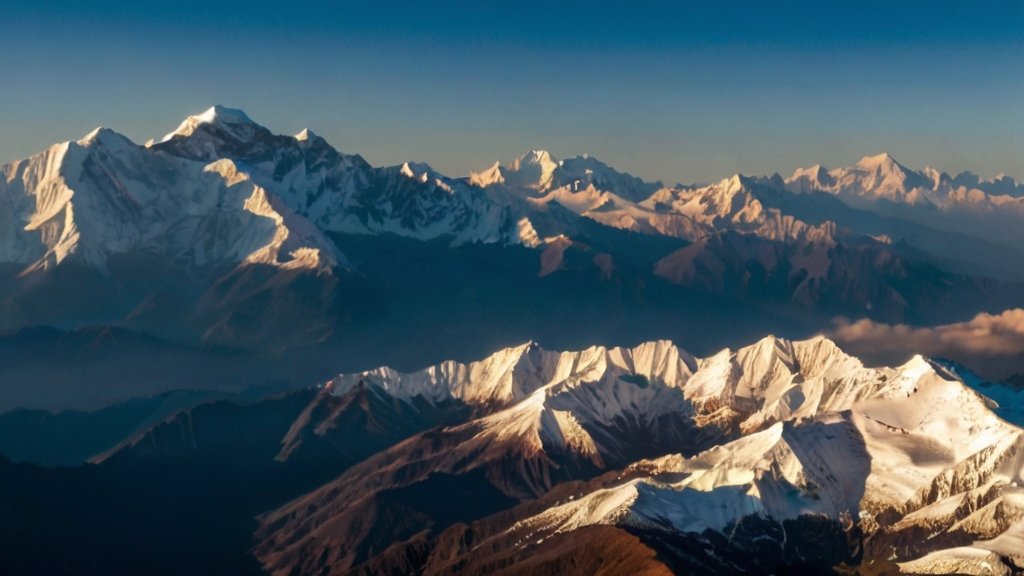
Mount Kanchenjunga, soaring to a staggering 8,586 meters (28,169 feet), is the third-highest mountain on Earth. Its name translates from Tibetan as “The Five Treasures of the High Snow,” referring to its five colossal peaks that straddle the remote eastern border between Nepal and the Indian state of Sikkim. For decades, this formidable massif was entirely closed to outsiders. Even today, the Kanchenjunga Circuit Trek remains one of the most fiercely isolated, heavily restricted, and profoundly rewarding wilderness expeditions on the planet.
Unlike the heavily trodden paths of Everest or Annapurna, there are no crowds here. There are no luxury bakeries, no internal airstrips close to the high valleys, and no paved roads disrupting the ancient footpaths. Trekking Kanchenjunga means committing to 19 days of raw, unvarnished Himalayan survival. It is an expedition designed exclusively for alpine purists, veteran hikers, and those seeking absolute solitude in a landscape that has remained virtually unchanged for centuries.
The true logistical and visual magic of the Kanchenjunga Circuit is that it is a double base camp trek. The colossal massif is so vast that you must hike up one entirely distinct glacial valley to reach the North Base Camp (Pang Pema), cross a terrifyingly beautiful, high-altitude pass system known as the Sele Le traverse, and drop into an entirely different valley to reach the South Base Camp (Oktang) before completing the grand loop.
Crafted by the far-eastern expedition experts at Mountain Treks Nepal, this exhaustive operational manual breaks down every grueling, glorious day of the 19-day itinerary. We detail the logistics of crossing three mountain passes in a single day, the reality of the rustic teahouses, the exact gear required for survival, and the strict permit requirements for entering Nepal’s wildest frontier in 2026.
The Evolution of the Wild East: Why Trek Kanchenjunga?
If you have already hiked the classic trails of Nepal and find yourself craving true isolation, Kanchenjunga is the logical pinnacle of your trekking career.
-
Absolute Solitude: While the Everest and Annapurna regions host tens of thousands of trekkers annually, only a few hundred complete the Kanchenjunga Circuit each year. The strict “two-person minimum” permit rule and the sheer geographical isolation keep the crowds at bay. On many days, your team will be the only humans walking the valley.
-
Two Distinct Expeditions in One: The geography dictates a massive, asymmetrical loop. You explore the Ghunsa Khola valley for the North Base Camp, and the Simbuwa Khola valley for the South Base Camp. These two distinct ecosystems are seamlessly linked by the high mountain passes of the Sele Le, effectively giving you two major treks for the effort of one.
-
Pristine Cultural Authenticity: The region is home to the Limbu, Rai, and Sherpa communities in the lower valleys, and ancient Tibetan Buddhist settlements in the upper reaches. Villages like Ghunsa and Phale have avoided the commercialization seen in Namche Bazaar, offering a profound glimpse into traditional Himalayan life where yak herding and potato farming still dominate the economy.
-
Historical Significance: Kanchenjunga was first summited in 1955 by a British expedition led by Charles Evans, with Joe Brown and George Band reaching the top. Out of respect for the religious beliefs of the indigenous Sikkimese people, they stopped a few feet short of the actual summit to leave the peak pristine a tradition still honored by mountaineers today.
Geography, Geology, and the Kanchenjunga Conservation Area (KCA)
Eastern Nepal catches the absolute full force of the Bay of Bengal monsoon. Because it receives significantly more rainfall than the Everest or Annapurna regions to the west, the biodiversity within the Kanchenjunga Conservation Area (KCA) is staggering. The KCA spans 2,035 square kilometers and is an evolutionary hotspot.
The Subtropical Lowlands (1,000m – 2,000m)
The trek begins in the cardamom-scented, humid foothills of the Taplejung district. The hillsides are draped in thick bamboo jungles, terraced farmlands, and sprawling tea estates (particularly near Illam and Kanyam). The trails here are often steep, muddy, and intensely humid.
The Temperate Cloud Forests (2,000m – 3,500m)
As you ascend the Ghunsa Khola, the humidity drops, and you enter dense, moss-draped temperate forests of oak, blue pine, and silver fir. This region boasts over 20 species of rhododendron. In the spring (March to May), the forests explode into vibrant shades of red, pink, and white, creating a surreal, colorful tunnel for trekkers.
The Glacial Valleys and Alpine Tundra (3,500m – 5,140m)
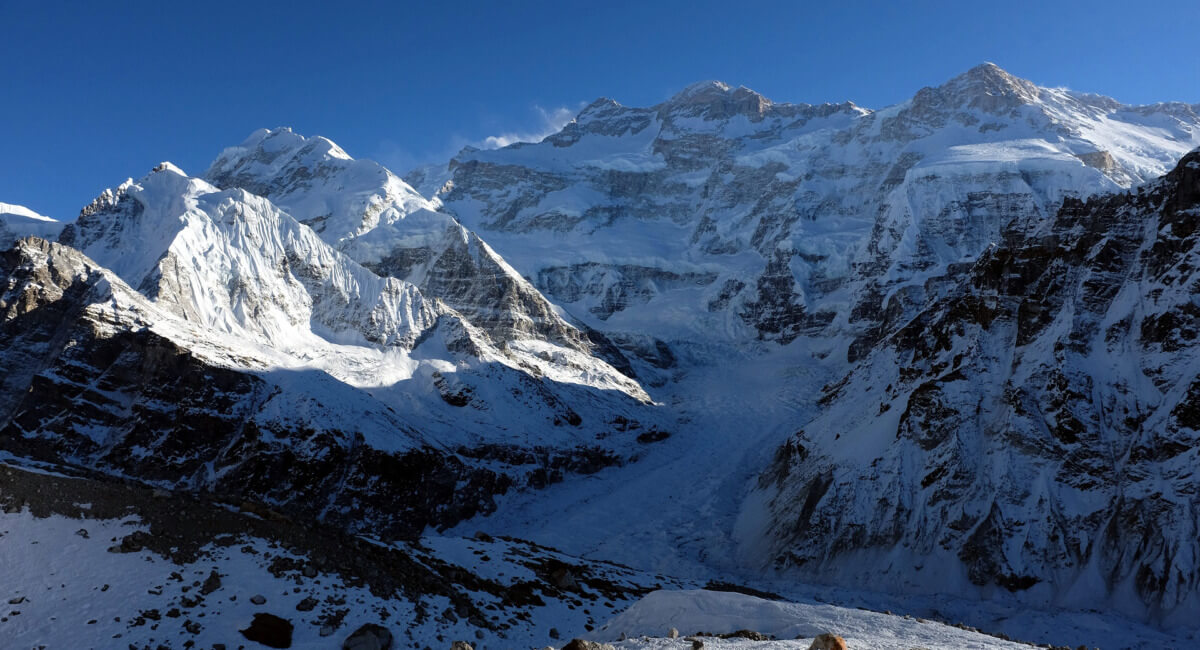
Above the tree line at Khambachen, the landscape transforms into a dramatic, U-shaped glacial canyon. Massive hanging glaciers cling to the sheer, vertical rock faces of Mount Jannu (7,710m) and Kanchenjunga. The terrain is a barren, wind-scoured alpine tundra of scree, boulders, and ancient moraines.
Wildlife of the KCA
The diverse microclimates provide sanctuary for highly endangered species. In the dense bamboo forests around Amjilosa and Gyabla, the Red Panda finds its perfect habitat. As you push into the alpine zones near Lhonak and Khambachen, you are in prime territory for Himalayan Black Bears, Blue Sheep (Bharal), and the apex predator of the Himalayas the elusive Snow Leopard.
The Brutal Reality: How Difficult is the Kanchenjunga Circuit?
The Kanchenjunga Circuit is universally graded as Strenuous / Extreme. It is physically and logistically more demanding than almost any other commercial teahouse trek in Nepal. You must be prepared for the reality of the trail.
The Physical Toll:
You are committing to 19 days of continuous, rigorous travel. The trails are notoriously rugged. You will navigate steep, muddy inclines in the jungle, cross active, landslide-prone scree slopes near Khambachen, and walk across shifting, unstable glacial moraines at Lhonak. There are no “easy” days on this circuit.
The Sele Le Traverse:
The crux of the trek is Day 14. To cross from the North side of the mountain to the South side, you must cross three high mountain passes in a single day Sinon La (4,440m), Mirgin La (4,480m), and Sinelapche Bhanjyang (4,646m). This is a grueling, 8-to-10-hour marathon at extreme altitude with zero bail-out options.
Infrastructure and Isolation:
The physical difficulty is severely compounded by the lack of comfort. You cannot recover in a warm bakery with high-speed Wi-Fi. The teahouses are basic wooden or stone shelters. You must have immense mental resilience to endure nearly three weeks of cold nights, highly repetitive food, and absolute off-the-grid isolation.
The Complete 19-Day Kanchenjunga Circuit Itinerary
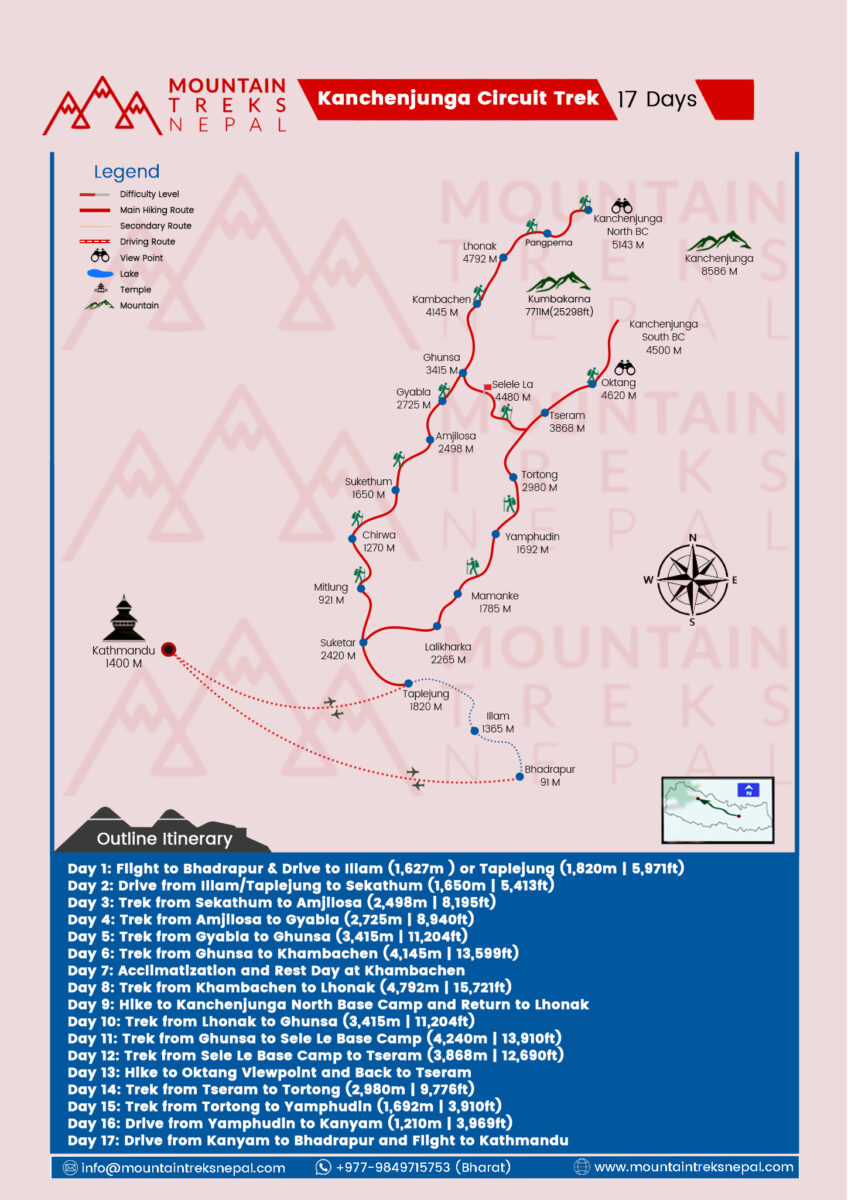
This is the definitive, day-by-day operational breakdown of the Mountain Treks Nepal 19-Day Kanchenjunga Circuit itinerary, engineered for maximum altitude safety, dual base-camp exploration, and cultural immersion.
Day 1: Arrival in Kathmandu (1,400m | 4,593ft)
Your monumental expedition begins as you land at Tribhuvan International Airport in Kathmandu. A representative from Mountain Treks Nepal will receive you and transfer you via private vehicle to your comfortable boutique hotel in Thamel. Take the afternoon to relax and shake off the jet lag. Thamel is a global hub for mountaineers, featuring countless cafes, gear shops, and historical sites. In the evening, enjoy a welcome dinner and rest.
Day 2: Trekking Preparation and Permit Processing (1,400m)
Before setting off to the wild east, administrative preparation is mandatory. At 9:00 AM, you will meet your expedition manager, who will collect your original passport to process the complex Kanchenjunga Restricted Area Permits (RAP) at the Department of Immigration.
In the afternoon, you will sit down with your lead trekking guide for a comprehensive gear check. Kanchenjunga requires robust equipment; if you are missing a genuine -20°C sleeping bag, high-altitude down jacket, or microspikes, your guide will assist you in renting or purchasing them in Thamel.
Day 3: Flight to Bhadrapur and Drive to Illam (1,627m) or Taplejung (1,820m)
The journey to the trailhead is an adventure in itself. After an early breakfast, you transfer to the domestic airport for a 45-minute flight to Bhadrapur, located in the hot, tropical plains of the Terai.
Upon landing, you board a private 4WD Jeep and begin the long, winding ascent into the hills. You drive through the manicured, rolling green hills of the famous Kanyam tea estates in the Illam district. Depending on road conditions, you will either stop for the night in the beautiful town of Illam (1,627m) or push further north to Taplejung (1,820m), the bustling district headquarters and the traditional gateway to the Kanchenjunga region.
Day 4: Drive to Sekathum (1,650m | 5,413ft)
Leaving Taplejung, your jeep navigates narrow, bumpy, and often muddy off-road tracks. You cross the massive Tamor River, passing through small, charming rural hamlets like Mitlung, Chirwa, and Thapethok.
At Thapethok, you officially enter the Kanchenjunga Conservation Area, and your permits are verified at the police checkpoint. The drive provides a spectacular sneak peek into the vibrant daily lives of the local Limbu people. The drive ends at the small riverside settlement of Sekathum, situated at the confluence of the Tamor and Ghunsa rivers.
Day 5: Trek to Amjilosa (2,498m | 8,195ft)
You finally lace up your boots. The trek starts with a demanding day, following the steep, narrow gorge of the Ghunsa Khola. The trail is heavily vegetated and frequently involves climbing steep stone staircases and navigating narrow cliffside paths.
You will cross the roaring Ghunsa Khola multiple times on swaying suspension bridges. After passing the small settlements of Jonggim and Ghaiyabari, a final steep, exhausting climb brings you to Amjilosa. This is a small, quiet Tibetan settlement that serves as an excellent geographical warm-up for the days ahead.
Day 6: Trek to Gyabla (2,725m | 8,940ft)
Leaving Amjilosa, the gorge opens up slightly. You walk through pristine, dense forests of bamboo, rhododendron, and oak. The sweet scent of the forest, the roar of the river below, and the sight of massive waterfalls cascading down the opposing cliffs make this a highly memorable day.
The trail features steady, rolling climbs broken up with flat, relaxing stretches. In the afternoon, you arrive at the peaceful village of Gyabla (also known as Kyapra). Surrounded by dramatic, forested mountains, Gyabla is a welcoming settlement where you can rest your legs and enjoy the isolation.
Day 7: Trek to Ghunsa (3,415m | 11,204ft)
Today, the landscape shifts from steep gorges to wider, open U-shaped alpine valleys. You traverse through rugged terrain and thick larch and pine woods to reach Phale, an ancient Tibetan refugee village famous for its notable wooden architecture and an active, centuries-old monastery.
Continuing from Phale, the valley widens further. You begin to see massive mani walls (stones carved with Buddhist prayers) and colorful prayer flags. You arrive in Ghunsa, the largest and most significant village in the region. Ghunsa is a thriving hub for Kanchenjunga expeditions, boasting strong Tibetan Buddhist vibes, wooden houses with satellite dishes, and a relatively comfortable array of teahouses.
Day 8: Trek to Khambachen (4,145m | 13,599ft)
Leaving Ghunsa, you push past the 4,000-meter mark into the true high alpine zone. The trail winds through beautiful pine and rhododendron forests, tracing the glacial river.
The trail requires extreme caution today. You must cross a massive, active landslide zone characterized by loose scree and falling rocks. Your guide will ensure you move swiftly and safely across this hazard. Once safely across, the reward is staggering: the sheer, terrifyingly steep, 7,710-meter north face of Mount Jannu (Kumbhakarna) dominates the skyline to your right. You arrive at Khambachen, a tiny, freezing settlement located in a wide, grassy meadow beneath the glaciers.
Day 9: Acclimatization and Rest Day in Khambachen (4,145m)
At over 4,100 meters, taking a rest day is a strict medical necessity to prevent Acute Mountain Sickness (AMS).
Following the “climb high, sleep low” rule, your guide will lead a morning hike up the ridge behind the village or toward the Jannu Glacier. This short hike triggers red blood cell production, helping your body adapt to the thin air. Spend the afternoon resting in the sun, rehydrating, and eating properly. The temperatures plummet as soon as the sun drops behind Mount Jannu.
Day 10: Trek to Lhonak (4,792m | 15,721ft)
After an early morning breakfast, you begin the push into the extreme high-altitude zone. The trail continues up the barren, wind-scoured valley along the edge of the massive Kanchenjunga Glacier.
You navigate steep, rocky slopes and cross lateral moraines. The landscape is entirely devoid of trees; it is a world of rock, ice, and sky. You are surrounded by a theater of awe-inspiring peaks, including Wedge Peak, Nepal Peak, and the Twins. You finally arrive at Lhonak (4,792m), a desolate campsite sitting on a sandy plain next to the glacier. The location is incredibly remote, and the nighttime temperatures are freezing.
Day 11: Hike to Kanchenjunga North Base Camp (Pang Pema) & Return to Lhonak
The First Climax. You wake up before dawn. The trek from Lhonak to Pang Pema (5,143m) the Kanchenjunga North Base Camp is highly challenging. The pathway follows the unstable, rocky crest of the glacial moraine. It requires careful footwork and immense physical effort in the oxygen-depleted air.
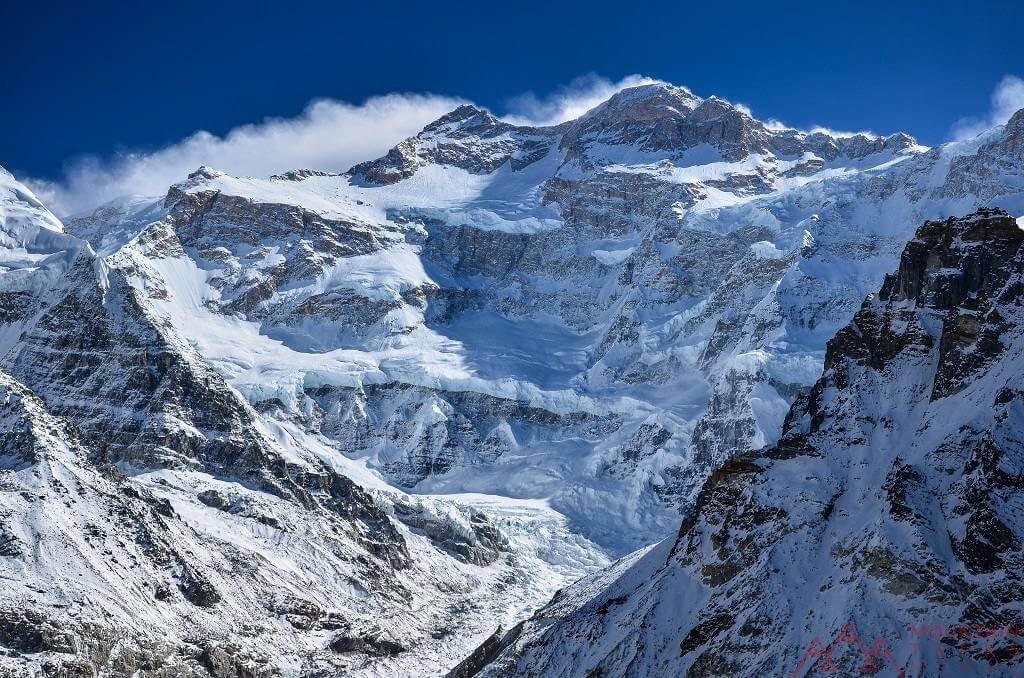
Upon reaching Pang Pema, the reward is absolute. You are presented with a staggering, unobstructed view of the immense north face of Mount Kanchenjunga (8,586m). The sheer scale of the icefalls and avalanches tumbling off the massif is humbling. After taking photos and absorbing the surreal environment, you retrace your steps back along the moraine to Lhonak for a well-deserved rest.
Day 12: Trek back to Ghunsa (3,415m | 11,204ft)
Today, you retrace your steps entirely, walking from Lhonak all the way back down the valley, past Khambachen, and crossing the landslide zone to return to the village of Ghunsa.
While you are walking a familiar trail, descending provides a completely unique perspective of the landscape. More importantly, dropping over 1,300 vertical meters allows your body to recover. The air grows thicker and richer, and the return to the lush green forests of Ghunsa feels like a return to paradise.
Day 13: Trek to Sele Le Base Camp (4,240m | 13,910ft)
You leave the main Ghunsa valley and begin the arduous traverse that links the North and South base camps. The trail climbs steeply through dense, silent forests of rhododendron and juniper.
This remote, steep ridgeline is one of the most isolated sections of the trek, offering excellent chances to spot wildlife. There are no permanent settlements here. You arrive at Sele Le Base Camp, a tiny, primitive clearing with a single, basic stone teahouse. It serves as a staging point for tomorrow’s massive pass crossing. Rest early; tomorrow is the hardest day of the expedition.
Day 14: Trek to Tseram (3,868m) via the Three Passes
The Crux of the Expedition. Today is a grueling, magnificent test of endurance. You must cross three high-altitude passes in a single day: Sinon La (4,440m), Mirgin La (4,480m), and Sinelapche Bhanjyang (4,646m).
You start before dawn. The climbs are steep, and the air is thin. However, from the crests of these passes, you are rewarded with some of the most grandiose, sweeping panoramic views on earth. On a clear day, you can see the distant peaks of Mount Everest (8,848m), Makalu (8,485m), and the colossal Kanchenjunga massif dominating the eastern horizon.
After clearing the final pass, you face a brutally steep descent into the Simbuwa Khola valley, eventually arriving at the peaceful forest clearing of Tseram (3,868m). You will be completely exhausted, but you have successfully crossed the divide.
Day 15: Trek to Oktang Viewpoint (South Base Camp) and Back to Tseram
The Second Climax. Today, you hike up the Simbuwa Khola valley alongside the immense Yalung Glacier. The trail passes the small settlement of Ramche and continues up the rocky moraine.
Your destination is the Oktang Viewpoint (4,730m), which serves as the Kanchenjunga South Base Camp. From Oktang, the view is a sheer, vertical wall of ice and rock. You look directly at the spectacular southern faces of Kanchenjunga, Kabru, and Rathong. After exploring this snowy amphitheater, you descend back to Tseram for a final night in the high alpine zone.
Day 16: Trek to Tortong (2,980m | 9,776ft)
The journey back to civilization begins. The descent from Tseram to Tortong is breathtaking as you plunge back into the tree line, following the Simbuwa Khola river downstream.
The trail winds through towering, lush rhododendron forests. The greenery and the thick, oxygen-rich air are incredibly rejuvenating. You arrive at the small, forested settlement of Tortong, enjoying a warm dinner and a restful night in a lower-altitude teahouse.
Day 17: Trek to Yamphudin (1,692m | 3,910ft)
Today is a long, demanding day of descent, characterized by steep drops and a few unexpected climbs. Leaving Tortong, you pass through the silent river valley of the Amji Khola.
You must cross the landslide-prone passes of Lasiya Bhanjyang and Lamite Bhanjyang. The vegetation shifts dramatically back to subtropical jungle, and the mountain air turns warm and humid. You finally arrive at Yamphudin, a vibrant, mixed community of Sherpas, Limbus, and Rais. Yamphudin is a major KCA checkpoint and feels like a bustling metropolis compared to the isolation of the last two weeks.
Day 18: Drive to Kanyam (1,210m | 3,969ft)
The trekking is officially over. From Yamphudin, you board a 4WD jeep and begin the long, bumpy drive back to the lowlands, transitioning from rugged mountain trails to paved roads.
You drive south into the Illam district, arriving at Kanyam. Known for its vast, manicured tea estates rolling over the hillsides, Kanyam is a peaceful, ambient paradise. It is a stunning visual contrast to the harsh ice of Kanchenjunga. Enjoy a relaxed evening walking through the tea gardens.
Day 19: Return to Kathmandu
Your last day begins with a warm breakfast overlooking the tea gardens. You take a final 2-to-3-hour drive down to the hot, tropical plains of Bhadrapur airport.
You board your domestic flight back to Kathmandu, watching the mighty Himalayas fade into the distance. Upon arriving in the capital, you are escorted to your hotel. You have the afternoon free for souvenir shopping in Thamel. In the evening, the Mountain Treks Nepal team will host a grand farewell dinner at a traditional Nepali restaurant to celebrate your successful completion of one of the hardest treks on earth.
Surviving the Altitude: Medical Safety at 5,143m
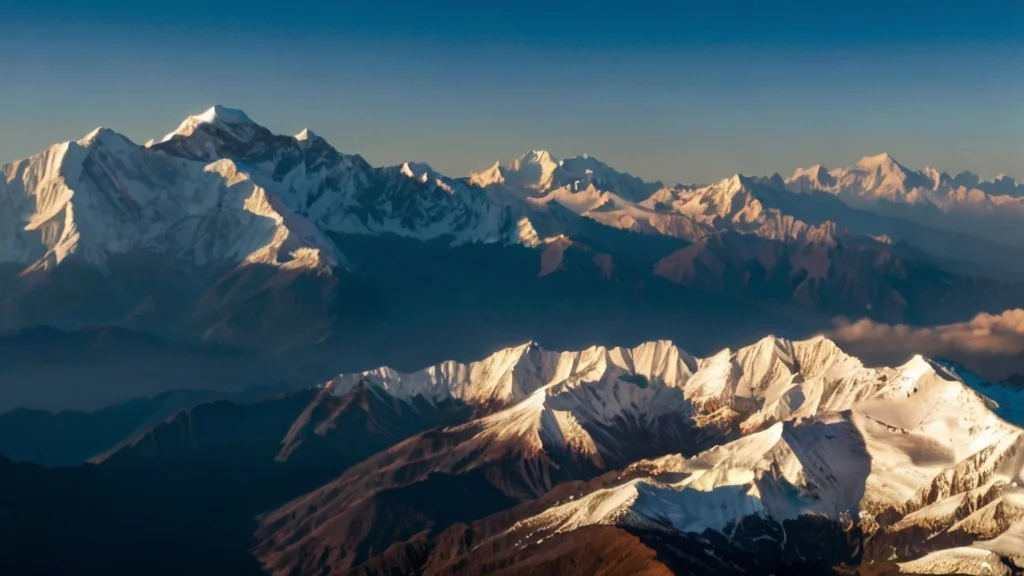
The Kanchenjunga Circuit pushes you to extreme altitudes twice once at Pang Pema (5,143m) and again during the Sele Le passes (4,646m). Acute Mountain Sickness (AMS) is a primary risk that must be actively managed.
At 5,000 meters, the barometric pressure is roughly half of what it is at sea level. Your body must work incredibly hard to oxygenate your blood. If you ascend faster than your body can adapt, AMS sets in. Symptoms include severe headaches, nausea, loss of appetite, and extreme fatigue. If ignored, AMS can progress into fatal High Altitude Cerebral Edema (HACE) or High Altitude Pulmonary Edema (HAPE).
Mountain Treks Nepal Safety Protocols
Our 19-day itinerary is medically optimized to ensure your survival and success.
-
Oximeter Monitoring: Our licensed wilderness guides use digital pulse oximeters twice daily to monitor your blood oxygen saturation ($SpO_2$) and resting heart rate.
-
Mandatory Acclimatization: The scheduled rest day at Khambachen (4,145m) is non-negotiable. It allows your body to build the necessary red blood cells before pushing to Lhonak and Pang Pema.
-
Hydration & Pacing: You must drink 4 to 5 liters of purified water daily. On the Sele Le traverse, maintaining a slow, rhythmic pace is critical to preserving your glycogen stores.
-
Helicopter Evacuation: Because Kanchenjunga is so remote, a helicopter rescue from Lhonak or Tseram to Kathmandu can take hours to coordinate and is entirely weather-dependent. Comprehensive travel insurance covering high-altitude evacuation up to 5,500m is absolutely mandatory.
Teahouse Culture: Surviving Off the Grid
If you expect the bakeries, high-speed Wi-Fi, and en-suite bathrooms of the Everest or Annapurna circuits, Kanchenjunga will be a severe shock.
Accommodation
Teahouses in the KCA are highly basic. In places like Lhonak, Khambachen, and Sele Le, you will sleep in simple wooden or stone huts. Rooms have basic wooden beds with thin foam mattresses. There is zero insulation, meaning the temperature inside your room will drop below freezing at night. You must bring a high-quality, genuine four-season sleeping bag. The only heated space is the communal dining room, warmed by a central wood or yak-dung stove.
Food and Nutrition
Because transport relies entirely on porters and yaks, the food menu is strictly limited to what can be grown locally or stored long-term. You will eat a lot of Dal Bhat (rice, lentil soup, and vegetable curry), potatoes, tsampa (roasted barley flour), instant noodles, and eggs. We highly recommend bringing a personal stash of protein bars, chocolate, and trail mix to supplement your caloric intake and break the monotony.
Electricity and Connectivity
There is virtually no cellular service above Ghunsa. You are completely off the grid. Electricity is provided by small solar panels, which are often unreliable in cloudy weather. Bring a high-capacity (20,000mAh+) power bank to charge your camera and phone, and sleep with it inside your sleeping bag to protect the lithium-ion battery from the cold.
Essential Packing List for Kanchenjunga
Packing for 19 days in extreme isolation requires precision. You are strictly limited to a 15 kg (33 lbs) porter weight limit.
The Layering System
Avoid cotton entirely; it absorbs sweat, freezes, and causes hypothermia.
-
Base Layers: 3 moisture-wicking synthetic shirts for the jungle, and 2 sets of heavy Merino wool thermals (top and bottom) for the high alpine camps.
-
Mid-Layers: A lightweight grid fleece and a heavier synthetic insulated jacket.
-
Outer Shell: A heavy-duty Gore-Tex windproof and waterproof jacket and pants. Windchill is your biggest enemy on the Sele Le pass.
Extreme Insulation and Sleep Systems
-
Heavy Down Jacket: An expedition-grade down parka (700-800+ fill power) is mandatory for Lhonak, Pang Pema, and the Sele Le traverse.
-
Sleeping Bag: A genuine four-season down sleeping bag rated to -20°C (-4°F) is non-negotiable. (Mountain Treks Nepal provides high-quality loaner sleeping bags and down jackets).
Footwear and Hardware
-
Footwear: Sturdy, waterproof trekking boots with excellent ankle support that are fully broken in.
-
Traction / Microspikes: Highly recommended. The Sele Le passes frequently hold hard-packed snow and ice. Slip-on microspikes will prevent dangerous falls on the steep descents.
-
Trekking Poles: Absolutely essential for navigating the scree slopes and steep descents.
-
Water Purification: Plastic bottles are banned. Bring two 1-liter Nalgene bottles and a reliable purification method (Chlorine Dioxide tablets or a SteriPen).
-
First Aid: Bring a robust personal blister kit (Compeed), Ibuprofen, broad-spectrum antibiotics, and Diamox (Acetazolamide) for altitude.
Mandatory Permits and Logistics (The 2-Person Rule)
The Kanchenjunga region is a Restricted Area, governed by strict Department of Immigration laws to protect the border with Sikkim/Tibet and preserve the local ecology.
The 2-Person Minimum Rule
Independent, solo trekking is highly illegal. The government mandates that a Kanchenjunga Restricted Area Permit (RAP) will only be issued to a minimum of two foreign trekkers applying together. Furthermore, they must be accompanied by a government-licensed guide registered to an authorized trekking agency. If you are a solo traveler, Mountain Treks Nepal can successfully pair you with another group departing on the same date, or arrange a legal “ghost permit” to satisfy the requirement.
Required Permits (Arranged by Mountain Treks Nepal)
-
Kanchenjunga Restricted Area Permit (RAP): Required for the specific border-zone village districts (Olangchung Gola, Lelep, Papung, Yamphudin). The cost is generally $20 USD per person, per week.
-
Kanchenjunga Conservation Area (KCA) Permit: NPR 3,000 (~$23 USD) per person, funding local conservation efforts.
Best Time to Trek the Kanchenjunga Circuit
-
Spring (Late March to May) — The Rhododendron Bloom: The most popular time for this specific trek. The lower valleys and cloud forests erupt into a spectacular bloom of rhododendrons and magnolias. The temperatures are warmer, making the high camps more bearable. However, afternoon clouds can obscure the peaks.
-
Autumn (Late September to November) — The Clear Skies: The gold standard for mountain visibility. The post-monsoon skies are razor-sharp and deeply blue, offering pristine views of Kanchenjunga and Jannu. The trade-off is extreme cold; by November, temperatures at Lhonak and Sele Le regularly drop below -20°C at night.
-
Winter & Monsoon (Avoid): We do not operate this trek in Winter (Dec-Feb) due to massive snowfall that completely blocks the Sele Le passes, severing the circuit entirely. The Monsoon season (June-Aug) brings severe landslide danger, impassable rivers, and relentless leeches in the lower jungles.
Physical Preparation: Training for the Wild East
You cannot walk off the couch and conquer Kanchenjunga. You will be walking for 5 to 8 hours a day for 19 days straight, covering incredibly steep, rocky terrain with a daypack. You must begin training at least 12 weeks before departure.
-
Cardiovascular Endurance: Build a massive aerobic base. Run, cycle, or swim 3 to 4 times a week for 45-60 minutes in Zone 2 to train your body to process limited oxygen efficiently.
-
Stair Climbing and Rucking: The trails in eastern Nepal are relentless. Load a backpack with 7-10 kg (15-20 lbs) and climb the tallest stadium stairs or local hill for 1-2 hours twice a week. This builds the exact muscular endurance in your calves and quads needed for the steep ascents to Amjilosa and the Sele Le passes.
-
Mental Resilience: The trek is a mental marathon. Prepare yourself for the discomfort of cold nights, basic food, and sheer physical exhaustion.
Frequently Asked Questions (FAQs)
How difficult is the Kanchenjunga Circuit compared to Everest Base Camp?
The Kanchenjunga Circuit is significantly harder than EBC. While the maximum altitude is similar, Kanchenjunga requires 19 days of continuous trekking (compared to 12-14 for EBC), features far rougher trails with active landslide zones, requires crossing three high passes in a single day, and offers zero luxury teahouse infrastructure to aid in recovery.
Do I need to carry a tent and my own food?
No, the Kanchenjunga Circuit has recently transitioned from a full-camping expedition to a “teahouse trek.” However, the teahouses are highly basic stone and wooden huts. You will sleep in a bed and eat local meals (Dal Bhat) provided by the host families, but you must bring your own heavy-duty sleeping bag and supplemental snacks.
What is the chance of seeing a snow leopard?
While the KCA is one of the premier habitats for the endangered snow leopard (especially around Khambachen and Lhonak), sightings are incredibly rare due to the animal’s stealth, camouflage, and massive territory. However, you have an excellent chance of spotting blue sheep (Bharal), Himalayan tahr, and red pandas in the lower bamboo forests.
Are there any emergency medical facilities on the trail?
No. There are no hospitals, pharmacies, or HRA (Himalayan Rescue Association) clinics anywhere on the Kanchenjunga Circuit. You must carry a comprehensive personal first-aid kit, and your guide will carry a satellite phone to coordinate a helicopter evacuation to Kathmandu in the event of a severe emergency.
The Kanchenjunga Circuit is the ultimate badge of honor for Himalayan trekkers. Reaching the North and South Base Camps of the world’s third-highest mountain demands true grit, endurance, and an expert support team you can trust with your life. Don’t leave your logistics in the remote east to chance. Contact the expedition planners at Mountain Treks Nepal today to navigate the restricted area rules, customize your itinerary, and start preparing for the rawest, most breathtaking adventure of your lifetime.