



Api Himal Base Camp Trek - 13 Days

-
Duration:
13 days -
Max Altitude:
4,200mm -
Difficulty Level:
Strenuous / Challenging -
Group Size:
1-15 -
Destination:
Api Himal Base camp -
Start/End:
Kathmandu -
Accommodation:
Hotel / Tea house -
Transportation:
Flight/ Vehicle -
Best Season:
March to May and September to November
Trip Overview
The Api Himal Base Camp Trek is a premier, off-the-beaten-path expedition into the wild, untouched landscapes of Far-Western Nepal. This custom 13-day itinerary is meticulously crafted by Mountain Treks Nepal to provide an authentic wilderness experience beneath Mount Api (7,132m), the highest peak in the Yasa Himalayan range. By skipping weeks of slow overland transit through a strategic combination of domestic flights to Dhangadhi and private 4WD jeeps, this layout maximizes your time on pristine trails.
The route travels deep into the Api Nampa Conservation Area, an area celebrated for its vast biological diversity, pristine alpine lakes, and dramatic river canyons. Trekkers traverse dense sub-tropical forests, passing remote villages inhabited by the historically unique Sauka and Mahara communities before breaking onto the high alpine pastures surrounding Kalidhunga Taal at 4,200 meters. The Api Himal Base Camp Trek 13 Days avoids the heavy crowds of commercial regions, delivering an extraordinary journey of raw exploration and deep wilderness solitude managed completely by Mountain Treks Nepal.
Preparation for the Api Himal Base Camp Trek
Due to the isolated nature and steep terrain of Far-West Nepal, excellent physical preparation is mandatory. The trails feature long, sustained elevation gains on steep mountain switchbacks that require solid physical conditioning. Focus on intensive cardiovascular workouts, strength training, and endurance building (such as weighted hill climbing or trail running) for at least 6 to 8 weeks before departure. Breaking in your trekking boots thoroughly and building lower-body endurance are essential for managing the remote trails comfortably.
Required Permits
The Api Nampa Conservation Area is a strictly protected and ecologically sensitive zone bordering India and Tibet. To enter this remote wilderness safely and legally, Mountain Treks Nepal secures two essential government documents for you:
-
Api Nampa Conservation Area Permit (ANCAP): This mandatory entry permit funds local environmental protection and community development, costing NPR 3,000 for international trekkers and NPR 1,000 for SAARC citizens.
-
Trekkers’ Information Management Systems (TIMS) Card: The standard safety registration card required across Nepal, costing NPR 3,000 per trekker.
Our administrative team collects your information and manages the entire permit registration process seamlessly before you arrive, ensuring quick clearance at all security checkpoints.
Guides & Porters
Trekking through an isolated wilderness requires a highly trained field team. Mountain Treks Nepal provides certified, government-licensed English-speaking guides who possess comprehensive wilderness first-aid training, emergency communication protocols, and extensive knowledge of Far-Western geography and cultural traditions.
Our professional local porters handle the heavy lifting, carrying up to 20–25 kg of shared duffel luggage between two trekkers. Walking unburdened with just a light daypack allows you to easily negotiate narrow river crossings and steep ridge sections safely.
Api Himal Base Camp Trek Elevation and Altitude
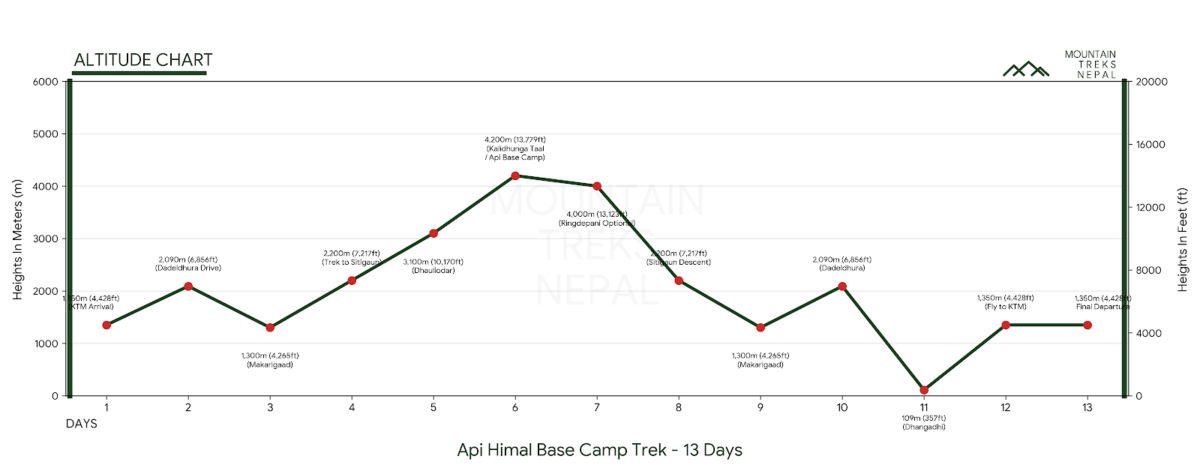
The Api Himal Base Camp Trek features a dramatic altitude profile, climbing rapidly from the low-lying Terai plains into the high-altitude glacial valleys of the Far-West:
-
Dhangadhi (Terai Plains Hub): 109 meters
-
Kathmandu (Capital Hub): 1,350 meters
-
Makarigaad (Trailhead): 1,300 meters
-
Dadeldhura (Hill Station): 2,090 meters
-
Sitigaun (Day 4 Stop): 2,200 meters
-
Dhauliodar (High Base Camp Hub): 3,100 meters
-
Api Himal Base Camp (Glacial Valley): 3,850 meters
-
Ringdepani Taal (Optional Lake Hike): ~4,000 meters
-
Kalidhunga Taal (Max Altitude Point): 4,200 meters
Altitude Sickness on the Api Himal Base Camp Trek: What You Need to Know
As you climb beyond the 3,000-meter mark on Day 5 and reach the high-altitude waters of Kalidhunga Taal at 4,200 meters, atmospheric pressure drops significantly. Because the Far-West is isolated and lacks commercial infrastructure, understanding Acute Mountain Sickness (AMS) is crucial for your safety.
Symptoms of Altitude Sickness
-
Mild Symptoms: A persistent throbbing headache, slight dizziness, physical fatigue, loss of appetite, or mild trouble sleeping at Dhauliodar.
-
Severe Symptoms: Unstable physical balance (ataxia), persistent vomiting, confusion, or severe shortness of breath while completely at rest.
Prevention Tips
-
Hydrate Intensely: Consume 4 liters of clean water daily to assist your cardiovascular system at high elevations.
-
Walk with a Rhythmic Pace: Climb the steep trails slowly and evenly without rushing (“pole, pole”).
-
Eat High-Carb Meals: Fuel your body with hot, freshly prepared carbohydrate-heavy meals at camp.
-
Avoid All Depressants: Do not consume alcohol, cigarettes, or sleeping pills, as they naturally suppress breathing rates.
Medication & Remedies
Acetazolamide (Diamox) can be utilized as a preventive measure after consulting with your doctor. Warm garlic soups and hot ginger teas are excellent local remedies used by our crew to promote natural acclimatization.
If Symptoms Get Worse
The primary safety rule of the mountains is absolute: never ascend with symptoms of AMS. If mild symptoms worsen or fail to clear with rest, immediate descent to Sitigaun or Makarigaad is mandatory. Mountain Treks Nepal guides carry emergency oxygen and maintain constant communication links for fast jeep evacuations if required.
Trip Grade: Fitness, Health, and Medical Requirements
This package is graded as Strenuous and Challenging. The trails are often narrow, rugged, and less developed compared to commercial routes, requiring real physical grit and mental determination.
Medical Considerations
Trekkers must possess excellent cardiovascular health, high lung capacity, and strong joints to handle consecutive days of heavy ascents and long descents. If you have a history of respiratory illness, asthma, severe knee issues, or heart conditions, obtaining a detailed medical clearance from your physician prior to booking is required.
Best Time To Go
Choosing the ideal trekking window ensures clear mountain backdrops and stable trail conditions in Far-West Nepal:
-
Autumn (September to November): The absolute best season for crisp air and pristine visibility. The post-monsoon skies are remarkably clear, providing postcard-perfect views of Mount Api and stable trail conditions.
-
Spring (March to May): A stunning window where the high alpine pastures are lush, and the rhododendron and oak forests bloom with vibrant colors. Wildflowers carpet the high valleys, though afternoon clouds are more common.
Is the Api Himal Base Camp Trek Suitable for Beginners?
No, the Api Himal Base Camp Trek is generally not recommended for absolute beginners. Due to the rugged, less-developed nature of the trails, primitive local homestays or camping setups, and the fast vertical ascent profile, this expedition is best suited for trekkers who already have experience with multi-day alpine hikes and feel comfortable in remote wilderness settings.
Essential Tips for Beginners on the Api Himal Base Camp Trek
-
Always use a pair of high-quality, adjustable trekking poles to protect your joints during steep river valley descents.
-
Pack versatile, premium layering systems to quickly adapt to wide temperature shifts.
-
Stay tightly aligned with your Mountain Treks Nepal guide; do not wander off on unmarked sidetracks.
Is Api Himal Dangerous? Understanding the Death Rate
The Api Himal Base Camp Trek is safe when managed properly, with a statistical mortality rate well under 0.5%. There are no technical mountaineering hazards or crevasses on the trekking path. The small number of incidents in this remote region are almost exclusively linked to solo trekkers getting lost on unmarked paths or unmanaged altitude sickness. Trekking with a professional crew like Mountain Treks Nepal eliminates these navigation and medical risks completely.
Travel Insurance for Api Himal Base Camp Trek
Having a comprehensive travel insurance policy is a mandatory requirement to join our team on this expedition. Your policy must be explicitly vetted to cover high-altitude trekking up to 4,500 meters above sea level. It must include full coverage for medical treatments, trip interruptions, and—crucially—remote emergency helicopter rescue and evacuation. You must provide a copy of your policy parameters to your guide during your briefing in Kathmandu.
What Is a Day on the Api Himal Base Camp Trek Actually Like?
Your morning starts around 6:00 AM with a hot drink and views of the mist rising off the rivers. After a hearty breakfast, the crew secures the gear, and walking begins by 7:30 AM. You will trek along pristine glacial rivers and through ancient forests, stopping for a freshly prepared hot lunch along the trail around mid-day.
Afternoon walks bring you to your next camp or local homestay by 3:00 PM. This leaves your afternoon free to interact with local families, explore hidden waterfalls, or rest in the dining tent before a delicious, freshly cooked dinner is served around 6:30 PM.
After the Api Himal Base Camp Trek: How to Unwind and Recharge
After flying back to Kathmandu on Day 12, take the time to pamper your body after your wilderness expedition. Book a deep-tissue massage at a professional spa in Thamel to soothe your leg muscles, enjoy a long hot shower, and join the Mountain Treks Nepal team for a celebratory farewell dinner featuring traditional music and authentic Nepalese cuisine.
Where Can I Meet Mountain Treks Nepal?
Our main operational and administrative headquarters is located in Kathmandu, where we hold comprehensive pre-trip briefings, check your gear, and issue your conservation permits. For trekkers arriving via domestic links, our coordination team meets you directly at the Dhangadhi airport terminal to handle your private 4WD jeep transitions seamlessly.
Booking and Payment with Mountain Treks Nepal
Securing your dates on this wilderness package requires an advance booking deposit submitted via our secure online payment portal or bank wire transfer. This deposit allows us to finalize domestic flights and secure private 4WD jeeps in advance. The remaining balance can be paid safely upon arrival in Kathmandu using cash or major credit cards.
Electricity on the Api Himal Base Camp Trek
Electricity is highly limited past the trailhead at Makarigaad. Lower villages rely on small community solar panels or micro-hydro networks, while high base camps have no electricity grid access. Carrying a high-capacity, heavy-duty power bank (20,000mAh to 30,000mAh) or portable solar charging cards is highly recommended to keep your cameras and phones powered.
Drinking Water during Api Himal Base Camp Trek
Proper hydration is critical at high altitudes. Our kitchen crew provides safe, boiled hot water at every camp. To protect the pristine, sensitive wilderness of the Api Nampa Conservation Area, Mountain Treks Nepal strictly discourages the use of single-use plastic bottles. We recommend bringing durable, reusable bottles (such as Nalgene) paired with purification tablets or reliable UV filters.
Communication and Internet Services
Mobile network coverage via Ncell and Nepal Telecom works well in large hubs like Dhangadhi and Dadeldhura, but becomes highly unstable or completely unavailable once you pass Makarigaad. There are no Wi-Fi networks in the high alpine valleys surrounding Base Camp. Our guides carry satellite communication devices to maintain safety and contact for emergencies.
Currency Exchange
The local currency required throughout this journey is the Nepalese Rupee (NPR). Ensure you exchange sufficient foreign currency into cash banknotes while you are in Kathmandu or Dhangadhi. ATMs are non-existent once you leave the highway at Gokuleshwor, and local homestays are unable to process credit cards or electronic payments.
Food on the Api Himal Base Camp Trek
Meals are freshly prepared by our expedition cook crew using local, organic mountain ingredients. You will enjoy the energy-packed classic traditional Dal Bhat (rice, lentil soup, and vegetable curry with free refills), alongside a variety of western and local options like pasta, noodles, garlic soups, porridge, fresh eggs, and pancakes to keep your energy high.
Culture and Festivals of the Far-West Region
The Far-West region preserves an incredibly authentic and unique cultural landscape. The valley is home to the Sauka ethnic group, who maintain deep ancestral traditions linked to trans-Himalayan trade. If your trek lines up with autumn celebrations, you might witness unique local festivals like Gaura Parva, featuring traditional Deuda dances and unique local music.
Local Dress and Cultural Etiquette on the Api Himal Base Camp Trek
-
Dress Modestly: Keep shoulders and knees covered when walking through traditional villages out of respect for local community norms.
-
Respect Local Customs: Always ask for permission before taking close-up portraits of residents or sacred spaces.
-
Remove Your Shoes: Always leave your footwear at the entrance before entering any local home, temple, or shrine.
-
Be Mindful of Traditions: Show respect for local shrines and ancient stone chortens by passing them on the left side in a clockwise direction.
How Much Cash Should You Carry on the Api Himal Base Camp Trek?
Even though your core package covers your accommodation and main meals, you should plan to carry about NPR 3,000 to NPR 4,000 (approximately USD 25 to USD 35) per day in small cash notes. This personal budget easily covers small out-of-pocket comforts like occasional local treats, laundry, minor personal purchases, and tips for your guide and porter team.
Alternative Treks Around the Region
If your travel plans adjust or you want to consider different wilderness environments, Mountain Treks Nepal offers excellent alternatives:
-
Short Upper Mustang Trek: A 10-day high-altitude desert trek exploring the ancient walled kingdom of Lo Manthang.
-
Short Mardi Himal Trek: A fast-paced, 4-day ridge hike in the Annapurna region offering close-up views of Mount Machhapuchhre.
-
Saipal Himal Base Camp Trek: Another premier, off-the-beaten-path expedition exploring the majestic neighboring peaks of Far-West Nepal.
Conclusion
The Api Himal Base Camp Trek 13 Days stands out as the ultimate wilderness adventure for seasoned trekkers looking to escape mass tourism and experience the raw beauty of the Himalayas. From the pristine waters of Kalidhunga Taal to the dramatic alpine views at Base Camp, every step offers a true encounter with nature. Guided safely by Mountain Treks Nepal, this expedition delivers a perfectly organized, unforgettable journey into the wild frontier of the Far-West.
Trip Highlights
-
Api Himal Base Camp: Standing at 3,850 meters in a spectacular, untouched glacial valley directly below Mount Api (7,132m).
-
Kalidhunga Taal: Climbing to a pristine, high-altitude alpine lake at 4,200 meters that mirrors the surrounding snow-capped peaks.
-
Api Nampa Conservation Area: Exploring an isolated, biologically rich wilderness filled with rare flora, deep canyons, and hidden waterfalls.
-
Sauka Cultural Immersion: Experiencing the authentic lifestyle, unique dialects, and genuine hospitality of remote Far-Western ethnic communities.
-
Hassle-Free Transit Loops: Enjoying an efficient, well-organized itinerary that utilizes domestic flights and private 4WD jeeps to maximize trail time.
Have a Question? Inquire Now
Why Mountain Treks Nepal?
- Expert Team for Unparalleled Experience
- Best Price Guarantee
- Safety is the first Priority
- Easy Booking & Secure Online Payment
- Flexible And Personalized Service
- 24/7 Support
- Highest Satisfaction Guaranteed
- Highly Experienced Guides
- Your Satisfaction is Our Guarantee
- One-time Deposit, Assured for a Life Time
Detailed Itinerary
Arrive at Tribhuvan International Airport in Kathmandu. A representative from Mountain Treks Nepal welcomes you at the terminal and provides a private transfer to your hotel. Spend your evening resting or exploring Thamel before your pre-trip safety briefing.
Take a scenic morning flight from Kathmandu down to the Terai plains at Dhangadhi. Upon landing, board a private 4WD jeep for a scenic drive winding up through the green sub-tropical hills to the beautiful hill station of Dadeldhura for an overnight stay.
A full-day scenic drive through the rugged mountains of Far-West Nepal. The route follows the Mahakali highway past Gokuleshwor, descending into the Chameliya River valley to reach the mountain trailhead at Makarigaad village.
The foot journey begins today. The trail climbs steadily along the banks of the Chameliya River, passing through dense subtropical forests and past remote farmlands. Tackle a sustained incline to reach the beautiful, traditional settlement of Sitigaun.
Climb out of Sitigaun as the vegetation transitions from thick sub-tropical forests to temperate oak and rhododendron woods. The trail ascends progressively along a dramatic river canyon, bringing you to the high alpine clearing of Dhauliodar.
The big exploration day. Wake up early to hike up the glacial valley to Api Himal Base Camp (3,850m) to witness the sunrise over Mount Api. Continue climbing along the moraine to the high alpine waters of Kalidhunga Taal (4,200m) before retracing your steps back to Dhauliodar.
A flexible day designed for deeper wilderness exploration or rest. Motivated trekkers can embark on a scenic day hike to the beautiful, hidden alpine waters of Ringdepani Taal, enjoying alternative panoramic views of the Yasa Himalayan range.
Leave the high alpine pastures behind and begin your steady descent. The trail winds back down through the deep canyon forests, offering a relaxed pace to appreciate the massive valley views before arriving back at the homestays of Sitigaun.
The final day of walking. Follow the path down through the rural farming settlements and sub-tropical greenery, descending smoothly back to the riverbanks at the Makarigaad trailhead to celebrate the successful end of your foot journey.
Board your private 4WD support jeep at Makarigaad for a full-day journey back up the mountain highway. The drive winds back through the remote villages of the Far-West, returning to the comfortable hill station of Dadeldhura.
A smooth morning drive descending out of the hills back down to the low-lying Terai plains. Arrive in the bustling hub of Dhangadhi by mid-day, leaving your afternoon free to relax at your hotel or explore the local city markets.
Transfer to the Dhangadhi airport terminal for your domestic flight back to Kathmandu. Upon landing, our team provides a private transfer to your hotel, leaving your afternoon free for souvenir shopping or relaxing before a farewell dinner.
Enjoy breakfast at your hotel. A representative from Mountain Treks Nepal provides a private vehicle transfer from your hotel to Tribhuvan International Airport for your onward flight home.
Trip Includes
-
All mandatory protected area permits, including the Api Nampa Conservation Area Permit (ANCAP) and TIMS safety card.
-
Round-trip domestic flight tickets between Kathmandu and Dhangadhi, including all airport transfers.
-
Private 4WD jeep transport for all overland driving segments as per the itinerary.
-
Standard local homestay and wilderness camping accommodation during the trekking days.
-
Three freshly prepared meals per day (Breakfast, Lunch, and Dinner) while on the walking route.
-
Professional, government-licensed English-speaking trekking guide.
-
Experienced local porters to handle and carry your main duffel luggage (1 porter for 2 trekkers, weight limit 20-25 kg).
-
Full arrangement of local government taxes and tourism service fees.
Trip Excludes
-
Hotel accommodation and meals in Kathmandu or Dhangadhi before or after the 13-day itinerary.
-
Personal travel insurance policies (compulsory; must explicitly cover helicopter rescue up to 4,500m).
-
Table beverages (bottled mineral water, boiled hot water, specialty teas, coffees, alcohol) and personal snacks.
-
Personal trekking gear and clothing (such as down jackets, hiking poles, and sleeping bags).
-
Out-of-pocket services like hot showers, device charging, and Wi-Fi access fees where available.
-
International airfare and Nepal entry visa fees.
-
Gratuities and tips for your guide and porter team.
Packing List For Api Himal Base Camp Trek

Clothing & Layers
-
Base Layer: Moisture-wicking thermal tops and bottoms (3 pairs).
-
Mid-Layer: Thick fleece jacket or insulated pullover.
-
Outer Layer: Windproof and waterproof jacket and pants.
-
Warm Insulation: Premium down jacket for freezing temperatures at high camps.
-
Head & Hands: Warm beanie, sun protection hat, and a pair of insulated gloves.
Footwear
-
Sturdy, ankle-supportive waterproof hiking boots (properly broken-in).
-
Thick, moisture-wicking wool trekking socks (4 pairs).
-
Lightweight camp shoes or sandals for relaxing in the evenings.
Gear & Equipment
-
Main Pack: Durable duffel bag (carried by your porter) with waterproof liners.
-
Daypack: 25L to 35L daypack with comfortable hip straps.
-
Sleeping Gear: Cold-weather sleeping bag rated down to at least -15°C.
-
Trekking Poles: Adjustable trekking poles to help with steep river valley trails.
-
Lighting: Bright headlamp with extra batteries for early morning lake climbs.
Personal Items & Health
-
UV-blocking sunglasses and high-SPF sunscreen and lip balm.
-
Two durable 1-liter water bottles or a convenient hydration bladder.
-
Water purification tablets or a portable filtration system.
-
Personal first-aid kit containing blister pads, rehydration salts, and altitude medication (Diamox).
-
High-energy snacks like chocolate, nuts, and electrolyte mix.
Frequently Asked Questions
Api Himal (7,132m) is situated in the remote Darchula District in the far-western corner of Nepal, bordering India and Tibet. Unlike heavily commercialized trails in the Everest or Annapurna regions, the Api Himal Base Camp Trek remains completely untouched by mass tourism. It offers a raw wilderness experience, pristine glacial valleys, untouched alpine lakes, and authentic cultural encounters with isolated ethnic groups like the Sauka.
The maximum altitude reached on this itinerary is 4,200 meters (13,780 feet) at the sacred alpine waters of Kalidhunga Taal, which you will hike to on Day 6. You will also have the option to visit another high-altitude lake, Ringdepani Taal, which sits at approximately 4,000 meters.
This expedition is graded as Strenuous and Challenging. The trails in Far-Western Nepal are less developed, narrower, and steeper than those in more popular trekking hubs. Trekkers must be prepared for consecutive days of heavy elevation gain, rugged river canyons, and rustic wilderness conditions that demand strong physical conditioning and mental resilience.
No, this trek is generally not recommended for absolute beginners. Due to the steep vertical climbs, remote trails, and basic accommodation options (camping and local homestays), this trip is best suited for trekkers who already have experience with multi-day alpine hikes and feel comfortable in remote wilderness environments.
To trek legally within this protected border zone, you require two permits: the Api Nampa Conservation Area Permit (ANCAP) and a Trekkers' Information Management Systems (TIMS) Card. Mountain Treks Nepal collects your passport details and handles the entire permit acquisition process before your trek begins.
Accommodations are rustic and adventurous. In the lower valleys, you will stay in simple, authentic local homestays run by villager families, offering a direct look into Far-Western lifestyle. Once you ascend past the last permanent villages on Day 5, our team sets up comfortable wilderness camping with high-quality sleeping, dining, and kitchen tents.
Mountain Treks Nepal sends a professional expedition cook crew along with your group. Our cooks prepare three fresh, hot, and highly nutritious meals a day right at our campsites. The menu features local organic ingredients, traditional Dal Bhat (for sustained energy), pasta, noodles, fresh soups, porridge, and eggs.
Our kitchen staff provides safe, boiled hot water at every camp and homestay. To protect the pristine, sensitive wilderness of the Api Nampa Conservation Area, Mountain Treks Nepal strictly discourages the use of single-use plastic bottles. We recommend bringing heavy-duty, reusable bottles (such as Nalgene) paired with purification tablets or reliable UV filters.
The premier windows to trek to Api Himal are Autumn (September to November) and Spring (March to May). Autumn offers the crispest mountain air, stable weather, and exceptionally clear blue skies. Spring brings warmer daytime temperatures and beautiful displays of blooming rhododendron and oak forests below the alpine meadows.
Electricity and mobile signals are highly limited once you pass the trailhead at Makarigaad. Lower villages rely on small solar panels or micro-hydro networks, and cellular signals (Ncell/NTC) are highly unstable or non-existent. There are no Wi-Fi networks in the high valleys. Carrying a high-capacity power bank (20,000mAh to 30,000mAh) or portable solar charging cards is highly recommended.
No. ATMs are completely non-existent once you leave the highway at Gokuleshwor, and local homestays are unable to process credit cards or accept foreign currencies. You must exchange your foreign currency into local Nepalese Rupees (NPR) cash banknotes while you are in Kathmandu or Dhangadhi.
We recommend bringing roughly NPR 3,000 to NPR 4,000 (approximately USD 25 to USD 35) per day in small cash notes. While your core meals, lodging, and transport are covered in our package, this cash pays for extra out-of-pocket expenses on the trail, such as personal snacks, occasional laundry, local purchases, and tips for your hardworking guides and porters.
Yes, comprehensive travel insurance is strictly mandatory to join this expedition. Because of the extreme remoteness of Far-Western Nepal, your policy must be explicitly vetted to cover high-altitude trekking up to 4,500 meters and must include comprehensive coverage for emergency helicopter evacuation, medical treatment, and trip cancellation.
Our guides are fully trained in wilderness first-aid and closely monitor all trekkers for early symptoms of Acute Mountain Sickness (AMS). If mild symptoms do not clear with rest, immediate descent to a lower elevation is mandatory. For severe medical emergencies, Mountain Treks Nepal will coordinate a priority helicopter rescue to transport you directly to a hospital in Kathmandu.
We specialize in off-the-beaten-path Himalayan logistics. Mountain Treks Nepal manages the entire complex transit loop for you from domestic flight ticketing to private 4WD jeep transport. We provide highly trained guides who know the Far-Western trails, send a dedicated campsite cook team, coordinate all necessary permits, and guarantee ethical, fair-wage working conditions for all our local field staff.
David
February 15, 2026 at 11:26 pmApi trek with Mounain treks Nepal
I had an amazing time on the Api Himal Base Camp Trek with Mountain Treks Nepal. The team was responsive before the trip and organized everything perfectly. Our guide Pamba was experienced, patient, and shared interesting insights about the local culture and mountains. Transportation was comfortable and on schedule, and the food and tea house accommodations exceeded my expectations for such a remote trek. It was a truly memorable adventure, Thank you mr Bharat for organizing this trip ,and I wouldn’t hesitate to book another trek with Mountain Treks Nepal.
Anderson (USA)
October 15, 2025 at 7:23 pmGreat api himal trek
Our 13-day Api Himal Base Camp Trek with Mountain Treks Nepal was an incredible experience from start to finish. The agency handled everything professionally, including transportation, permits, accommodation, and meals, so we could simply enjoy the journey. Our guide Amrit was knowledgeable, friendly, and always made sure everyone was safe and comfortable. The food throughout the trek was fresh and satisfying, and the stunning landscapes made every day unforgettable. I highly recommend Mountain Treks Nepal to anyone looking for a well-organized adventure in a remote and beautiful region.