


Share This:
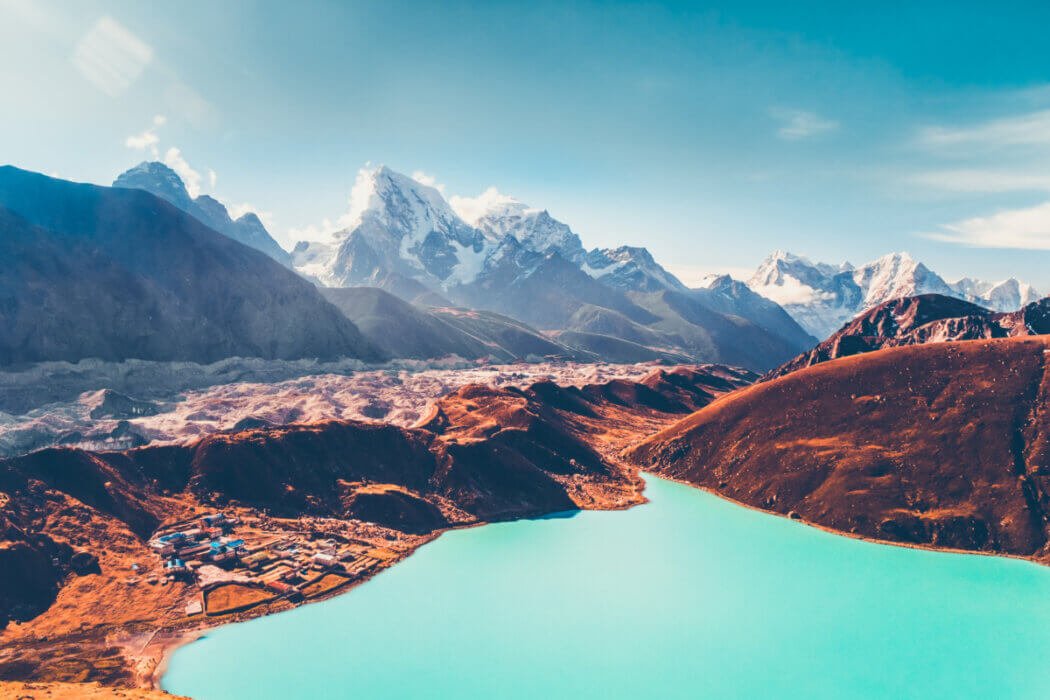
Everest Three Passes Trek – Complete Guide for Trekking in Nepal
The Everest Three Passes Trek is one of the most comprehensive trekking routes in Nepal’s Khumbu region. It combines high mountain passes, Everest Base Camp, Gokyo Lakes, Sherpa villages, and panoramic Himalayan viewpoints into a single trekking journey.
Unlike the standard Everest Base Camp trek, this route crosses three major Himalayan passes Kongma La Pass (5,535m), Cho La Pass (5,420m), and Renjo La Pass (5,360m). The trek is suitable for experienced trekkers looking for a longer and more physically demanding Himalayan adventure.
This guide explains everything you need to know about the Everest Three Passes Trek including itinerary, difficulty, altitude, cost, permits, acclimatization, preparation, and best trekking seasons.
What Is the Everest Three Passes Trek?
The Everest Three Passes Trek is a high-altitude trekking circuit in Nepal’s Everest (Khumbu) region. Unlike the standard Everest Base Camp route that follows the same trail in and out, the Three Passes Trek forms a loop through different valleys and mountain landscapes while crossing three major Himalayan passes above 5,000 meters.
This trek is considered one of the most complete trekking experiences in Nepal because it combines:
- Everest Base Camp
- Kala Patthar viewpoint
- Gokyo Lakes
- Remote Sherpa villages
- Glacier crossings
- Three high mountain passes
The route takes trekkers through the heart of the Khumbu region inside Sagarmatha National Park, a UNESCO World Heritage Site known for its Himalayan biodiversity, Sherpa culture, and views of Mount Everest.
The trek is physically demanding because of the altitude, long walking days, and steep ascents over mountain passes. However, it also offers greater route diversity and fewer repeated trails compared to the classic Everest Base Camp trek.
Why Is It Called the “Three Passes Trek”?
The trek is named after the three high-altitude mountain passes that trekkers cross during the journey:
| Pass | Elevation | Connects |
|---|---|---|
| Kongma La Pass | 5,535m | Chhukung to Lobuche |
| Cho La Pass | 5,420m | Dzongla to Thagnak |
| Renjo La Pass | 5,360m | Gokyo to Lungden |
These passes connect different valleys of the Everest region and create a circular trekking route instead of a simple return trail.
Crossing these passes is one of the main reasons the trek is considered more challenging than the regular Everest Base Camp trek.
Main Highlights of the Everest Three Passes Trek
The route combines several famous destinations in the Khumbu region. Each location offers a different experience, from Sherpa villages to glaciers and high mountain viewpoints.
Lukla – The Gateway to Everest
Located at an altitude of 2,860 meters, Lukla is the main entry point for Everest region trekking. The town is known for the Tenzing-Hillary Airport, which has one of the shortest mountain runways in the world.
From Lukla, trekkers begin walking through traditional Sherpa settlements, suspension bridges, and forest trails along the Dudh Koshi River.
Lukla is also an important supply and trading hub for villages deeper in the Khumbu region.
Namche Bazaar – The Sherpa Trading Center
This horseshoe-shaped mountain town is the largest settlement in the Khumbu region and serves as the main acclimatization stop for trekkers.
Trekkers usually spend at least one extra day here to help the body adjust to higher altitude.
Namche Bazaar includes:
- Tea houses
- Cafes
- Gear shops
- Bakeries
- Small museums
- Internet facilities
The town also offers early panoramic views of Everest, Lhotse, and Ama Dablam.
Acclimatization hikes around Namche often include:
- Everest View Hotel
- Khumjung village
- Syangboche airstrip
Tengboche – Spiritual Center of the Khumbu
Located at 3,867 meters, the village is famous for the Tengboche Monastery, the largest Buddhist monastery in the Khumbu region.
The monastery is surrounded by Himalayan peaks including:
- Ama Dablam
- Everest
- Lhotse
- Nuptse
Many trekkers consider Tengboche one of the most scenic overnight stops on the route.
The area also has:
- Pine and rhododendron forests
- Buddhist prayer flags
- Mani walls
- Traditional Sherpa settlements
Dingboche – Important Acclimatization Stop
The landscape begins changing noticeably here:
- Trees become sparse
- Terrain becomes more alpine and rocky
- Temperatures become colder
Trekkers often spend an additional acclimatization day in Dingboche before attempting higher passes.
Popular acclimatization hikes include:
- Nagarjun Hill
- Chhukung Valley
The village offers wide views of Ama Dablam and surrounding Himalayan ridges.
Everest Base Camp – Base of the World’s Highest Mountain
Located beside the Khumbu Glacier, the base camp is used by mountaineering expeditions attempting to climb Mount Everest during the spring climbing season.
Although Mount Everest itself is not fully visible from base camp, trekkers experience:
- Glacier terrain
- Ice formations
- Expedition camps
- High-altitude Himalayan environment
The trail to Everest Base Camp passes through Gorakshep, the final settlement before the base camp area.
During peak climbing season, colorful expedition tents cover sections of the glacier.
Kala Patthar – Best Viewpoint of Mount Everest
It is widely regarded as the best location for panoramic views of Mount Everest during the trek.
Trekkers usually climb Kala Patthar early in the morning for sunrise views.
From the summit area, visible peaks include:
- Everest
- Nuptse
- Pumori
- Lhotse
- Lingtren
Because Everest Base Camp itself does not provide a full view of Everest, Kala Patthar is often considered the visual highlight of the trek.
Gokyo Lakes – High-Altitude Glacial Lakes
These turquoise-colored lakes sit between 4,700 and 5,000 meters and are considered sacred by both Hindus and Buddhists.
Compared to the Everest Base Camp trail, the Gokyo Valley is generally quieter and less crowded.
The area offers:
- Glacier landscapes
- High mountain lakes
- Gokyo Ri viewpoint
- Views of Cho Oyu
Gokyo Ri (5,357m) is another major viewpoint during the trek and provides wide panoramic views of Everest and surrounding peaks.
The Three High Passes Explained
The defining feature of this trek is crossing three major Himalayan passes.
Kongma La Pass (5,535m)
The route between Chhukung and Lobuche includes:
- Steep ascents
- Rocky terrain
- Glacier sections
- Thin air at high altitude
The trail is more remote and less developed than lower trekking routes.
Weather conditions can change quickly here, especially during afternoon hours.
Cho La Pass (5,420m)
This pass is known for:
- Rocky trails
- Steep climbs
- Ice and snow sections
- Glacier crossing areas
Depending on weather conditions, crampons may occasionally be useful during colder months.
The route offers dramatic views of surrounding snow-covered peaks.
Renjo La Pass (5,360m)
The viewpoint overlooking the Gokyo Lakes and Everest range is one of the iconic landscapes of the Everest region.
Compared to Kongma La and Cho La, Renjo La is generally less technical but still physically demanding because of altitude.
The trail descending toward Lungden passes through quieter valleys with fewer trekkers.
How Long Does the Everest Three Passes Trek Take?
Most Everest Three Passes Trek itineraries take between 18 and 22 days.
The duration depends on:
- Acclimatization days
- Weather conditions
- Trekking pace
- Flight delays in Lukla
- Side trips and rest days
Trekkers typically walk:
- 5 to 8 hours daily
- Longer on pass-crossing days
Additional contingency days are strongly recommended because weather in the Everest region can affect domestic flights and trail conditions.
Why the Route Is Different From the Standard Everest Base Camp Trek?
The classic Everest Base Camp trek follows the same route to base camp and back.
The Everest Three Passes Trek creates a larger circuit by connecting multiple valleys and viewpoints through the high passes.
Advantages of the circular route include:
- More varied scenery
- Less repetition
- Access to Gokyo Lakes
- Additional mountain viewpoints
- More remote trekking sections
For many experienced trekkers, the route provides a broader experience of the Everest region beyond just Everest Base Camp.
Everest Three Passes Trek Overview
| Trek Detail | Information |
|---|---|
| Region | Everest / Khumbu |
| Trek Duration | 18–22 Days |
| Maximum Elevation | 5,555m (Kala Patthar) |
| Highest Pass | Kongma La Pass (5,535m) |
| Trek Difficulty | Challenging |
| Accommodation | Tea Houses |
| Best Seasons | Spring and Autumn |
| Starting Point | Lukla |
| Ending Point | Lukla |
| Required Permits | Khumbu Permit & Sagarmatha National Park Permit |
Why Choose the Everest Three Passes Trek?
Many trekkers choose this route because it provides a more complete Everest region experience compared to shorter Everest treks.
Key Highlights
- Cross three Himalayan high passes
- Visit Everest Base Camp
- View Mount Everest from Kala Patthar
- Explore Gokyo Lakes
- Experience Sherpa culture and monasteries
- Trek through Sagarmatha National Park
- Less repetitive route compared to the standard EBC trail
The trek also offers views of several Himalayan peaks including:
- Mount Everest (8,848.86m)
- Lhotse
- Nuptse
- Ama Dablam
- Cho Oyu
- Makalu
- Thamserku
How Difficult Is the Everest Three Passes Trek?
The Everest Three Passes Trek is considered a challenging trek due to:
- Long trekking days
- Steep ascents and descents
- High altitude
- Glacier crossings
- Variable mountain weather
Trekkers usually walk 6–8 hours daily, with some pass-crossing days extending beyond 9 hours.
Who Is This Trek Suitable For?
This trek is best for:
- Experienced trekkers
- Physically fit hikers
- People with previous high-altitude trekking experience
- Travelers comfortable with basic mountain accommodation
Beginners can complete the trek with proper preparation, but prior trekking experience is strongly recommended.
Everest Three Passes Trek Route Explained
1. Kongma La Pass (5,535m)
Kongma La is often considered the toughest of the three passes due to steep terrain and thinner oxygen levels.
The trail connects:
- Chhukung
- Lobuche
Highlights include:
- Glacier landscapes
- Mountain panoramas
- Remote alpine terrain
2. Cho La Pass (5,420m)
Cho La Pass links:
- Dzongla
- Thagnak
The route includes rocky terrain and occasional ice sections depending on season and weather conditions.
Many trekkers consider this pass technically more demanding than Renjo La.
3. Renjo La Pass (5,360m)
Renjo La is famous for panoramic views over the Gokyo Lakes and Everest range.
The route connects:
- Gokyo
- Lungden
This section is generally less crowded and offers quieter trekking trails.
Typical Everest Three Passes Trek Itinerary
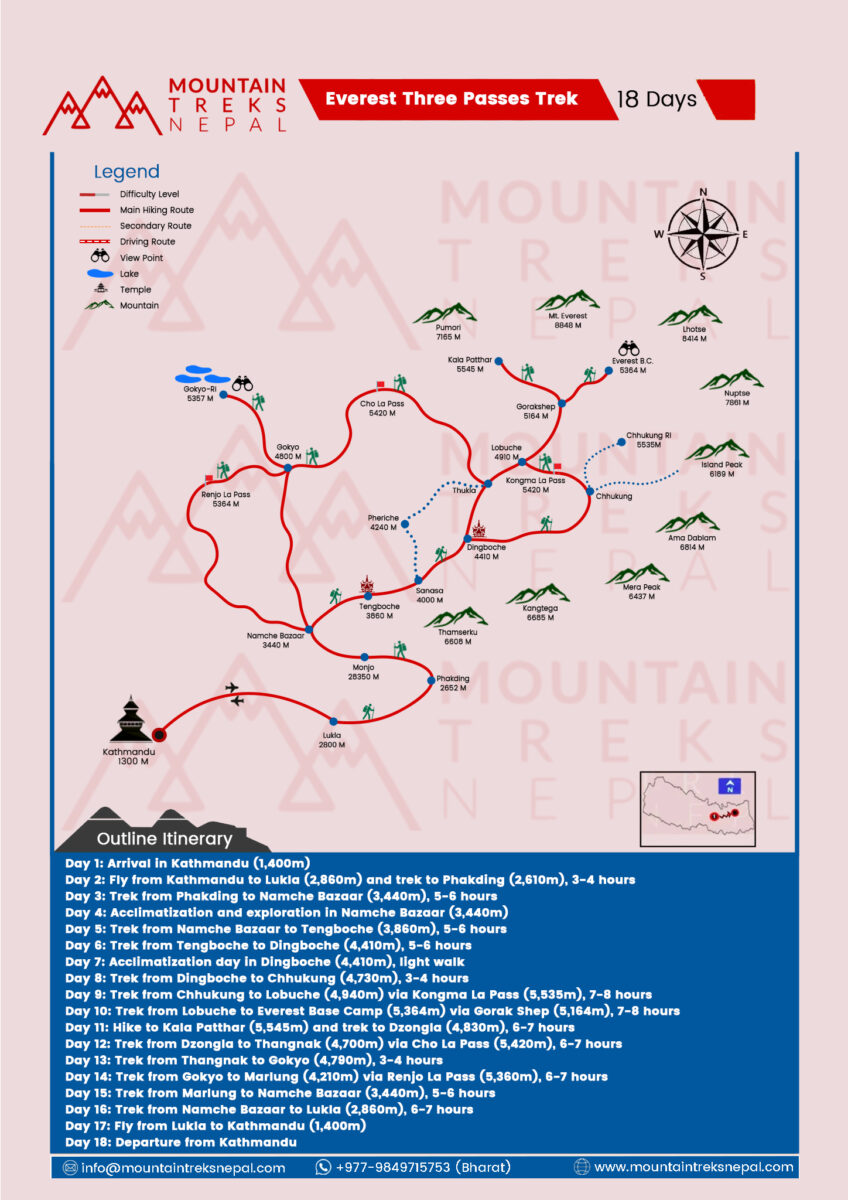
The Everest Three Passes Trek itinerary is designed to balance trekking progress with proper acclimatization. Since the route crosses multiple high-altitude passes above 5,000 meters, gradual ascent and rest days are essential for safety and successful completion of the trek.
Below is a detailed explanation of the standard 20-day Everest Three Passes Trek itinerary.
Day 1: Fly from Kathmandu to Lukla and Trek to Phakding
| Detail | Information |
|---|---|
| Flight Duration | 30–40 minutes |
| Trek Duration | 3–4 hours |
| Starting Elevation | Kathmandu (1,400m) |
| Ending Elevation | Phakding (2,610m) |
The journey begins with an early morning mountain flight from Kathmandu to Lukla. The flight itself is considered one of the highlights of trekking in Nepal because it offers aerial views of Himalayan peaks and deep valleys.
After landing at Lukla Airport (2,860m), the trek starts with a relatively easy descent toward Phakding.
The trail passes through:
- Sherpa villages
- Pine forests
- Mani stones
- Suspension bridges over the Dudh Koshi River
This first day helps trekkers adjust gradually to the trekking pace and altitude.
Day 2: Trek from Phakding to Namche Bazaar
| Detail | Information |
|---|---|
| Trek Duration | 6–7 hours |
| Elevation Gain | Approx. 830m |
| Overnight Elevation | Namche Bazaar (3,440m) |
This is one of the more physically demanding early trekking days because of the steep uphill climb before reaching Namche Bazaar.
The trail crosses several suspension bridges, including the famous Hillary Suspension Bridge.
Trekkers enter Sagarmatha National Park at Monjo, where permits are checked.
As altitude increases, the environment begins changing noticeably:
- Cooler temperatures
- Thinner forests
- Wider mountain views
On clear days, trekkers may catch their first distant view of Mount Everest before arriving in Namche Bazaar.
Day 3: Acclimatization Day in Namche Bazaar
Acclimatization days help the body adapt to decreasing oxygen levels at higher elevations.
Instead of complete rest, trekkers usually take short hikes around Namche to improve altitude adaptation.
Popular acclimatization hikes include:
- Everest View Hotel
- Khumjung village
- Syangboche ridge
These hikes provide panoramic views of:
- Everest
- Ama Dablam
- Thamserku
- Lhotse
Trekkers then return to Namche for overnight sleep at a lower elevation, which supports safer acclimatization.
Day 4: Trek from Namche Bazaar to Tengboche
| Detail | Information |
|---|---|
| Trek Duration | 5–6 hours |
| Overnight Elevation | Tengboche (3,867m) |
The trail from Namche to Tengboche offers some of the best mountain scenery of the trek.
The route includes:
- Forest trails
- River crossings
- Gradual ridgeline walking
Trekkers often enjoy clear views of Ama Dablam along this section.
Tengboche Monastery is the main attraction here. It is the largest monastery in the Khumbu region and an important spiritual center for Sherpa communities.
Many trekkers attend evening prayer ceremonies if timing allows.
Day 5: Trek from Tengboche to Dingboche
| Detail | Information |
|---|---|
| Trek Duration | 5–6 hours |
| Overnight Elevation | Dingboche (4,410m) |
After descending through forest sections, the trail gradually climbs into more alpine terrain.
At this altitude:
- Trees become sparse
- Air becomes thinner
- Temperatures drop significantly
The village of Dingboche sits in a wide valley surrounded by Himalayan peaks.
This section offers close-up views of:
- Ama Dablam
- Island Peak
- Lhotse walls
Dingboche is another major acclimatization stop before entering higher elevations.
Day 6: Acclimatization Day in Dingboche
Common acclimatization hikes include:
- Nagarjun Hill
- Chhukung Valley
These hikes help improve the body’s adaptation to high altitude while providing additional mountain views.
Proper acclimatization at Dingboche is important because upcoming sections involve elevations above 5,000 meters.
Day 7: Trek from Dingboche to Chhukung
| Detail | Information |
|---|---|
| Trek Duration | 3–4 hours |
| Overnight Elevation | Chhukung (4,730m) |
This is a shorter trekking day intended to prepare trekkers for the Kongma La Pass crossing.
Chhukung is a small settlement located in the upper Imja Valley.
The route offers excellent views of:
- Island Peak
- Lhotse
- Ama Dablam
Because of the increasing altitude, trekkers usually walk slowly and conserve energy for the following day.
Day 8: Cross Kongma La Pass and Trek to Lobuche
| Detail | Information |
|---|---|
| Trek Duration | 8–10 hours |
| Highest Elevation | Kongma La Pass (5,535m) |
| Overnight Elevation | Lobuche (4,940m) |
This is often considered the hardest day of the trek.
Trekkers begin early in the morning because weather conditions are generally more stable before afternoon winds develop.
The route includes:
- Steep rocky climbs
- Glacier terrain
- Loose scree sections
- High-altitude exposure
The pass provides panoramic views of surrounding Himalayan peaks and glaciers.
After crossing the pass, the trail descends toward Lobuche.
Day 9: Trek to Everest Base Camp and Overnight at Gorakshep
| Detail | Information |
|---|---|
| Trek Duration | 7–8 hours |
| Everest Base Camp Elevation | 5,364m |
| Overnight Elevation | Gorakshep (5,164m) |
Trekkers follow the Khumbu Glacier moraine toward Everest Base Camp.
The terrain becomes increasingly rocky and barren.
At Everest Base Camp, trekkers can observe:
- Glacier formations
- Icefall areas
- Expedition camps during climbing season
After visiting the base camp, trekkers return to Gorakshep for overnight accommodation.
Day 10: Kala Patthar Sunrise and Trek to Dzongla
| Detail | Information |
|---|---|
| Highest Elevation | Kala Patthar (5,555m) |
| Trek Duration | 7–8 hours |
Trekkers usually start before sunrise to reach Kala Patthar for panoramic Everest views.
Kala Patthar is widely regarded as the best viewpoint for Mount Everest during the trek.
After descending to Gorakshep for breakfast, the trail continues toward Dzongla.
This section is quieter compared to the Everest Base Camp trail.
Day 11: Cross Cho La Pass and Trek to Thagnak
| Detail | Information |
|---|---|
| Trek Duration | 7–9 hours |
| Highest Elevation | Cho La Pass (5,420m) |
Cho La Pass involves:
- Rocky climbs
- Ice sections
- Glacier crossings
Depending on conditions, snow and ice may make the trail more technical.
Trekkers descend into the Gokyo Valley and overnight at Thagnak.
Day 12: Trek from Thagnak to Gokyo
| Detail | Information |
|---|---|
| Trek Duration | 3–4 hours |
| Overnight Elevation | Gokyo (4,790m) |
The trail crosses glacier terrain before reaching the Gokyo Lakes area.
The turquoise glacial lakes and surrounding peaks create one of the most scenic landscapes in the Everest region.
Gokyo village sits beside the third lake and serves as the main accommodation point in the valley.
Day 13: Explore Gokyo Ri
| Detail | Information |
|---|---|
| Gokyo Ri Elevation | 5,357m |
| Hiking Duration | 3–4 hours |
Trekkers hike to Gokyo Ri early in the morning for panoramic Himalayan views.
Visible peaks include:
- Everest
- Cho Oyu
- Makalu
- Lhotse
Many trekkers consider Gokyo Ri one of the finest viewpoints in Nepal.
The remainder of the day is generally used for rest and acclimatization.
Day 14: Cross Renjo La Pass and Trek to Lungden
| Detail | Information |
|---|---|
| Trek Duration | 7–8 hours |
| Highest Elevation | Renjo La Pass (5,360m) |
Renjo La offers one of the most famous panoramic viewpoints of the Everest region.
The route descends into a quieter valley with fewer trekkers.
Compared to the Everest Base Camp trail, this section feels more remote and peaceful.
Day 15: Trek from Lungden to Thame
| Detail | Information |
|---|---|
| Trek Duration | 5–6 hours |
| Overnight Elevation | Thame (3,820m) |
The descent continues toward traditional Sherpa villages.
Thame is known for:
- Sherpa culture
- Buddhist monasteries
- Historical Everest mountaineering heritage
This area receives fewer trekkers than the main Everest Base Camp route.
Day 16: Trek from Thame to Namche Bazaar
The lower altitude usually feels noticeably easier after several days above 5,000 meters.
This is often one of the more comfortable overnight stops of the trek.
Day 17: Trek from Namche Bazaar to Lukla
| Detail | Information |
|---|---|
| Trek Duration | 6–7 hours |
The final trekking day retraces the route through:
- Monjo
- Phakding
- Dudh Koshi Valley
Trekkers often celebrate the completion of the Everest Three Passes Trek in Lukla before the return flight to Kathmandu.
Days 18–20: Contingency Days and Departure
These buffer days help reduce scheduling problems caused by:
- Flight cancellations
- Strong winds
- Poor visibility
- Snowfall
Most trekking companies recommend at least 1–2 contingency days when planning Everest region treks.
After returning to Kathmandu, trekkers typically use remaining days for:
- Rest
- Sightseeing
- International departure preparation
Best Time for Everest Three Passes Trek
Choosing the right season significantly affects trekking conditions and mountain visibility.
Spring (March to May)
Spring is one of the most popular trekking seasons.
Conditions:
- Stable weather
- Moderate temperatures
- Clear mountain views
- Rhododendron forests in bloom
Average daytime temperatures:
- Lower region: 10°C to 15°C
- High passes: -10°C to -5°C
Autumn (September to November)
Autumn offers the clearest mountain views after the monsoon season.
Conditions:
- Dry trails
- Stable weather
- Excellent visibility
- Busy trekking routes
This season is often preferred for high-pass trekking.
Winter Trekking (December to February)
Winter trekking is possible but conditions become more demanding.
Challenges include:
- Heavy snowfall
- Closed passes
- Very cold nights
- Flight delays
Monsoon Season (June to August)
Monsoon is generally not recommended due to:
- Rainfall
- Slippery trails
- Poor visibility
- Increased flight cancellations
Everest Three Passes Trek Altitude and Acclimatization
Altitude sickness is one of the main concerns during this trek.
Important Altitude Points
| Location | Elevation |
|---|---|
| Lukla | 2,860m |
| Namche Bazaar | 3,440m |
| Dingboche | 4,410m |
| Everest Base Camp | 5,364m |
| Kala Patthar | 5,555m |
| Kongma La | 5,535m |
| Cho La | 5,420m |
| Renjo La | 5,360m |
Acclimatization Tips
- Ascend gradually
- Drink 3–4 liters of water daily
- Avoid alcohol at altitude
- Include acclimatization days
- Listen to your guide
- Descend if symptoms worsen
Common altitude sickness symptoms include:
- Headache
- Nausea
- Fatigue
- Dizziness
- Loss of appetite
Everest Three Passes Trek Permits
Trekkers need two permits for the Everest region.
Required Permits
| Permit | Cost |
|---|---|
| Sagarmatha National Park Permit | Approx. NPR 3,000 |
| Khumbu Pasang Lhamu Rural Municipality Permit | Approx. NPR 3,000 |
Permit costs may change periodically.
Everest Three Passes Trek Cost
The cost depends on trek duration, guide services, accommodation standard, and transportation choices.
Average Cost Breakdown
| Expense | Approximate Cost |
|---|---|
| Flights Kathmandu–Lukla | $180–$250 |
| Guide | $30–$40/day |
| Porter | $20–$30/day |
| Accommodation | $5–$15/night |
| Meals | $25–$40/day |
| Permits | $50–$60 |
Average Total Budget
| Trek Type | Estimated Cost |
|---|---|
| Independent Trek | $1,200–$1,800 |
| Guided Trek | $1,800–$3,000 |
Food and Accommodation on the Trek
Tea houses are available throughout the route.
Common Meals
- Dal Bhat
- Fried rice
- Noodles
- Soups
- Pancakes
- Eggs
- Tea and coffee
Food prices increase with altitude because supplies are transported by porters or yaks.
Accommodation
Most tea houses provide:
- Twin-sharing rooms
- Shared toilets
- Dining hall with heating stove
Electricity and Wi-Fi are available in many villages for additional charges.
What to Pack for Everest Three Passes Trek?
Packing correctly is important because temperatures vary significantly.
Essential Trekking Gear
Clothing
- Base layers
- Insulated jacket
- Waterproof shell
- Trekking pants
- Thermal gloves
- Warm hat
Trekking Equipment
- Trekking boots
- Trekking poles
- Sleeping bag (-15°C recommended)
- Headlamp
- Water bottles
Health & Safety
- First aid kit
- Water purification tablets
- Sunscreen
- Lip balm
- Personal medications
Everest Three Passes Trek vs Everest Base Camp Trek
Many trekkers compare the Everest Three Passes Trek with the standard Everest Base Camp trek.
| Feature | Everest Three Passes Trek | Everest Base Camp Trek |
|---|---|---|
| Difficulty | Challenging | Moderate |
| Duration | 18–22 Days | 12–14 Days |
| Maximum Passes | 3 High Passes | None |
| Route Type | Circular | Out-and-back |
| Crowds | Less crowded sections | Busier trails |
| Scenic Diversity | Very high | High |
The Three Passes Trek is often chosen by trekkers seeking a more immersive Everest region experience.
Is a Guide Necessary for Everest Three Passes Trek?
A guide is strongly recommended due to:
- Remote mountain terrain
- Weather changes
- High altitude risks
- Route navigation
An experienced local guide also provides:
- Cultural insights
- Emergency support
- Trekking logistics management
Experienced trekking companies like Mountain Treks Nepal provide guides familiar with Everest region conditions and acclimatization planning.
Safety Tips for Everest Three Passes Trek
Important Trekking Safety Guidelines
- Train before the trek
- Allow proper acclimatization
- Keep extra contingency days
- Carry travel insurance with helicopter evacuation coverage
- Check weather forecasts regularly
- Trek with experienced guides
According to Himalayan rescue organizations, proper acclimatization significantly reduces severe altitude-related incidents in the Everest region.
Internet, Charging, and Connectivity
Most villages offer:
- Mobile network coverage
- Paid Wi-Fi services
- Battery charging facilities
However:
- Internet speed is limited at higher elevations
- Charging may cost extra
- Power outages can occur
Carrying a power bank is recommended.
Sustainable Trekking in the Everest Region
Responsible trekking helps preserve the fragile Himalayan environment.
Sustainable Trekking Practices
- Avoid single-use plastics
- Carry reusable water bottles
- Respect local customs
- Stay on designated trails
- Support local tea houses and guides
- Dispose of waste responsibly
The Everest region receives thousands of trekkers annually, making sustainable tourism increasingly important.
Frequently Asked Questions
How long does the Everest Three Passes Trek take?
Most itineraries range from 18 to 22 days depending on acclimatization and weather conditions.
What is the hardest pass in the Everest Three Passes Trek?
Kongma La Pass is often considered the most physically demanding due to steep ascents and altitude.
Can beginners do the Everest Three Passes Trek?
Beginners with strong fitness levels can complete the trek, but prior trekking experience is highly recommended.
What is the best month for Everest Three Passes Trek?
October and April are commonly considered the best months because of stable weather and clear mountain visibility.
Is altitude sickness common on the Everest Three Passes Trek?
Yes. Since the trek reaches above 5,500 meters, proper acclimatization is essential.
Do I need travel insurance?
Yes. Insurance covering high-altitude trekking and helicopter evacuation is strongly recommended.
Final Thoughts
The Everest Three Passes Trek is one of Nepal’s most rewarding high-altitude trekking routes. It combines Everest Base Camp, Himalayan passes, Sherpa culture, and remote mountain landscapes into a single trekking journey.
Compared to shorter Everest treks, this route offers greater route diversity and a deeper exploration of the Khumbu region. However, it also requires stronger physical preparation, proper acclimatization, and careful planning.
For trekkers seeking a longer and more challenging Himalayan experience, the Everest Three Passes Trek remains one of the most complete trekking adventures in Nepal.