



Share This:

Journey to Mera Peak – A Himalayan Masterpiece
Rising majestically to approximately 6,476 m (21,247 ft), Mera Peak claims its place as one of Nepal’s most rewarding and accessible high‑altitude climbs. Nestled in the Hinku Valley of the Mahalangur Himal, this peak offers a potent blend of sweeping Himalayan panoramas, remote Sherpa culture, and a climbing challenge that bridges trekking and mountaineering.
For adventurers seeking an expedition beyond the usual trek but below the rigours of the 8,000‑metre giants, this climb presents an ideal gateway. The company behind the experience, Mountain Treks Nepal, brings deep local expertise, logistic strength, and cultural authenticity enabling a journey that is as much about the region as the summit.
Why Climb Mera Peak?

Spectacular panoramic views
From the summit, five of the world’s eight‑thousand‑metre peaks dominate the horizon: Mount Everest, Lhotse, Makalu, Cho Oyu and Kanchenjunga. The jaw‑dropping 360‑degree Himalayan vista is one of the major draws for this expedition.
A blend of trekking and climbing
Although listed as a “trekking peak,” the climb demands snow, ice and glacier travel including the use of crampons and an ice‑axe. The route is less technically demanding than high‑altitude expedition peaks, but the altitude and remoteness elevate the challenge significantly.
Remote and culturally rich terrain
The Hinku Valley (and its sister Hongu Valley on some itineraries) offers trails away from the busiest trekking corridors, passing through yak pastures, rhododendron forests, and traditional Sherpa villages. The company guiding the climb ensures the journey is rooted in local culture, helping to deepen the experience.
Preparation for bigger peaks
This peak is often referred to as a “practice peak” for mountaineers aiming for higher altitudes. It trains the body and mind for high‑altitude climbing while providing a tremendously rewarding summit.
The Role of Mountain Treks Nepal

Mountain Treks Nepal stands out among Himalayan expedition providers for several reasons:
-
Local knowledge: Based in Kathmandu and operating year‑round in the Solukhumbu and Hinku regions, they combine decades of guiding experience with full logistical support.
-
Safety‑first mindset: Mountaineering at 6,000 m+ demands serious planning. Their teams include certified guides and Sherpas who know the mountain, the glaciers, the weather patterns.
-
Comprehensive support: From flights and teahouse lodging (or camping where appropriate), to equipment logistics, to high‑quality food and acclimatisation strategies all combined for a seamless experience.
-
Cultural integration: The team emphasises Sherpa culture, high‑altitude village life, and sustainable travel practices, enhancing the climb with more than just the summit.
In choosing Mountain Treks Nepal for a Mera Peak ascent, the expedition becomes smoother, safer and more immersive.
Typical 17‑Day Itinerary Snapshot
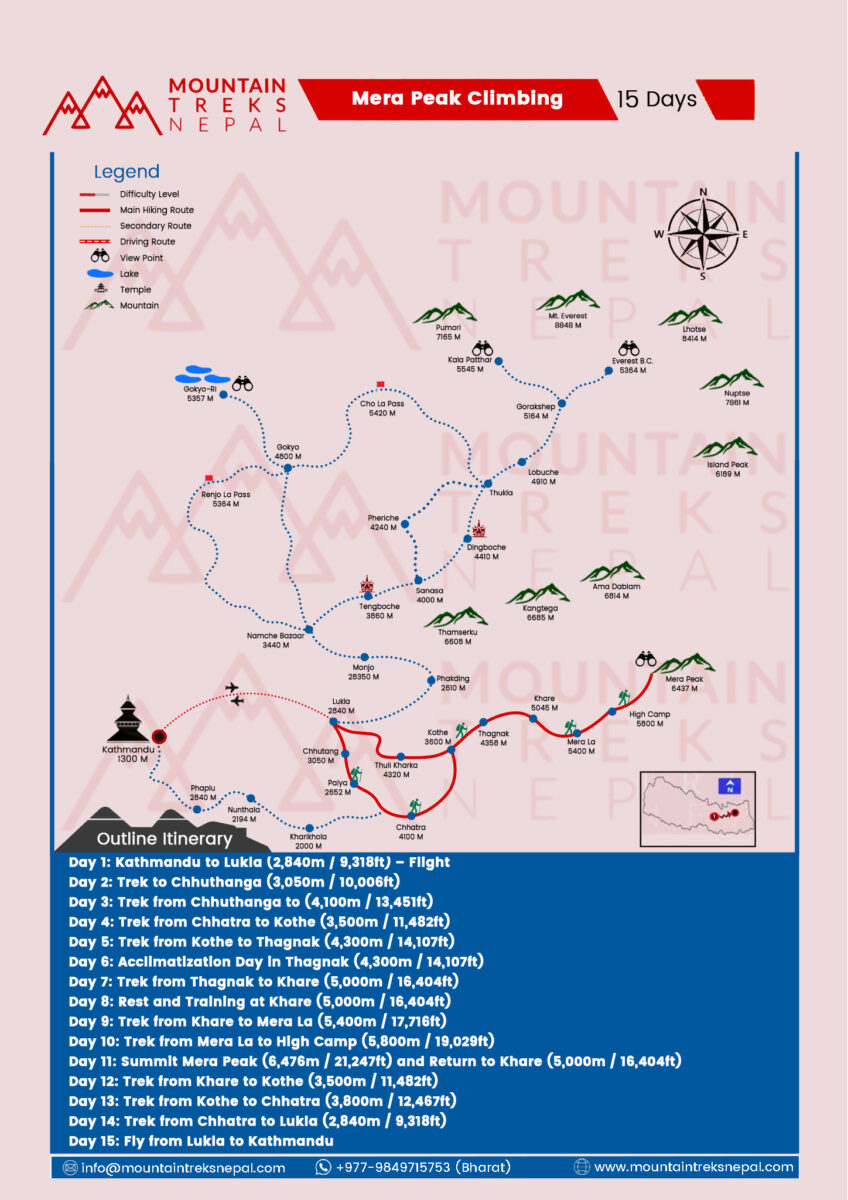
Here is an approximate outline of how the climb is structured of course, Mountain Treks Nepal can tailor it according to group size, weather conditions, and client requirements:
| Day | Route / Activity |
|---|---|
| 1 | Arrival in Kathmandu, equipment check, expedition briefing |
| 2 | Fly Kathmandu → Lukla (2,840 m), trek to Paiya or nearby village |
| 3–5 | Trek through Hinku Valley: pine & rhododendron forests, yak pastures, reaching Tuli Kharka (4,300 m) |
| 6–8 | Push to base camp and high camp: trail climbs across moraines, glaciers toward Khare (5,000 m) and high camp |
| 9 | Summit day from high camp: very early start, summit ~6 000+m, descend to camp |
| 10–13 | Descent: retrace steps toward Kothe and Lukla, with acclimatisation and recovery built in |
| 14–16 | Return to Kathmandu, recovery day, optional sightseeing or rest |
| 17 | Departure from Kathmandu |
Several days are reserved as contingency for weather or acclimatisation — something Mountain Treks Nepal prioritises to maximise success and safety.
Key Challenges & How They Are Managed
Altitude & Acclimatisation
Ascending rapidly to 6,000 m+ terrain is strenuous. While the route is non‑technical for much of the climb, the thin air and remoteness demand respect. Mountain Treks Nepal builds in acclimatisation days and monitors health closely.
Technical Sections
Although the climb doesn’t involve extreme rock or ice walls, it does cross glaciers, snow slopes and might feature fixed ropes or steep ice. Guides from Mountain Treks Nepal provide necessary gear, rope‑fixing, guidance and support.
Weather & Terrain Variability
The Himalayas are unpredictable. Weather windows, snow conditions, glacier changes all affect the climb. The operator remains flexible, adjusting itinerary or waiting for safe conditions. Good gear, layered clothing, proper boots are essential.
Physical Fitness & Mental Resilience
Climbs of this nature involve long days, heavy packs, steep ascents and high exposure. Even the descent requires careful walking. Mountain Treks Nepal encourages prior training and often runs a briefing on fitness, gear and mindset.
What to Expect Along the Trail?

-
Village culture: Arrival into the Hinku or Hongu valleys reveals remote Sherpa settlements, yak herds grazing in high alpine pastures, and Buddhist monasteries perched in quiet solitude.
-
Trail variety: From dense rhododendron and pine forests at lower altitude to moraines, icy slopes and snow‑glazed terrain higher up.
-
Glacier travel: The route to base camp crosses glacier moraines, requiring steady footing and caution.
-
High‑camp environment: At 5,300‑5,800 m, high camp is cold, thin‑aired and basic — yet the reward is night skies full of stars and dawns rich in Himalayan colours.
-
Summit push: Early (often pre‑dawn) departure, layered gear, crampons on. The final snow slopes demand concentration. Then, upon reaching the summit, a moment of profound stillness and panoramic wonder.
-
Descent and reflection: Returning to lower elevations brings relief, recovery walks and time to absorb the achievement.
Why Partnering With Mountain Treks Nepal Elevates the Experience
-
Local logistics handled: Permits, porters or yaks, lodges, equipment transport — all coordinated by the Nepal‑based expert team.
-
Support at every step: Guides accompany every day; Sherpas fix ropes and lead the summit push; safety protocols and first‑aid prepared.
-
Tailored comfort: Accommodations—teahouses or tents depending on route—are selected for comfort, cleanliness and local experience.
-
Sustainable & respectful travel: Emphasis on low‑impact climbing, supporting local communities, respecting culture and environment.
-
Post‑climb recovery: Return to Kathmandu includes rest, optional cultural tours, and space to reflect and celebrate.
Preparing for the Expedition
Physical Preparation
-
Build cardiovascular stamina: hiking with loaded backpack, stair climbing, long‑duration cardio.
-
Strength training: legs, core, back essential for carrying packs and negotiating snow slopes.
-
Some prior altitude experience is helpful it’s not mandatory, but beneficial.
-
Gear rehearsal: using crampons, ice‑axe, harness; even if basic, familiarity reduces fatigue.
Equipment & Gear
-
Mountaineering boots with crampon compatibility.
-
Crampons, ice‑axe, helmet, harness (often provided by operator).
-
Layered clothing: base layers, insulating mid‑layers, outer wind/water‑proof shell, down jacket for summit.
-
Good quality sleeping bag rated to ‑15 °C or lower for high camp.
-
Day‑pack, gloves, hat, sunglasses, sunscreen, hydration system.
-
Optional: satellite phone/PLB, though the operator handles major communications.
Best Seasons
The prime windows are spring (March‑May) and autumn (September‑November). In these periods, weather is clearer, snow conditions more stable. Outside these windows, risks increase and logistic support may be more limited.
Cost Considerations & Value
Typical expedition cost for a Mera Peak climb ranges around USD 1,700 to USD 2,500 depending on duration, route, group size and included services. Mountain Treks Nepal offers competitive pricing combined with high‑standard service making the climb excellent value considering altitude, logistics and cultural richness.
What the cost typically covers: domestic flights (Kathmandu → Lukla), lodging in teahouses or tents, meals, guide and sherpa support, permits and insurance for guides, emergency support. What may be extra: gear rental, personal insurance, tips, hot showers or phone charges on the trail.
The Summit Moment & Beyond
Reaching the summit of Mera Peak delivers a visceral, unforgettable high. From the apex, the world’s tallest peaks spread before the climber Everest to the west, Kanchenjunga to the east. The air is thin, the wind may bite, but the view is pure Himalayan majesty.
The descent offers its own satisfaction – every step brings relief, every lodge meal tastes richer, and the mind begins to process the journey. Back in Kathmandu, the expedition shines in hindsight: a story to be shared, a summit photo framed, a mountain markedly conquered.
Final Thoughts
Mera Peak stands as a quintessential Himalayan climb — combining the thrill of a summit push, the beauty of remote alpine terrain, and the cultural depth of Nepal’s Solukhumbu region. With the expert support of Mountain Treks Nepal, the expedition becomes smooth, safe, and endlessly rewarding.
For climbers seeking a high‑altitude adventure without the extremes of 8,000‑metre peaks, this journey delivers on both challenge and inspiration. The mountain waits; the valley calls; the summit beckons.