



Ama Dablam Expedition - 21 Days
-
Duration:
21 days -
Max Altitude:
6812m -
Difficulty Level:
Challenging -
Best Season:
March to May and September to November
Trip Overview
Ama Dablam Expedition is a trek cum mountaineering that blends the beauty of the Nepalese Himalayas into the warm and hospitable Sherpa Culture. If you want to find some real thrill, this is what you will find: the climbing of Ama Dablam Peak.
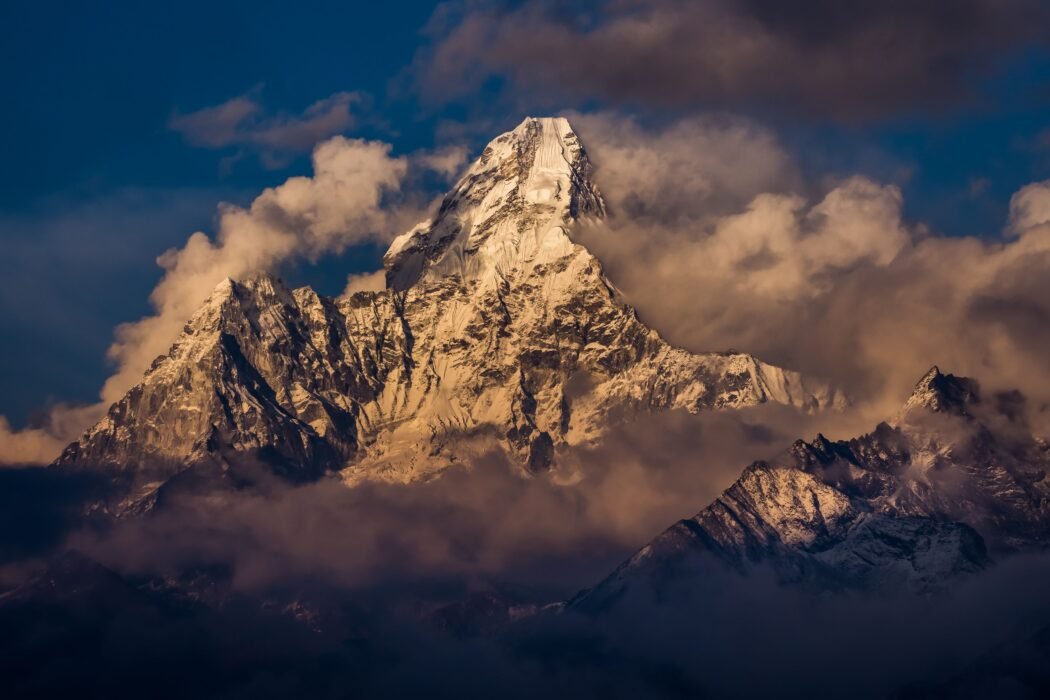
Ama Dablam Peak is in the Everest region of Nepal and stands at a height of 6,812 meters. Ama Dablam Expedition 21 Days gives a good reward to those climbers who are willing to go out there and put their limits to the test. Starting with a scenic flight to Lukla, the typical itinerary involves trekking through the illustrious Sherpa villages of Namche Bazaar and Tengboche, where trekkers absorb the rich culture of the region. The Ama Dablam Expedition 21 Days has spectacular views of some of the highest peaks, like Everest, Lhotse, and Ama Dablam.
The landscape gradually changes from dense forests and alpine meadows to rocky glacial moraines and frozen slopes as one continues climbing higher. The ascent toward Ama Dablam Peak is not entirely straightforward. Ama Dablam Expedition 21 Days provides great technical challenges due to steep ridges and some fixed rope sections. One has to learn to use specialized equipment such as crampons and ice axes to perform the climb.
Slowly but surely develops the team spirit and the feeling of success along the ascent by other climbers as well as experience from good guides and porters. At the very summit, it offers some of the finest and most breathtaking panoramic views of the Himalayas, well worth the adventurous climb.
Preparation for Ama Dablam Expedition 21 Days
Permits and Regulations
For Ama Dablam Expedition, climbers must acquire a peak climbing permit from Nepal Mountaineering Association (NMA). And the cost varies from one season to another.
During the peak seasons like Spring and Autumn, the climbing permit costs you USD 400 per person while during the off-seasons like Monsoon and Winter, it has a price of USD 200 per person.
Besides, you will also need to obtain Sagarmatha National Park and Khumbu Pasang Lhamu Entry Permits. Both of these permits can be obtained from Nepal Tourism Board or from Monjo Check Post.
Sagarmatha National Park Entry Permit costs NPR 3000 for foreign trekkers and NPR 1000 for SAARC Nationals. Similarly, it costs NPR 3000 per person for Khumbu Pasang Lhamu Entry Permits.
Best Season for Ama Dablam Expedition
Unlike lower-altitude treks, peak climbing has very tight weather windows. Ama Dablam is best climbed during two specific seasons:
-
Autumn (October to November) : Autumn is widely considered the absolute best time to climb Ama Dablam. Post-monsoon skies offer exceptional clarity, stable weather, cold but dry conditions, and firm snow/ice conditions on the technical ridges like the Yellow Tower and Grey Tower.
-
Spring (April to May) : Spring brings warmer temperatures and longer daylight hours. While there is slightly more snow accumulation on the technical rock faces, the blooming rhododendrons in the lower Khumbu valley make the trek to Base Camp stunning.
-
Monsoon (June to Aug) & Winter (Dec to Feb): Monsoon brings high avalanche risks, heavy rain, and zero visibility. Winter brings extreme sub-zero temperatures (below -25°C at Camp 2) and severe jet-stream winds.
Ama Dablam Expedition Difficulty Level
Ama Dablam (6,812m) is not a trekking peak like Island Peak or Mera Peak; it is a serious technical mountain often called the “Matterhorn of the Himalayas.”
-
Technical Rock & Ice: The route involves sustained vertical climbing on rock, mixed ice, and steep snow slopes. You will encounter key technical Cruxes like the Yellow Tower (pitch of vertical rock at ~6,000m) and the Mushroom Ridge.
-
Fixed Ropes & Jumar Use: Climbers must be completely proficient in using Jumars (ascenders) on vertical fixed lines, performing rappels (abseiling) with a figure-8 or ATC device on exposed ridges, and cramponing on steep ice.
-
High Altitude & Exposure: Camping at Camp 2 (6,000m) requires sleeping on tiny, highly exposed ledge platforms. Excellent cardiovascular endurance, previous high-altitude experience (preferably a 5,000m–6,000m peak), and strong mental grit are mandatory.
Altitude Chart
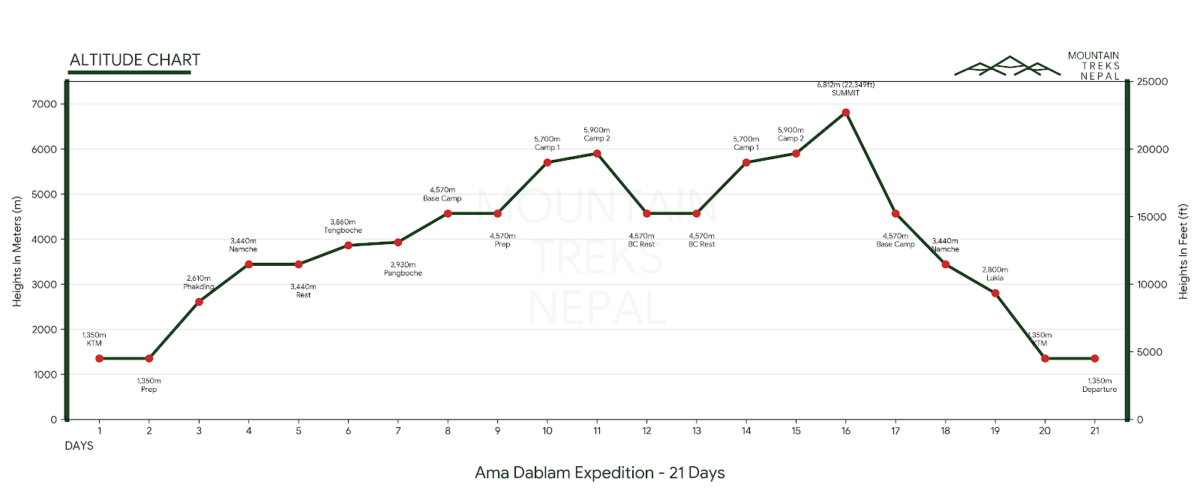
This altitude chart for the Ama Dablam Expedition outlines the 21-day journey in feet and meters. The expedition starts in Kathmandu and quickly ascends to Lukla, and you reach Namche on day 4 of trekking. There is a rest day, then a few more trekking days to arrive at the Base Camp, sitting at an elevation of 4,570 meters. Days 9 to 11 are preparation days and ascending days towards Camp 1 and Camp 2. Then, the expedition involves going back to base camp to rest on days 12 and 13. Days 14 and 15 involve going back to Camp 1 and Camp 2. Then on day 16, you will make the final push to summit Ama Dablam, a stunning peak standing at 6,812 meters and 22,349 feet. That same day you return to base camp. The descend involves backtracking through Namche and Lukla with a final flight back to Kathmandu.
Guides and Porters during Ama Dablam Expedition 21 Days
Without a doubt, guides and porters are very necessary for a successful Ama Dablam Expedition 21 Days. Knowledge of the route, weather conditions, and safety precautions make the journey smooth and well-informed through an experienced guide. These guides also help with the acclimatization strategy and technical climbing skills. The conventional definition of a porter is a person hired to carry what one can’t on their trek, making things manageable for climbers. They help make a trek enjoyable by lightening the load that a climber carries. Both guides and porters are typically local Sherpas, well suited to high-altitude living and gladly familiar with the terrain, having lived most of their lives in this vicinity.
Accommodation and Food
Accommodations during the Ama Dablam Expedition vary from tea houses to tented camps. Tea houses provide fairly decent but clean rooms, usually with common bathrooms, sometimes with warm blankets. Meals are usually hearty and nutritious, from the basic Nepali staple of dal bhat to pasta and soup and seasonal vegetables. Options may become quite limited at high altitudes but yet sufficient to keep one powering through the trekking. Meals at camping times will be prepared by the expedition team, freshly ensuring weight and hygienic factors. Hot beverages such as tea and coffee give one warmth and drip. Accommodation and food provide much-needed rest and nourishment throughout the difficult journey.
Why Is Travel Insurance Needed?
As to everybody who does Ama Dablam Expedition, travel insurance is one of the most important concerns. This has to meet the requirements for very high-altitude trekking (above 6,000m), medical emergencies, helicopter evacuation, and eventual trip cancellations. The terrain and the heights always have their risks, like altitude sickness and injuries that usually require immediate evacuation. In addition, travel and flight arrangements may sometimes be affected because of unpredictable weather conditions, leading to delays or cancellations of flights into and out of these regions.
Therefore, travel insurance provides full or really comprehensive insurance coverage, which instantly provides additional peace of mind and allows climbers to focus on the journey instead of the financial consequences of emergencies. Mandatory safety net, actual security coverage in one of the most difficult and inaccessible trekking regions above its major sections on the continent.
Communication and Internet during Ama Dablam Expedition
The communication and internet connectivity scenario is slowly improving in the Ama Dablam region; however, these are severely limited. For example, one of the big villages, Namche Bazaar, offers Wi-Fi, usually at a fee. Another reliable way to stay connected while trekking is through satellite phones and local service providers’ SIM cards with data packages, such as Ncell or Namaste. Availability of connectivity reduces as one climbs up, and the distance to be covered increases, thus increasing one’s dependence on satellite communication. They are not guaranteed everywhere, but these options will allow an update to emergencies. It remains really important to manage expectations and get into the spirit of disconnection as a part of the best immersive experience in the mountains.
Is the Ama Dablam Expedition Your Next Great Adventure?
This expedition is ideal for experienced trekkers and aspiring mountaineers looking to step up into technical Himalayan climbing. You should book this trip if:
-
You have prior non-technical/semi-technical peak experience: You have climbed peaks like Island Peak, Mera Peak, Kilimanjaro, Mont Blanc, or Aconcagua, and want to test yourself on technical terrain.
-
You possess foundational rope skills: You know how to tie in, operate ascenders/descenders, and feel comfortable moving on fixed ropes with exposed drops below you.
-
You want a true Alpine Challenge without the 8,000m price tag: Ama Dablam offers the exact technical feel, exposure, and logistical thrill of an 8,000m giant (like Everest or Lhotse) in a compact 21-day itinerary.
Equipment and Kit Necessary for the Ama Dablam Expedition
- Trekking Boots are sturdy, waterproof, and with good ankle support.
- Backpack with a capacity of 50-70 liters for multi-day treks.
- Hikers use trekking poles to enhance stability, reduce strain on their knees, and improve balance.
- Clothing Layers include Base layers, insulation layers (fleece or down), and waterproof outer layers.
- Sleeping Bag rated for -10°C (14°F) or lower for high-altitude conditions.
- 3-season or 4-season tent for wind and snow resistance.
- Water Purification Systems include water filters, purification tablets, or UV purifiers.
- The first aid kit includes basic first aid supplies, altitude sickness medication, blister care, and personal medications.
- Sunglasses with UV Protection to protect your eyes from glare and UV rays at high altitudes.
- Portable Charger to keep your electronic devices charged for navigation and communication.
Why Choose Mountain Treks Nepal for Your Ama Dablam Expedition?
-
Sherpa Guide on Summit Day: Safety is non-negotiable. Every climber is paired with an experienced, UIAGM-certified or highly veteran high-altitude Sherpa guide on the summit push.
-
Fixed Line & Logistics Mastery: We handle all NMA permits, Sagarmatha National Park fees, high-altitude tent setups, satellite communications, and high-quality kitchen staff at Base Camp.
-
Comprehensive Gear Inspection in Kathmandu: Before flying to Lukla, our lead expedition leader inspects your personal safety gear (harness, boots, crampons, jumar) to guarantee zero mechanical failures on the mountain.
-
Emergency Safety Net: We maintain direct satellite links with helicopter rescue dispatch centers in Kathmandu to handle immediate high-altitude evacuations if medical emergencies arise.
Conclusion
Ama Dablam Expedition 21 Days isn’t just a challenging journey, it’s certainly a wonderful blend of natural and cultural journey deep into the Himalayas. This adventure challenges perseverance, resistance, and technical skill, besides being surrounded by some of the finest natural and cultural treasures. Whether you are a budding mountaineer or an experienced climber, summiting Ama Dablam Peak transforms an experience worth remembering for everybody’s personal thrills and ties to Nepal’s wonderful geographical beauty.
If you are looking for any other regions to trek in Nepal, you can also check our Manaslu Circuit Trek 14 Days package, Everest Base Camp Trek 14 Days for more stay in typical community of Nepal.
Trip Highlights
- Summit one of the 6000ers of Nepal, Ama Dablam 6,812 meters above sea level.
- Scenic views of the mountains from the Mahalangur Range, including Ama Dablam itself and Mt. Everest, Lhotse, and Thamserku.
- Encounter the diverse landscapes, flora and fauna of the Sagarmatha National Park.
- Get in close with the Sherpa culture around Namche Bazaar and other settlements.
Trip Route

Have a Question? Inquire Now
Why Mountain Treks Nepal?
- Expert Team for Unparalleled Experience
- Best Price Guarantee
- Safety is the first Priority
- Easy Booking & Secure Online Payment
- Flexible And Personalized Service
- 24/7 Support
- Highest Satisfaction Guaranteed
- Highly Experienced Guides
- Your Satisfaction is Our Guarantee
- One-time Deposit, Assured for a Life Time
Detailed Itinerary
On the first day of the Ama Dablam Expedition, Kathmandu greets you upon arrival in the lively national capital of Nepal, where you might meet your expedition team and be transferred to the hotel. The city is an engaging blend of antiquity and modernity. You can spend your time visiting sites close to Swayambhunath (or the Monkey Temple) or take the opportunity to relax after the journey.
Later in the evening, you have the chance to attend the welcome dinner organized by your climbing guide and expedition team. This provides a perfect opportunity to get to know everyone and talk about the journey ahead. Indulge in the wonderful flavors of traditional Nepali cuisine during the briefing on logistics and safety for the climb.
The second day begins in Kathmandu. After breakfast, you will meet with the climbing guide and travel operator for a final operational briefing about the impending tent-sleeping event. The event will also include details of safety measures, equipment checks, and how it will be in the field.
You can spend the rest of the day discovering sites listed in the UNESCO heritage catalog of Kathmandu, such as Pashupatinath Temple or Boudhanath Stupa. Make sure that all the necessary items are organized and ready to travel. This preparation day is extremely important before proceeding with climbing to have a safe as well as a well-coordinated expedition.
The early morning flight to Lukla from Kathmandu itself begins the adventure. You also get to see the aerial amazing views of the Himalayas on this 30-minute flight. Landing at the beautiful place of Lukla, the trek begins fast forward toward Phakding. You will hike through a lively trail pattern of Sherpa villages and fluttering prayer flags.
Down the path of Dudh Koshi River, darting into lush pine forests and crossing suspension bridges, the trail will continue further for approximately 4 hours to reach Phakding (2640m). It is a lovely riverside Sherpa Village where you’ll enjoy a nice teahouse stay under the mountain ambiance.
A hike from Phakding to Namche Bazaar is both a challenge and rewarding. The path winds through rhododendron forests and leads near the Dudh Koshi River and many suspension bridges decorated with colorful prayer flags.
The smooth, gradual ascent turns challenging steeply as you begin to approach Namche Bazaar (3,440m), and beam up the benefits towards the Everest region. Namche is a place full of excitement; it goes into the bakeries, shops, and, of course, the ever-so-attractive Sherpa Museum. You will stay overnight at a local hotel here.
The fifth day of the Ama Dablam Expedition will set you for the acclimatization in Namche Bazaar. You can practice acclimatization to adapt to high altitude before pushing yourself further ahead. Today, you will start with a short hike to the Everest View Hotel, from where you may enjoy more panoramic views of Everest, Lhotse, and Ama Dablam.
During your stay, you can visit local markets or even come by the Sherpa Culture Museum to understand the history of the area. On this day, it is important to acclimatize at altitude but experience the energy of Namche and its stunning surroundings.
The beautiful and spiritual sights mix on the journey from Namche to Tengboche. You start by walking through rhododendron woods, where you can see towering views of Everest, Lhotse, and Ama Dablam. Later, you will go steeply downhill towards the Dudh Koshi River and up through pine forests to reach Tengboche.
Tengboche at 3,867 m is famous for the Tengboche Monastery-the most important place of worship in the Khumbu. You visit the monastery and enjoy the quiet surroundings at the foot of the great Himalayas.
From Tengboche, the trail winds its way through juniper and rhododendron forests but always with the marvelous outline of Ama Dablam in sight. You will then cross a wooden bridge over Imja Khola and after a gentle ascent reach Pangboche.
Pangboche village at 3,930m is a traditional Sherpa village, famous for its age-old monastery, which is believed to contain a relic of a Yeti scalp. A different perspective on the village is a peek into the local life and culture. The evening would be spent in a teahouse surrounded by towering peaks amidst the serenity of the Himalayas.
On the eighth day of the Ama Dablam Expedition, you will catch the alternative trail and trek to today’s Ama Dablam Base Camp. It begins with the gentle rising through alpine meadows with nothing to break the view of the magnificent southern face of Ama Dablam. Gradually, you have rough areas on your feet-kicking terrain, interspersed among scattered boulders and glacial moraine.
The Ama Dablam Base Camp stands at around 4,570m in a beautiful area on top of impressive surrounding peaks like Thamserku and Kangtega. Here, you just settle down in your new campsite and absorb the peace and beauty that surrounds you as a preparation for more technical climbs.
Today is the day to organize and know your climbing equipment well. The entire team will conduct detailed equipment checks before the final preparations for the climbs, including crampons and harnesses. The guide will explain how to efficiently use each piece of equipment during the climb.
You will also go over climbing techniques and safety protocols that could allow you to get through the technical sections of Ama Dablam, as well as rest and acclimatization for the remainder of the day. Rewind and relish the relative comfort of Base Camp, absorbing the expansive views of the peaks surrounding yourself.
The hike to Camp One (5,700m) marks the first technical ascent of the expedition. The trail begins on rocky moraines, becoming steeper and more exposed as it carries one along fixed ropes. The route has demanding footwork over boulder fields as well as narrow ridges.
After a grueling few hours of climbing, you will arrive at Camp One, which sits on a narrow plateau. The sights from here should prove thrilling, showing most away toward Everest, Lhotse further out. You will camp here for the night, gathering the excitement of being near the great Himalayas.
From Camp One, the way progressively turns technical, predominantly with mixed sections of rock and ice. The climb to Camp Two, which is at 6,000 meters, is detailed with exposed ridges, vertical rock faces, and ice fields with fixed lines. It is strenuous but equally enriching since the views of the surrounding Himalayas will reward you.
Camp Two is set on a small, flat piece of land under the covered peaks. This camp will be vital for staging the summit push into a different perspective of the massive Ama Dablam summit towering up above. Then, camp will be set while preparations are made for the coming summit attempt.
The Ama Dablam Expedition takes you to Ama Dablam Base Camp on the twelfth day. You will go down from camp two back to base camp, repeating the steps backward through the technical parts. The downhill climb needs to be made with great care and attention, as the highly exposed and steep terrain asks for careful navigation.
Again, you will be back at Base Camp with a well-deserved rest. Recovering under a lower altitude and relaxed environment for the body along with much time to think how far you’ve come. Rest is essential during this period to refuel before the last stages of the expedition.
This is a recovery day from base camp for acclimatization. After days of climbing at altitude, your body will be thanking you for the soft relative comfort of base camp. Spend this time hydrating and nourishing yourself for the climbs ahead, mentally preparing for them.
Now is the time to go over the summit strategy with your guide and team. This is the moment to resupply and resoundingly check all gear again, ensuring everything is in order for the second phase of the climb. It really makes this day in the mountains glorious with breathtaking landscapes and tranquil surroundings.
The ascent to Camp One is well-known yet still challenging. The same route has to be followed-the rocky moraine and the steeper ridges. Since you already know this part, you will find the climb easier. The views of the snow-capped peaks around will make your journey more enjoyable.
Upon reaching Camp 1, you will settle into the tent and get ready to climb to Camp Two the following day. You can really relax in this camp because you have beautiful views of Everest and Lhotse and all the other giants of the Himalayas as you save energy for the coming days.
The ascent to Camp Two once again challenges endurance and technique. To pass across the steep landscaped rocks and ice strands, make sure you make use of the fixed rope. Here, everything happens under the influence of high altitude, so make sure that you have prepared well enough. The climb will be much slower and more deliberate, with more stopping to catch one’s breath and to enjoy the spectacular surroundings.
You pitch your tent at Camp Two and get ready for your summit attempt. This is the camp from which your summit day originates, adding not just a tint of excitement but also the apprehension of what awaits in the adventure that lies ahead.
The sixteenth day of the Ama Dablam Expedition is the most important day as you will push to the summit of this amazing peak. The summit push starts in early hours and during this trekking route, steep climbs over rock and ice must be carefully navigated as it features some exposed ridges and technical sections. Then, as the climb continues, the horizon starts to glow until the summit of Ama Dablam becomes visible.
Reaching the peak is as proud as it gets, delivering the unrivaled 360-degree sight of Everest, Lhotse, Makalu, and other Himalayan peaks. After conquering the peak of Ama Dablam, descent to Camp Two will commence. Upon reaching Camp 2, you will stay overnight at a tented camp.
Today, you will descend from Camp Two through the technical sections to Base Camp again while being supported by fixed ropes. The return trip is a little lighter, supported by the uplift of completion on the summit. After you reach the base camp, you can celebrate your victory with the team, remembering together the struggles and those unforgettable views through the climb that made everything worthwhile in the end. Technical climbs have ended; time to relax and enjoy the comforts of Base Camp once more.
Today is the trek back to Namche Bazaar, starting with a broad and gradual descent on well-known trails. The trip would not be as exhausting as the previous day’s, for you will be more appreciative of the natural beauty of this region. You cross suspension bridges, go through forests, and get glimpses of the towering peaks you have recently taken.
As you reach Namche, you check into a hotel for rest. For the rest of the day, you can visit a local Sherpa Museum or explore the cafes and restaurants around to taste diverse dishes.
The last day of hiking from Namche Bazaar leads you along the well-known path to Lukla, which follows the course of the Dudh Koshi River. You will come across several Sherpa villages, such as Phakding, Chheplung, and Larja Doban, before making your way to Lukla.
It is the last trekking destination: Lukla, where you can celebrate with your team and enjoy a quiet evening in a teahouse before returning to Kathmandu.
Today, a flight in the early morning from Lukla will send you back to Kathmandu. This short flight will give one last final glimpse of the high Himalayan mountains above. After reaching Kathmandu, you will proceed to your hotel, where the spare day can be spent on one’s terms.
Also, you can stroll the lively streets of Thamel to buy a few souvenirs or explore a few pubs and bars in the evening. Also, in the evening, Mountain Treks Nepal organizes a farewell dinner where you, along with your guides, will celebrate the completion of this beautiful journey.
As you have successfully completed the Ama Dablam Expedition journey, you will travel back to your home country full of memories. A representative from Mountain Treks Nepal will escort you to Tribhuvan International Airport, where you will go through some formalities before heading back to your home.
Trip Includes
- All ground transportation.
- Flight Kathmandu – Lukla – Kathmandu.
- Climbing Guide and assistance staff (porter)
- Deluxe Hotel accommodation in Kathmandu. Local houses while hiking including breakfast and tent during the trip…
- Lunch and dinner during trekking and exploring.
- Rope climbing equipment, Ice Axe etc…
Trip Excludes
- Lunch and Dinner in Kathmandu
- Personal Expenses like Drinks, internet, laundry, phone calls, betray charge ,WIFI etc
- International airfare and visa fee
- Tipping for guide and support staff
- Summit Bonus for Ama Dablam Expedition supporter
Packing List For Ama Dablam Expedition


General
- Four-season (zero degree) sleeping bag
- Sleeping bag liner
- Puffy down jacket
- Daypack (35-45 liters) with rain cover

Upper Body
- Warm Hat
- Sunglasses
- Scarf/Neck Gaiter/Buff (highly recommended)

Torso
- Moisture-wicking base layers
- Insulating layers (fleece jacket)
- Puffy down jacket
- Waterproof and windproof outer shell jacket

Lower Body
- Quick-drying trekking pants
- Thermal leggings (for high altitudes)
- Waterproof and windproof pants
- Sturdy hiking boots
- Moisture-wicking trekking socks
- Shorts (for lower altitudes or warmer days)

Hands
- Insulated gloves or mittens
- Liner gloves (for added warmth or dexterity)
- Waterproof outer gloves or mittens
- Hand warmers (optional, for extra cold conditions)
- Sunscreen (for protecting your hands from sunburn at high altitudes)
- Hand sanitizer or wet wipes
- Small repair kit (including duct tape for any handwear repairs)

Feet
- Tough hiking boots
- Trekking socks that wick away moisture
- Optional liner socks for increased comfort
(To prevent snow and debris out of your boots) gaiters - Foot warmers—optional in very cold climates
extra laces - Supplies for treating blisters

Medicines and First Aid Kits
- Personalized first aid kit
- Bandages and adhesive tape
- Antiseptic wipes
- Pain relievers
- Anti-diarrheal medication
- Altitude sickness medication
- Sunburn relief cream
- Cough Syrup

Other Equipments
- Passport and Documents
- Trekking poles for stability
- Water bottles or hydration system
- Water purification tablets or filter
- Lightweight towel and toiletries
- Sunscreen and lip balm with SPF
- Insect repellent
- Portable charger or solar charger
Frequently Asked Questions
The ideal time to go on Ama Dablam Expedition is during Spring and Autumn. You can expect minimal chances of snowfall with a clear and crisp view while the weather condition is favorable.
Ama Dablam Expedition is a tough expedition as it requires long hours of hiking followed up by technical climb to its summit.
During the journey, you will have multiple forms of accommodations. At lower altitude, you will stay at a local tea house while at high altitudes, you will set up a camp for staying.
It takes 21 days to complete Ama Dablam Expedition with Mountain Treks Nepal.
Yes. Ama Dablam is not suitable for beginners. You must have prior high-altitude trekking experience and preferably have climbed at least one 5,000m to 6,000m peak. Familiarity with crampons, ice axes, harness use, and ascending/descending fixed lines is required.
The climb involves sustained rock climbing (up to Class 5.7 on the Yellow Tower), steep ice slopes, and knife-edge ridge traversing. All technical sections are secured with fixed ropes, but you must be physically capable of pulling yourself up and maneuvering past anchor points.
At Base Camp, you will enjoy fresh, hot meals served in a comfortable mess tent prepared by our expedition chef. At Camp 1 and Camp 2, we use heavy-duty 4-season mountain tents (e.g., Mountain Hardwear or similar). High-altitude freeze-dried meals, soups, hot teas, and energy bars are prepared using high-altitude stoves.
We build contingency days into our schedule. If high winds or heavy snowfall hit Camp 2, the team will hold position or safely descend to Base Camp to wait for the next safe weather window before making another summit attempt.
No. Insurance covering high-altitude search, medical treatment, and emergency helicopter evacuation up to 7,000 meters is mandatory for all climbers and must be purchased independently prior to arrival.
You need double mountaineering boots (such as La Sportiva Baruntse, Olympus Mons, Scarpa Phantom 6000, or Spantik). Single leather boots are not warm enough and pose a high risk of frostbite above Camp 1 where temperatures drop significantly and you are standing on cold rock/ice for hours.
We supply all group climbing gear, including fixed ropes, snow bars, ice screws, high-altitude tents, and cooking equipment. You are responsible for bringing your personal climbing gear (harness, helmet, ice axe, crampons, ascender/Jumar, descender/Figure 8, safety lanyards, carabiners, and double boots). We perform a thorough gear check in Kathmandu to ensure everything meets safety standards.
Yes, up to Ama Dablam Base Camp, solar charging and generator power are available in our mess tent (or teahouses along the trek for a nominal fee). Above Base Camp (Camp 1 and Camp 2), battery performance drops drastically due to freezing temperatures. We recommend bringing cold-resistant power banks (20,000+ mAh) and keeping spare camera/phone batteries inside your sleeping bag at night.
Because Ama Dablam requires special climbing permits from the Nepal Mountaineering Association (NMA) and high-demand flight slots to Lukla, we strongly recommend booking at least 3 to 6 months in advance. This ensures sufficient time for permit processing, flight reservations, and securing top-tier lead Sherpa guides.
Mountain weather in Lukla can be unpredictable. We recommend adding 2–3 buffer days at the end of your itinerary in Kathmandu before your international flight home. If flights are grounded for multiple days, we can arrange private helicopter transfers to/from Lukla at an additional cost (which can often be claimed through your travel insurance).
Andrew
May 27, 2025 at 7:09 pmA Dream Ama Dablam Expedition with the Best Team
Climbing Ama Dablam had always been my biggest goal, and Mountain Treks Nepal made it possible. Their experienced Sherpa guides, excellent expedition planning, and constant support gave me confidence throughout the climb. Everything from permits to logistics was perfectly organized. If you’re looking for a reliable company for an Ama Dablam Expedition in Nepal, I highly recommend Mountain Treks Nepal.
Janbi
November 15, 2019 at 11:46 pmHighly Skilled and Supportive Team:
A huge thank you to Manager Mr. Bharat for his exceptional organization and leadership throughout the entire trip. His experience and attention to detail ensured everything ran smoothly, from logistics in Kathmandu to setting up camps on the mountain.
Our trek guide, Yake, was fantastic. His knowledge of the region and his friendly demeanor made the trek enjoyable and informative. He was always patient and supportive, ensuring everyone’s safety and well-being.
Lakpa, our climbing guide, deserves the highest praise. His expertise on Ama Dablam was invaluable. He guided us confidently and safely through the technical sections, providing clear instructions and encouragement every step of the way.
The climb itself was an unforgettable adventure. The breathtaking scenery and the challenge of reaching the summit were truly life-changing experiences. Mountain Treks Nepal provided excellent equipment and ensured our safety throughout the climb.
Cassie chen
October 12, 2019 at 7:47 pmMemorable Expedition Ama Dablam
Overall, I highly recommend Mountain Treks Nepal for your Ama Dablam expedition. Their professionalism, expertise, and dedication to their clients made this a truly unforgettable journey
Dichoso
May 27, 2018 at 11:59 pmExceptional Organization: The entire expedition was meticulously planned and executed by Mountain Treks Nepal. Their attention to detail ensured everything ran smoothly, from logistics to permits.
Special Thanks to Mr. Bharat: A huge shoutout to Mr. Bharat, the manager, for his professionalism and leadership. He was always available to address any concerns and ensured the team felt supported throughout the climb.
Expert Trekking Guide – Yake: Yake’s knowledge of the region and his expertise in trekking were invaluable. He made the approach to base camp enjoyable and informative.
Lakpa: Lakpa’s climbing skills and experience on Ama Dablam were truly exceptional. His calm demeanor and clear instructions inspired confidence throughout the climb.
Overall Experience:
The combination of Mountain Treks Nepal’s exceptional organization and the expertise of the guiding team made this Ama Dablam expedition an unforgettable success.
If you’re considering climbing Ama Dablam, I highly recommend Mountain Treks Nepal. Their professionalism, experienced guides, and focus on safety will make your expedition an incredible adventure.
Anggia
April 20, 2018 at 10:51 amGreat Experience - Overall Experience
The entire team at Mountain Treks Nepal was fantastic. Special thanks go to Mr. Bharat, the manager, who ensured everything was meticulously organized and ran smoothly throughout the expedition. His professionalism and attention to detail were invaluable.
Our success on Ama Dablam wouldn’t have been possible without our exceptional guides. Yake, our trekking guide, was knowledgeable, friendly, and always ensured our safety and well-being on the approach trek. Lakpa, our climbing guide, was an absolute rockstar. His expertise on the mountain and calm demeanor under pressure were essential during the challenging climb.
The entire Ama Dablam expedition was an unforgettable adventure. Mountain Treks Nepal provided top-notch service, and the expertise of our guides was instrumental in our success. I highly recommend them to anyone considering climbing Ama Dablam or any other Himalayan peak.