



Share This:
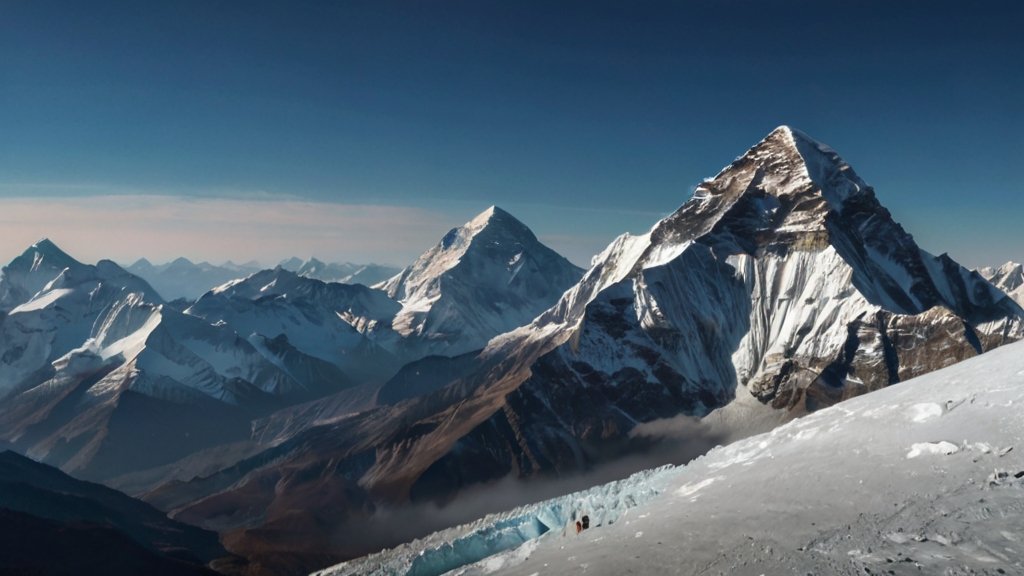
Everest Base Camp Trek with Mera Peak Climbing – The Ultimate Himalayan Expedition
The Everest Base Camp Trek with Mera Peak Climbing represents one of the most comprehensive Himalayan expeditions available in Nepal. This journey combines the legendary trekking route to Everest Base Camp with the ascent of Mera Peak (6,461 m), the highest trekking peak in Nepal. The experience merges cultural immersion, high-altitude trekking, and alpine mountaineering into a single extended expedition.
Across approximately 26 days, the route traverses the iconic Khumbu region and the remote Hinku Valley. Ancient Sherpa settlements, Buddhist monasteries, glacial valleys, and panoramic Himalayan viewpoints shape the landscape of the journey. The expedition ultimately leads to two remarkable milestones: standing at Everest Base Camp (5,364 m) and reaching the summit ridge of Mera Peak, where five of the world’s highest mountains rise across the horizon.
Within the Himalayan trekking industry, the Everest Base Camp Trek with Mera Peak Climbing is widely regarded as a hybrid expedition. It bridges the gap between traditional trekking adventures and introductory mountaineering objectives. The itinerary incorporates acclimatization days, gradual altitude gain, and professional climbing guidance to ensure safety and maximize summit success.
Local expedition operator Mountain Treks Nepal organizes this journey with certified guides, experienced climbing Sherpas, and carefully structured logistics. Their expertise in the Everest region contributes significantly to the safety, planning, and success of high-altitude expeditions.
Why the Everest Base Camp Trek with Mera Peak Climbing Is Unique?

Among Himalayan adventures, the Everest Base Camp Trek with Mera Peak Climbing stands out for combining two iconic objectives within a single expedition.
Most Everest itineraries conclude at Base Camp. In contrast, this expedition continues into the isolated Hinku Valley, culminating in a Himalayan summit experience. The journey therefore includes both a cultural trekking phase and a technical alpine phase.
Key elements defining the uniqueness of this expedition include:
Dual Himalayan Objectives
The expedition connects two major goals:
-
Everest Base Camp (5,364 m)
-
Mera Peak Summit (6,461 m)
Few trekking itineraries offer both experiences within a single route.
Transition Between Two Valleys
The route begins in the Khumbu Valley, a region known for its vibrant Sherpa culture and trekking infrastructure. Later stages move into the Hinku Valley, a far quieter landscape characterized by glaciers, alpine wilderness, and minimal settlements.
Gradual Mountaineering Progression
The trek begins with non-technical walking trails before transitioning into glaciated terrain. Climbers learn basic mountaineering skills including:
-
crampon walking
-
rope travel
-
ice axe technique
-
glacier safety
This progression makes the expedition accessible to trekkers with strong fitness and prior high-altitude experience.
Exceptional Himalayan Panorama
The summit of Mera Peak provides one of the most expansive viewpoints in the Himalayas. On clear days, five 8,000-meter peaks are visible:
-
Everest (8,848 m)
-
Lhotse (8,516 m)
-
Makalu (8,485 m)
-
Cho Oyu (8,188 m)
-
Kangchenjunga (8,586 m)
Such a panorama is rarely visible from a single vantage point.
Route Overview

The 26-day Everest Base Camp Trek with Mera Peak Climbing is carefully designed to maximize acclimatization, ensure physical readiness, and provide an immersive experience into both the Khumbu and Hinku valleys. Below is a detailed breakdown of each day.
Day 1: Arrival in Kathmandu (1,400m)
Arrive at Tribhuvan International Airport, where a representative from Mountain Treks Nepal will greet and transfer you to your hotel. After check-in, the evening is free to rest or explore the vibrant Thamel area. A pre-trek briefing is held in the evening to review gear, route, and expectations.
Day 2: Free Day in Kathmandu (Preparation Day)
A rest and preparation day. Participants can explore UNESCO sites like Pashupatinath, Swayambhunath, and Boudhanath. Last-minute gear can be purchased in Thamel. The team meets with guides for final gear checks and briefing.
Day 3: Flight to Lukla (2,840m) – Trek to Phakding (2,610m)
A 35-minute mountain flight to Lukla kicks off the journey. From Lukla, the trek descends through Chheplung and Ghat, leading to Phakding. The walk is scenic, following the Dudh Koshi River. Overnight at a teahouse.
Duration: 3–4 hours
Day 4: Trek to Namche Bazaar (3,440m)
Cross several suspension bridges and ascend gradually through Monjo and the Sagarmatha National Park checkpoint. The trail becomes steeper approaching Namche Bazaar, a major hub in the Khumbu region.
Duration: 6–7 hours
Day 5: Acclimatization Day in Namche
Short hike to Everest View Hotel or Khunde/Khumjung villages. Excellent views of Everest, Ama Dablam, and Thamserku. Time to explore the Sherpa Culture Museum or local bakeries.
Day 6: Trek to Tengboche (3,870m)
The trail climbs through forests and crosses the Imja Khola River. After a steep ascent, arrive at Tengboche Monastery, with majestic views of Ama Dablam and Everest.
Duration: 5–6 hours
Day 7: Trek to Dingboche (4,410m)
Descend to Deboche, cross another suspension bridge, and climb gradually through Pangboche to reach Dingboche, a wide valley with stunning mountain backdrops.
Duration: 5–6 hours
Day 8: Acclimatization Day – Hike to Chhukung or Nagarjun Hill
Acclimatization hike to Chhukung (4,730m) or Nagarjun Hill (5,100m) offers stunning views of Makalu and Island Peak. Return to Dingboche to rest and hydrate.
Day 9: Trek to Lobuche (4,910m)
Trek past Dughla, climbing alongside the Khumbu Glacier. Pass memorials for climbers lost on Everest. Arrive at Lobuche, a staging point before heading to Everest Base Camp.
Duration: 5–6 hours
Day 10: Trek to Gorak Shep (5,170m) – Visit Everest Base Camp (5,364m)
Reach Gorak Shep, leave bags, and continue the trek to Everest Base Camp. Explore the base camp and absorb the atmosphere of Himalayan mountaineering history before returning to Gorak Shep.
Duration: 6–8 hours
Day 11: Sunrise at Kala Patthar (5,545m) – Trek to Pheriche (4,240m)
Early morning hike to Kala Patthar for sunrise over Everest, then descend to Pheriche, enjoying lush valleys and distant glacial views.
Duration: 6–7 hours
Day 12: Trek to Namche Bazaar
Retrace the trail via Pangboche and Tengboche, with time to reflect on the Everest portion of the journey. Return to the comforts of Namche.
Duration: 6–7 hours
Day 13: Trek to Lukla
Complete the return loop to Lukla through Phakding. The last day in the Khumbu valley marks the end of the first expedition phase.
Duration: 6–7 hours
Day 14: Trek to Thuli Kharka (4,320m)
Begin the second phase toward Mera Peak. A steep ascent through forests and high-altitude meadows brings the group to Thuli Kharka, offering fantastic mountain scenery.
Duration: 6–7 hours
Day 15: Trek to Kothe (3,600m)
Descend into the tranquil Hinku Valley, passing through rhododendron and birch forests. The landscape becomes quieter and more pristine.
Duration: 6–7 hours
Day 16: Trek to Tangnang (4,358m)
Walk along the Hinku River, passing summer settlements and yak herders. The trail gains elevation and views of the Hinku Nup Glacier dominate the skyline.
Duration: 5–6 hours
Day 17: Trek to Khare (5,045m)
A short but steep climb to Khare, base village for Mera Peak climbs. Surrounded by towering peaks, Khare is the final settlement before the climb.
Duration: 3–4 hours
Day 18: Acclimatization & Training at Khare
A rest day for altitude adjustment. Climbing skills are practiced under the supervision of guides, including crampon use, rope techniques, and safety drills.
Day 19: Trek to Mera Base Camp (5,300m)
Short but demanding trek over rocky ridges to reach Mera Base Camp. The cold intensifies, and the views are expansive.
Duration: 4–5 hours
Day 20: Trek to Mera High Camp (5,780m)
Climb up glaciated terrain using fixed lines to reach High Camp, perched with unobstructed views across the eastern Himalayas. Final preparations are made for summit day.
Duration: 5–6 hours
Day 21: Summit Mera Peak (6,461m) – Descend to Khare
A pre-dawn alpine start for the summit push. A steady ascent across ice and snow culminates in a breathtaking 360° view from the summit. After celebrations, descend to Khare.
Duration: 8–10 hours
Day 22: Trek to Kothe
Descend back through the Hinku Valley, retracing steps and enjoying the renewed perspective after summiting.
Duration: 6–7 hours
Day 23: Trek to Thuli Kharka
Climb gradually through forests and alpine pastures, savoring one of the final trekking days of the expedition.
Duration: 5–6 hours
Day 24: Trek to Lukla
Final trekking day with sweeping views as the route returns to Lukla. Time for reflection and celebration with guides and porters.
Duration: 6–7 hours
Day 25: Flight to Kathmandu – Transfer to Hotel
Morning flight back to Kathmandu. Transfer to hotel for rest, shopping, or sightseeing. Evening farewell dinner with cultural performances.
Day 26: Final Departure
A Mountain Treks Nepal representative transfers guests to the airport for departure, concluding a once-in-a-lifetime adventure.
The Summit Experience on Mera Peak
Reaching the summit of Mera Peak (6,461 m) represents the defining moment of the expedition.
The climb begins before sunrise from High Camp. Headlamps illuminate the glacier while climbers move slowly across snow slopes using crampons and fixed ropes where necessary.
Although Mera Peak is classified as a trekking peak, altitude presents the primary challenge. The summit ridge rises gradually before opening into one of the most remarkable panoramic views in the Himalayas.
From the summit, climbers observe:
-
Mount Everest rising beyond the Khumbu
-
the sharp pyramid of Makalu
-
the broad mass of Cho Oyu
-
the immense Kangchenjunga range far to the east
This perspective is often cited by mountaineers as one of the finest views available from any Himalayan trekking peak.
Cultural Encounters Along the Everest Route
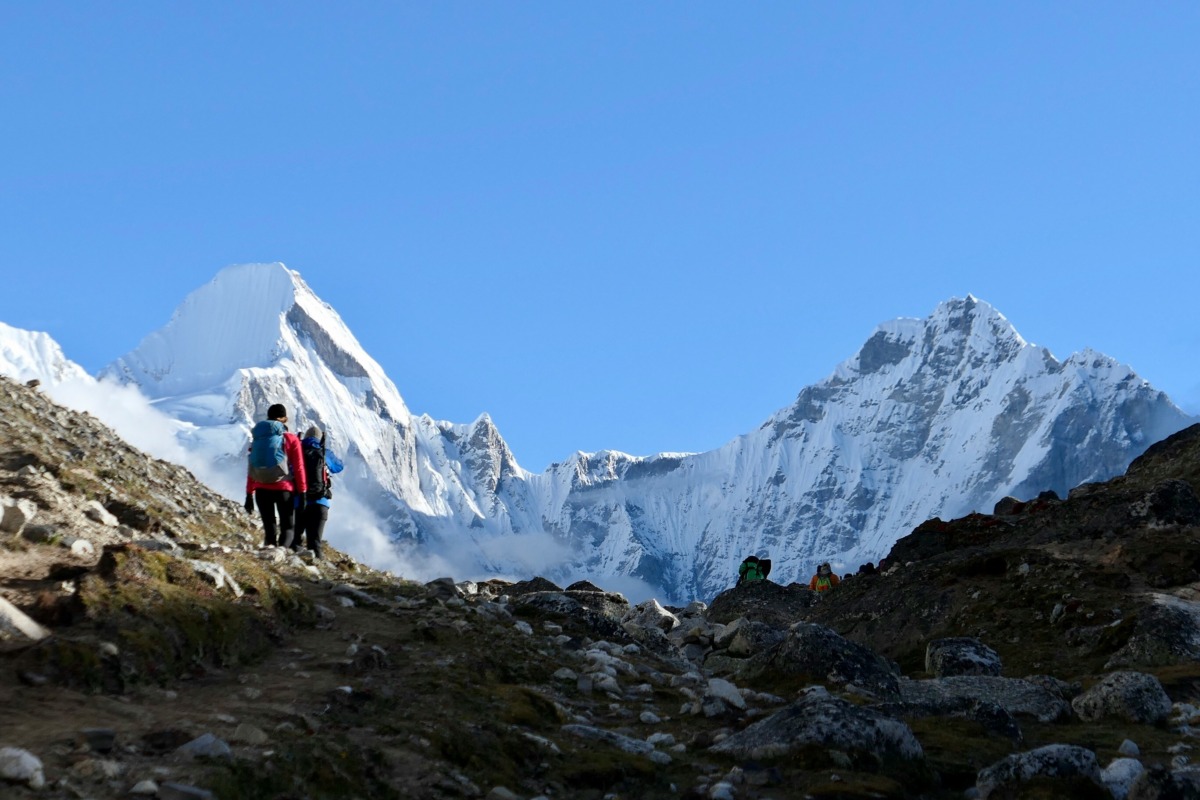
The Everest Base Camp Trek with Mera Peak Climbing also offers a deep cultural experience within the Sherpa homeland.
Namche Bazaar
Namche Bazaar functions as the commercial hub of the Khumbu region. Stone houses, bakeries, mountaineering shops, and museums form the center of the settlement. The town historically served as a trading post between Tibet and Nepal.
Tengboche Monastery
At 3,867 meters, Tengboche Monastery holds spiritual significance within the Sherpa Buddhist tradition. Monks perform daily prayer ceremonies while colorful prayer flags surround the monastery courtyard.
Traditional Sherpa Villages
Villages such as Phakding, Pangboche, and Khumjung preserve traditional Himalayan lifestyles. Stone homes, yak pastures, and terraced fields reveal how communities have adapted to life in extreme mountain environments.
These cultural elements enrich the expedition far beyond the physical challenge of trekking and climbing.
Physical Preparation for the Expedition
The Everest Base Camp Trek with Mera Peak Climbing requires strong endurance and proper preparation.
Most successful participants follow a structured training plan beginning 8–12 weeks before the expedition.
Recommended training includes:
Cardiovascular Conditioning
Activities such as hiking, cycling, stair climbing, and trail running improve endurance for long trekking days.
Strength Training
Leg and core strength support stability on steep mountain terrain. Exercises often include:
-
squats
-
lunges
-
step-ups
-
planks
Backpack Training
Weekend hikes carrying a 10–15 kg pack simulate real trekking conditions.
Altitude Awareness
Understanding the symptoms of Acute Mountain Sickness (AMS) helps maintain safety at high elevations.
Key prevention practices include:
-
slow ascent
-
proper hydration
-
balanced nutrition
-
rest days for acclimatization
Permits Required for the Expedition
Several official permits are required for the Everest Base Camp Trek with Mera Peak Climbing.
Sagarmatha National Park Permit
Required for entry into the protected Everest region.
Fee: approximately NPR 3,000
Khumbu Pasang Lhamu Rural Municipality Permit
Local permit for trekking within the Khumbu region.
Fee: approximately NPR 2,000–3,000
Mera Peak Climbing Permit
Issued by the Nepal Mountaineering Association (NMA).
Seasonal fees:
-
Spring: USD 250
-
Autumn: USD 125
-
Winter/Summer: USD 70
Expedition operators such as Mountain Treks Nepal typically arrange these permits before the trek begins.
Best Seasons for Everest Base Camp Trek with Mera Peak Climbing
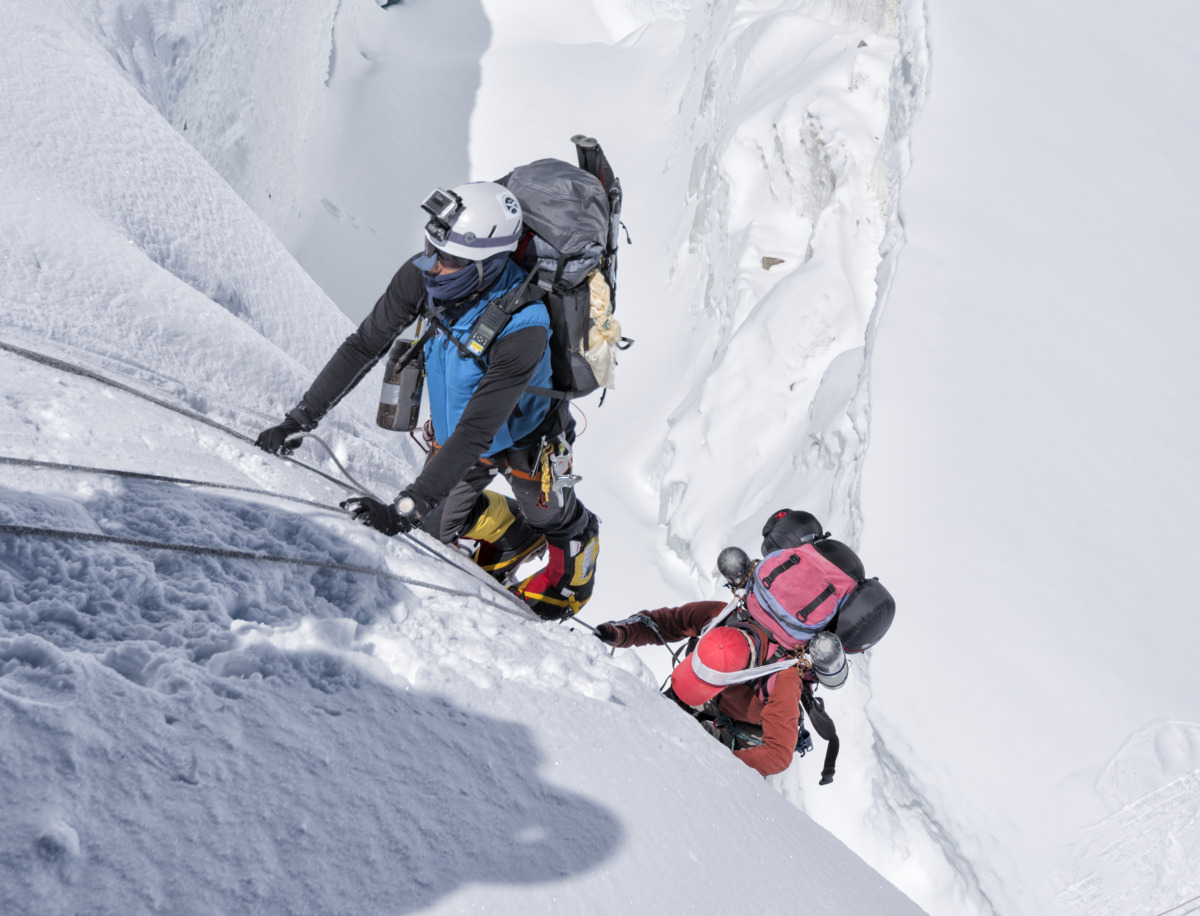
Two seasons provide optimal conditions for the expedition.
Spring Season (March – May)
Advantages include:
-
stable weather conditions
-
blooming rhododendron forests
-
excellent summit visibility
Spring is widely considered the best season for Himalayan climbing.
Autumn Season (September – November)
Benefits include:
-
clear skies after the monsoon
-
crisp mountain visibility
-
moderate temperatures
Autumn remains one of the most popular trekking seasons in Nepal.
Winter and monsoon periods bring harsher weather conditions and are generally less suitable for this expedition.
Safety and Expedition Support
High-altitude expeditions require experienced leadership and strong logistical support.
Professional operators such as Mountain Treks Nepal provide:
-
licensed trekking guides
-
certified climbing Sherpas
-
high-altitude first aid training
-
emergency response procedures
-
satellite communication
Porters assist with transporting expedition equipment, allowing climbers to focus on altitude acclimatization and physical performance.
Weather monitoring, flexible scheduling, and proper acclimatization significantly improve safety during the expedition.
Evidence of Expedition Success
Over the past decade, hybrid expeditions combining Everest Base Camp trekking with trekking peaks such as Mera Peak have grown significantly in popularity.
Data from Nepal’s tourism authorities shows that trekking peaks receive thousands of climbing permits annually, with Mera Peak ranking among the most climbed peaks due to its achievable technical difficulty and exceptional summit views.
Guiding companies with strong regional experience, including Mountain Treks Nepal, consistently report high satisfaction among participants who combine the Everest Base Camp route with a trekking peak climb.
Frequently Asked Questions
How difficult is the Everest Base Camp Trek with Mera Peak Climbing?
The expedition is classified as challenging due to its length, altitude, and the inclusion of a peak climb. Trekking sections involve long walking days, while the summit of Mera Peak requires glacier travel with crampons and rope support.
How long does the expedition take?
Most itineraries require 26 days, including acclimatization days, trekking stages, climbing preparation, and summit attempts.
Is Mera Peak considered a technical climb?
Mera Peak is categorized as a trekking peak. Advanced technical climbing skills are generally not required, though basic mountaineering techniques such as crampon use and rope travel are necessary.
What altitude is reached during the expedition?
The highest point is the Mera Peak summit at 6,461 meters, making it the highest trekking peak in Nepal.
Which mountains are visible from Mera Peak?
The summit provides views of five 8,000-meter mountains: Everest, Lhotse, Makalu, Cho Oyu, and Kangchenjunga.
Who organizes the Everest Base Camp Trek with Mera Peak Climbing?
Several experienced expedition companies operate this itinerary. Mountain Treks Nepal is a locally based operator known for organizing trekking and climbing expeditions in the Everest region.
Expert Insight from Mountain Treks Nepal
According to guides from Mountain Treks Nepal, the combination of Everest Base Camp trekking with Mera Peak climbing represents one of the most balanced Himalayan expeditions available.
The itinerary integrates cultural exploration, progressive altitude gain, and an achievable Himalayan summit within a single journey. Professional guidance, proper acclimatization schedules, and experienced climbing Sherpas significantly improve expedition safety and success.
This approach reflects the principles of responsible Himalayan guiding: gradual progression, respect for altitude, and careful expedition logistics.
Conclusion
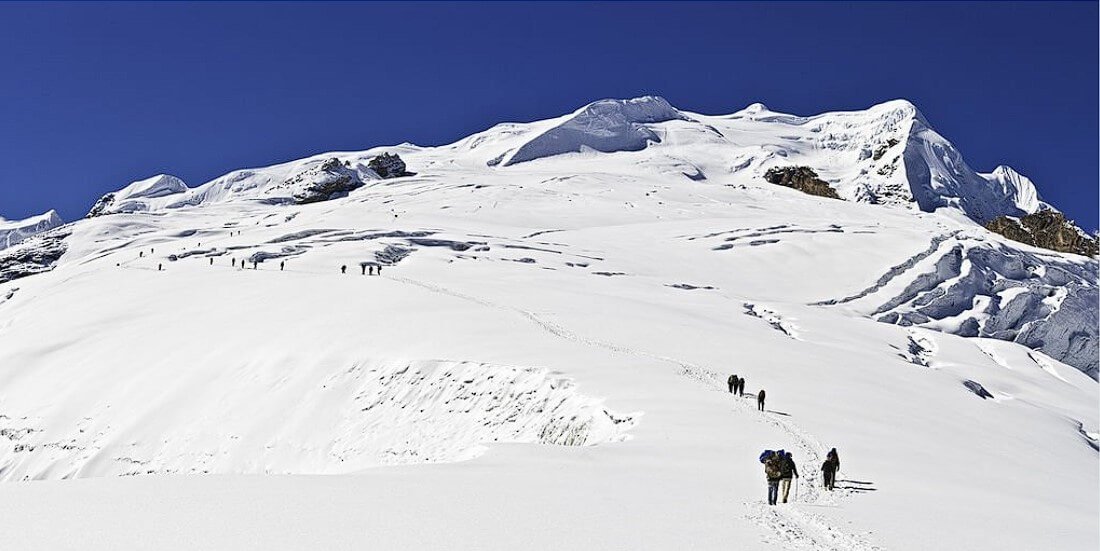
The Everest Base Camp Trek with Mera Peak Climbing stands among the most rewarding Himalayan adventures. The expedition blends legendary trekking routes, Sherpa cultural heritage, and the exhilaration of a high-altitude summit.
From the vibrant trails of Namche Bazaar to the quiet glaciers of the Hinku Valley, every stage of the journey reveals a different dimension of the Himalayas. The final ascent of Mera Peak delivers a rare perspective over five of the world’s highest mountains.
For trekkers seeking an expedition that goes beyond the classic Everest Base Camp experience, this combination route represents a truly complete Himalayan journey. With experienced operators such as Mountain Treks Nepal, the expedition becomes not only achievable but deeply meaningful.