



Share This:
Mera Peak Climbing 2026 | 17 Days Expedition | Mountain Treks Nepal
The allure of the Himalayas often centers on the world’s 8,000-meter giants, yet tucked within the Hinku Valley lies a magnificent objective that offers the grandeur of a major expedition with a more accessible approach. Mera Peak Climbing stands as the premier choice for adventurers seeking the title of the highest trekking peak in Nepal. Reaching an impressive altitude of 6,476 meters (21,247 feet), this expedition provides a profound mountaineering experience without the extreme technical demands of vertical rock or ice walls. At Mountain Treks Nepal, the focus remains on delivering a safe, culturally immersive, and successful journey to this iconic summit.
Understanding the Three Summits of Mera Peak
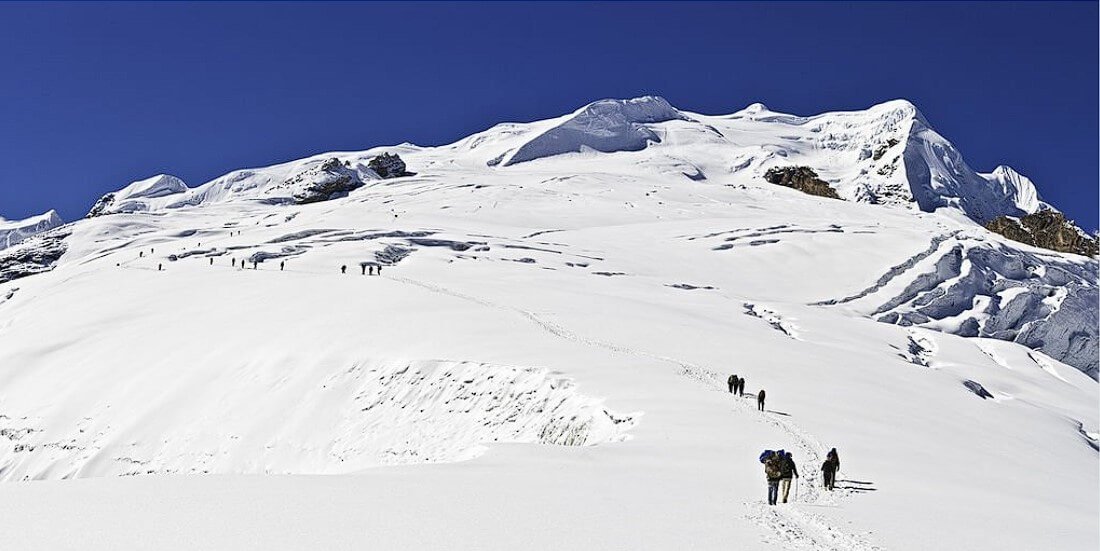
Mera Peak is not a single point but a small massif consisting of three distinct summits. Each offers a different perspective of the surrounding wilderness:
-
Mera North (6,476m / 21,246ft): The highest point and the primary objective for most climbing expeditions. The route involves traversing high-altitude glaciers.
-
Mera Central (6,461m / 21,197ft): Often the most popular destination for trekking groups, providing nearly identical views to the North summit.
-
Mera South (6,065m / 19,898ft): The lowest of the three, usually used as an acclimatization point or a secondary objective.
For climbers joining Mountain Treks Nepal, the goal is typically Mera Central or North, ensuring the achievement of standing above 6,000 meters while gazing upon five of the world’s six highest mountains.
The Unrivaled Panorama from the Summit
The primary reason Mera Peak Climbing has gained massive popularity is the reward waiting at the top. The summit serves as a 360-degree theater of the giants. From the crest, five of the highest peaks on Earth are visible in a single sweeping glance:
-
Mount Everest (8,848.86m): Standing tall as the roof of the world.
-
Lhotse (8,516m): The imposing neighbor to Everest.
-
Makalu (8,485m): An isolated pyramid of rock and ice.
-
Cho Oyu (8,188m): The turquoise goddess to the west.
-
Kanchenjunga (8,586m): The massive Five Treasures of the Snow on the far eastern border.
Beyond these giants, the view includes Ama Dablam, Nuptse, Chamlang, and Baruntse. This specific visual vantage point is unique to Mera Peak, making it a superior choice for photographers and mountain enthusiasts.
Detailed 17-Day Expedition Itinerary
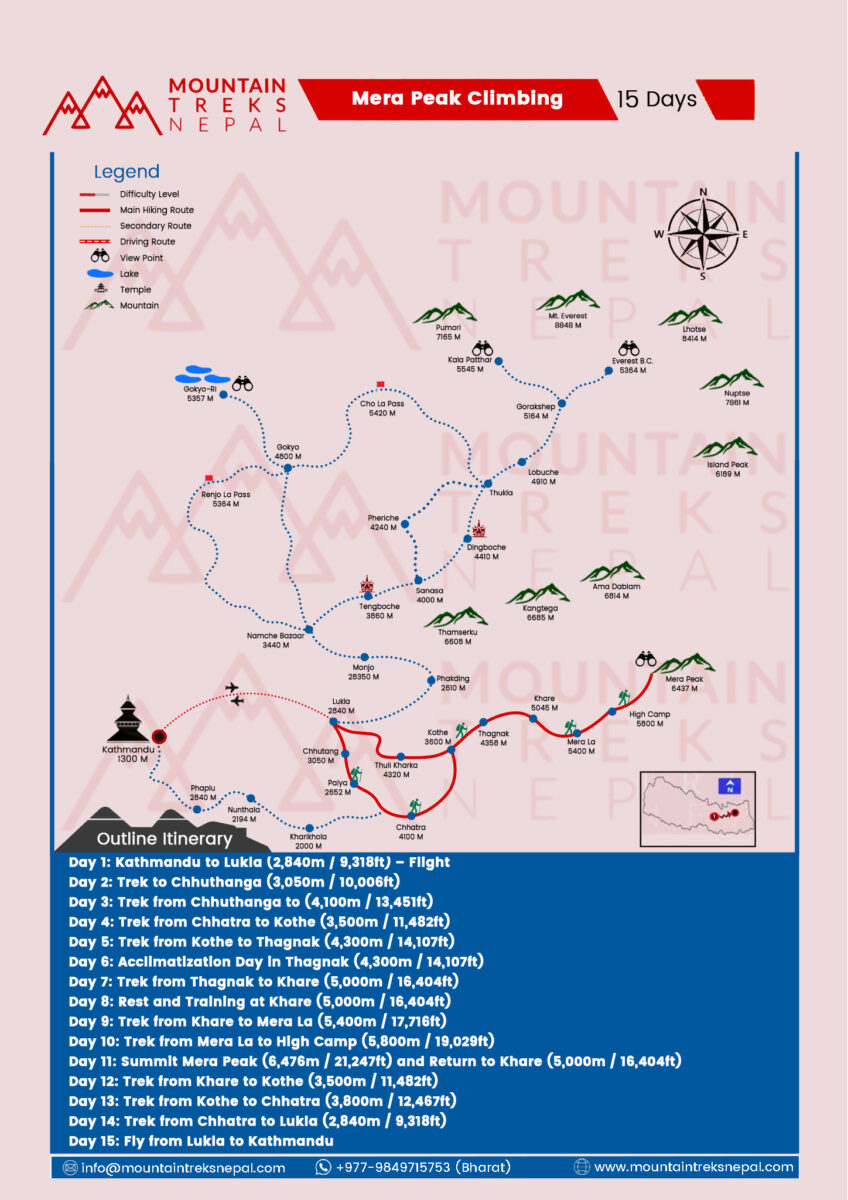
Success on a 6,000-meter peak depends entirely on the pacing of the journey. Mountain Treks Nepal utilizes a carefully crafted 17-day schedule to ensure maximum acclimatization and physical readiness.
Phase 1: Preparation and the Gateway
Day 01–02: Arrival and Cultural Immersion in Kathmandu
The journey begins at Tribhuvan International Airport. The first two days focus on logistical preparation and cultural orientation. Kathmandu, the city of temples, hosts seven UNESCO World Heritage Sites. Explorations typically include the sacred Pashupatinath Temple or the towering Boudhanath Stupa. A final gear check and briefing at the Mountain Treks Nepal office ensure all technical equipment is ready for the alpine environment.
Day 03: Flight to Lukla and Trek to Chhuthang (3,020m)
A thrilling 35-minute flight lands at the Tenzing-Hillary Airport in Lukla. Unlike the standard Everest Base Camp trail, the route for Mera Peak turns away from the crowds, heading toward the Kalo Himal Ridge. The trek to Chhuthang winds through thick rhododendron forests, setting a peaceful tone for the adventure ahead.
Phase 2: Crossing the High Pass
Day 04: Chhuthang to Tuli Kharka (4,300m) via Zatrawal Pass (4,600m)
This is a pivotal day. Crossing the Zatrawal Pass is a challenging introduction to high-altitude trekking. Reaching 4,600 meters provides the first taste of thin air and expansive views of Lumdung Himal. The descent into Tuli Kharka leads to a high pasture land where the silence of the mountains truly begins.
Day 05–06: Deep into the Hinku Valley (Kothe to Thangnak)
The trail descends into the lush Hinku Valley. Forests of pine and oak give way to rocky riverbanks. Thangnak (4,326m) serves as a vital resting point. Nearby, the 200-year-old Lungsumgba Gumba offers a spiritual sanctuary for climbers seeking blessings for a safe summit.
Phase 3: The Approach to the Peak
Day 07–08: Reaching Khare and Acclimatization (5,000m)
Khare is the final permanent settlement before the climb. At 5,000 meters, the body requires time to adjust. Mountain Treks Nepal schedules a full acclimatization day here. This time is spent practicing basic mountaineering skills: using crampons, handling an ice axe, and learning to move on a fixed rope.
Day 09–10: Mera High Camp and Contingency (5,700m)
Leaving the comforts of the teahouses, the team moves onto the Mera La Glacier. High Camp is perched on a rocky shelf at 5,700 meters. A contingency day is built into the schedule here. High-altitude weather is unpredictable; having a “reserve day” significantly increases the success rate by allowing the team to wait for a perfect weather window.
Phase 4: The Summit and Return
Day 11: The Summit Push (6,461m) and Return to Khare
The climb begins long before dawn, around 2:00 AM. Under the glow of headlamps, climbers navigate the snowy slopes. The final 40-50 meters involve a steep snow dome requiring the use of a jumar on a fixed rope. Reaching the summit as the sun rises over the Himalayas is a life-changing moment. After soaking in the views, a long descent leads back to the safety of Khare.
Day 12–17: Retracing Steps and Farewell
The return journey follows the Hinku Valley back through Kothe and Tuli Kharka, crossing the Zatrawal Pass once more to reach Lukla. A final flight to Kathmandu marks the transition back to civilization, celebrated with a farewell dinner hosted by Mountain Treks Nepal.
Best Seasons for Mera Peak Climbing
Timing is everything in the Himalayas. Mountain Treks Nepal recommends two primary windows:
Spring (March to May)
Spring is the season of rebirth. The lower trails are vibrant with blooming rhododendrons, and the weather is generally stable. While the summit temperatures remain cold (dropping to -10°C or lower), the daytime trekking temperatures are pleasant. This season is ideal for those who enjoy lush landscapes and active wildlife.
Autumn (September to November)
Autumn is widely considered the “Gold Standard” for Mera Peak Climbing. After the monsoon rains, the atmosphere is scrubbed clean, resulting in the sharpest, most crystal-clear views of the high peaks. The weather is very stable, though temperatures at High Camp can be significantly colder than in spring. This season also coincides with Nepal’s major festivals, adding a layer of cultural richness to the trip.
Physical and Mental Preparation
Mera Peak Climbing is classified as a “trekking peak,” but that does not mean it is easy. It is a physically demanding endeavor that requires preparation 4 to 6 months in advance.
Strength and Endurance
The trek involves covering approximately 125 kilometers (78 miles) with significant elevation changes. Training should include:
-
Cardiovascular Fitness: Long-distance running, swimming, or cycling to improve lung capacity.
-
Leg Strength: Squats, lunges, and step-ups (ideally while wearing a weighted backpack).
-
Practice Hikes: Weekend treks on steep terrain help break in boots and prepare the body for consecutive days of movement.
Mental Fortitude
The high-altitude environment brings discomfort—cold temperatures, basic living conditions, and the effects of thin air. Developing a “growth mindset” and practicing controlled breathing techniques are essential. Being prepared to step out of a comfort zone is what separates a successful climber from the rest.
Essential Gear and Equipment
While Mountain Treks Nepal provides group climbing gear such as ropes and snow bars, individual climbers must be equipped with high-quality personal gear.
| Category | Essential Items |
| Footwear | Double plastic or insulated leather mountaineering boots, trekking boots, down booties for camp. |
| Clothing | Base layers (merino wool), fleece mid-layers, hardshell waterproof jacket/pants, down suit or heavy down jacket. |
| Technical Gear | Climbing harness, crampons (fitted to boots), ice axe, jumar (ascender), carabiners, and a helmet. |
| Miscellaneous | -30°C rated sleeping bag, UV-protection sunglasses (Cat 4), headlamp with extra batteries, and a 50L–60L rucksack. |
Safety, Altitude Sickness, and Insurance
Safety is the cornerstone of every Mountain Treks Nepal expedition. At altitudes above 5,000 meters, Acute Mountain Sickness (AMS) is a real risk.
Preventive Measures:
-
Hydration: Drinking 3–4 liters of water daily helps thin the blood and aids acclimatization.
-
Pace: Moving slowly (“Bistari, Bistari”) allows the heart and lungs to adjust.
-
Acclimatization: Following the “climb high, sleep low” philosophy.
Travel Insurance:
It is mandatory to have a comprehensive insurance policy that specifically covers mountaineering up to 6,500 meters and includes helicopter evacuation. In the remote Hinku Valley, a helicopter is often the only means of rapid medical transport.
Why Choose Mountain Treks Nepal?

Choosing a partner for a Himalayan expedition is a decision that impacts both safety and enjoyment. Mountain Treks Nepal distinguishes itself through:
-
Expert Guiding: Our guides are licensed by the Nepal Mountaineering Association (NMA) and possess years of experience on Mera Peak. They understand the nuances of the terrain and the local weather patterns.
-
Sustainability: We follow eco-tourism principles, ensuring that our presence in the Hinku Valley leaves no trace and supports the local economy.
-
High Success Rate: By including contingency days and focusing on proper nutrition and hydration, we maintain a success rate of over 95% for our climbers.
-
Logistical Excellence: From private airport transfers to carefully selected teahouses and high-quality tented camps, every detail is managed so climbers can focus on the mountain.
Mera Peak Climbing is more than just a summit; it is a journey through the heart of the world’s highest mountains. It offers a gateway into the world of high-altitude mountaineering, providing the skills and confidence needed for future 7,000 or 8,000-meter objectives. Whether standing on the summit looking at Everest or sharing a meal in a remote teahouse in the Hinku Valley, the experience with Mountain Treks Nepal is designed to be the adventure of a lifetime.