



Share This:

Mera Peak Climbing: Complete 2026 Guide (Route, Permits, Training, Safety)
Mera Peak Climbing stands among Nepal’s most rewarding high-altitude objectives because it blends a remote Himalayan trek with a non-extreme summit day and a panoramic payoff that includes Everest, Lhotse, Makalu, Cho Oyu, and Kanchenjunga on clear mornings. The peak sits above the Hinku Valley in the Mahalangur (Khumbu) region of Solukhumbu, away from the busiest Everest Base Camp corridor, so the approach often feels wilder, quieter, and more alpine than classic teahouse routes.
The term “trekking peak” can be misleading. Mera Peak Climbing is not technical in the way of steep ice faces or sustained mixed climbing, but the environment remains serious: glacier travel, crevasse terrain, winter wind, whiteout risk, and the physiology of sleeping above 5,000 meters. Successful outcomes depend more on acclimatization, decision-making, and systems (weather planning, rope protocols, hydration strategy, rescue planning) than on advanced rock or ice skills.
Mountain Treks Nepal operates Mera Peak Climbing itineraries with the usual 17-day structure (Kathmandu–Lukla–Hinku Valley approach–Khare training and acclimatization–High Camp–summit–return), aligning with established logistics in the region while keeping the climb within a realistic timeframe for most fit trekkers.
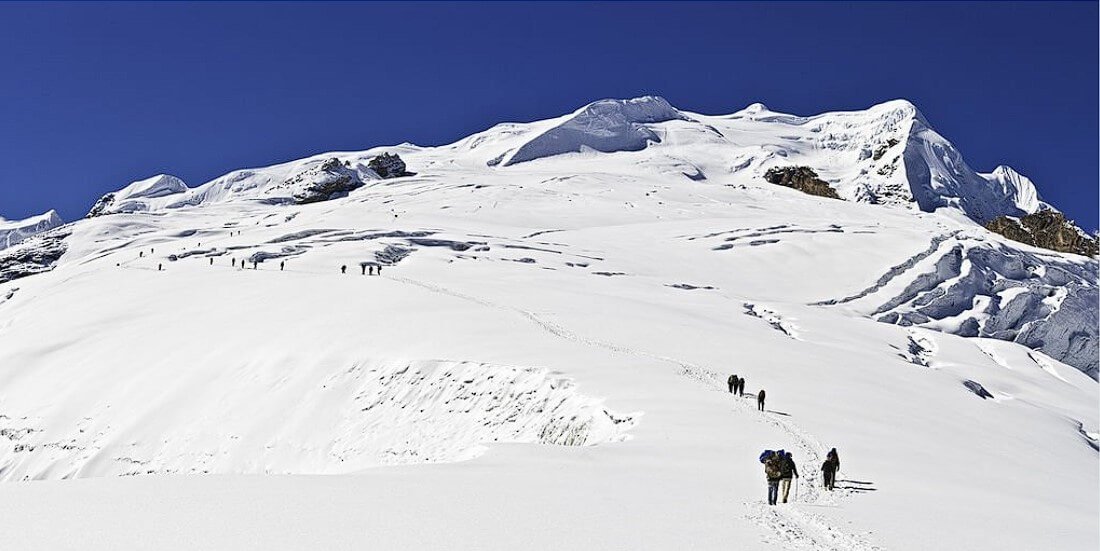
Mera Peak at a glance
-
Region: Solukhumbu (Khumbu/Mahalangur), Hinku Valley approach
-
High point: Often listed as 6,476 m, while Nepal Government peak profile lists 6,470 m (different references and survey conventions appear across sources)
-
Experience category: High-altitude glacier trek + summit day (rope, crampons, ice axe commonly used)
-
Typical duration: 15–18 days; 17 days is common and matches official profile duration listings
-
Best seasons: Spring (March–May) and Autumn (September–November) for stability and visibility (winter/monsoon can work but raise weather risk)
Why Mera Peak Climbing is considered “the highest trekking peak”?
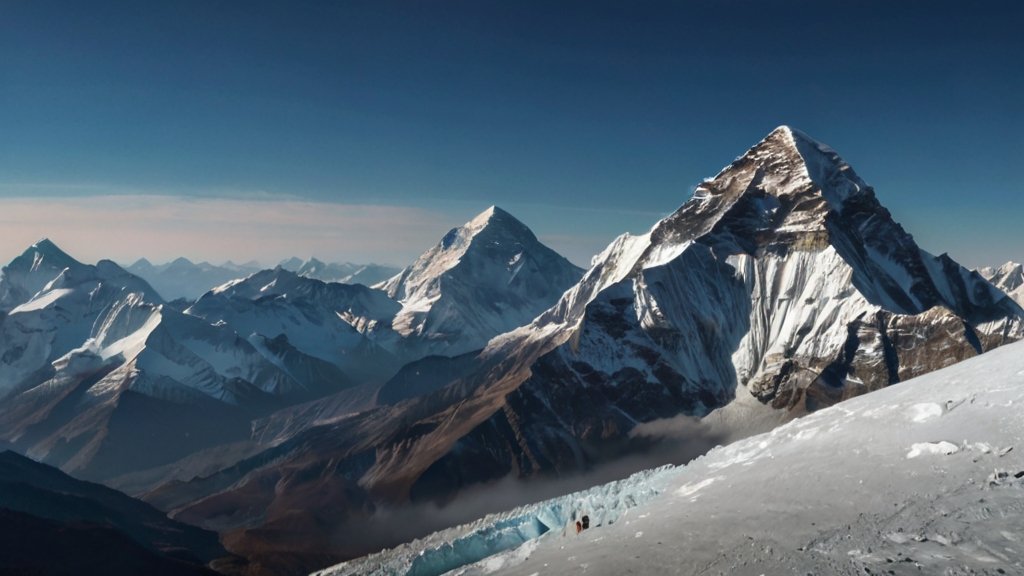
Mera Peak is widely described as Nepal’s highest trekking peak because it sits near the upper limit of what Nepal’s trekking peak system covers and because its most popular summit line avoids highly technical terrain in normal conditions. The practical result: an attainable summit for climbers with strong trekking fitness and guided glacier training, while still delivering a true high-altitude summit experience.
However, “attainable” does not mean “easy.” At 6,400 meters, oxygen availability is significantly reduced, sleep quality declines, dehydration accelerates, and minor respiratory infections can turn serious quickly. The route also crosses glaciated terrain above Khare and High Camp where rope travel and crevasse awareness matter.
Route overview: Lukla to Hinku Valley to High Camp

Most itineraries start with a flight to Lukla, then cross the Zatrwa La area into the Hinku Valley and continue through settlements such as Kothe, Thagnak, and Khare, which functions as a primary staging and training base. From Khare, the route climbs across glacial terrain toward Mera La and High Camp, followed by a summit push and descent back to Khare before returning toward Lukla.
Key route logic (why the itinerary works)
-
Early days: Gradual elevation gain and forest trails build aerobic rhythm and reduce early overexertion.
-
Mid-route: Time in Kothe/Thagnak supports a steady climb profile before the 5,000 m threshold.
-
Khare block: Extra nights at ~5,000 m enable both acclimatization and glacier skills practice.
-
High Camp: A short, high sleep before summit day improves timing to hit stable morning conditions.
Difficulty: what makes Mera Peak Climbing “moderate to difficult”
Difficulty on Mera Peak Climbing comes from compounding factors rather than technical moves:
-
High altitude physiology
Acute Mountain Sickness (AMS) risk increases with rapid ascent and poor hydration, and performance drops sharply above 5,500 m. -
Cold + wind exposure
High Camp and summit ridge can be wind-affected; frostbite risk rises with inadequate glove/boot systems. -
Glacier travel and timing
Crevasse zones demand roped movement and pacing discipline; summit success often depends on efficient transitions (crampons on/off, layering, hydration access). -
Logistics volatility
Lukla flights and high valley weather windows can shift itineraries quickly.
Mera Peak Climbing is therefore best described as moderate technically, demanding physically, and serious environmentally.
Training standards that correlate with summit success
Evidence from expedition operations across Nepal consistently points to the same predictors of success:
-
Aerobic base: Ability to hike 6–8 hours for consecutive days with a moderate pack at low altitude.
-
Uphill durability: Comfort on sustained climbs (1,000–1,400 m vertical gain days).
-
Strength endurance: Step-ups, lunges, loaded carries, and calf/ankle resilience reduce overuse injuries on descent.
-
Cold and systems readiness: Familiarity with layering, hydration management in freezing temperatures, and glove dexterity.
A simple benchmark often used in expedition screening: consistent weekly hiking or stair training for 8–12 weeks, plus at least one long day (6+ hours) per week in the final month.
Acclimatization strategy: the non-negotiable core of Mera Peak Climbing
A safe Mera Peak Climbing plan respects acclimatization through gradual ascent, rest or active acclimatization days, and early recognition of symptoms.
Common acclimatization placements:
-
One extra night around Thagnak (4,300 m) or nearby ridges
-
One to two extra nights in Khare (5,000 m), including training and a short acclimatization hike
This structure mirrors the route patterns used across modern Mera Peak itineraries.
Best seasons for Mera Peak Climbing
Spring (March–May)
-
Typically stable mornings, improving summit window probability
-
Warmer temperatures than winter; snow conditions can still vary
Autumn (September–November)
-
Often excellent visibility after monsoon, with cooler, crisp conditions
-
Nights become colder as November progresses
Winter (December–February)
-
Fewer crowds; colder, windier, greater storm exposure
Monsoon/Summer (June–August)
-
Higher precipitation; cloud cover and trail conditions can complicate approach travel
Season choice should align with risk tolerance, cold readiness, and flexibility for flight and weather delays.
Permits and official fees for Mera Peak Climbing
Mera Peak is managed under Nepal’s trekking peak system. Official listings vary by institution and reference year, but the Government peak profile and TAAN’s published schedule show the commonly used foreign climber royalty figures for Mera Peak as:
-
Spring: USD 250
-
Autumn: USD 125
-
Winter/Summer: USD 70
TAAN also lists an additional garbage deposit of USD 250 for acquiring a climbing permit (refundable under NMA provisions), along with crew insurance requirements and a helicopter rescue coverage requirement statement in its published guidance.
Important note (practical reality): Permit systems and fee schedules in Nepal sometimes change. The most reliable approach is confirming the current fee and documentation requirements through the operating agency and the issuing authorities close to departure.
Food, accommodation, and the comfort curve
Kathmandu
Hotel accommodation with broad food options (Nepali, continental, Asian staples). Early trip meals are useful for carbohydrate loading and hydration.
Teahouse trekking phase (Lukla to Khare)
-
Accommodation: Basic lodges with shared rooms and common dining spaces; blankets vary by lodge.
-
Food: Dal bhat, noodles, soups, potatoes, eggs, pancakes; portions and menus shrink as altitude rises.
-
Hydration: Boiled water and purification remain the norm; carrying electrolyte mix is common practice.
High Camp and summit phase
Above Khare, the itinerary generally shifts to tented camps for High Camp. Warm fluids and easy-to-digest meals matter more than variety because appetite often drops at altitude.
Communication and connectivity
Connectivity reduces quickly beyond Lukla. Some lodges offer paid Wi-Fi or hotspot access, but reliability varies. Local SIMs (Nepal Telecom / Ncell) may provide intermittent signal in parts of the region; gaps are normal. Expedition operations often carry satellite communication options for safety-critical messaging.
Safety: altitude illness, cold injury, and decision protocols
Altitude illness (AMS/HACE/HAPE)
Risk rises with rapid ascent, dehydration, poor sleep, and overexertion. Operational best practice includes:
-
Conservative pacing (rest-step rhythm above 4,500 m)
-
Mandatory hydration targets
-
Symptom-led decision-making with clear descent triggers
Cold injury
Windchill is the hidden amplifier. Frostbite prevention is mostly systems-based:
-
Correct mitt/glove layering
-
Warm boots compatible with crampons
-
Dry-sock discipline and vapor management
Weather and whiteout
Summit days can deteriorate quickly. A “turnaround time” rule (fixed time to abandon summit attempt regardless of proximity) is a standard safety protocol on Mera Peak Climbing.
Recent incidents reported in Nepal’s high mountains underline the seriousness of early-season storms and exposure risk in the region.
Gear and equipment: the practical essentials
A functional Mera Peak Climbing kit focuses on warmth, footing, and glacier safety:
-
Footwear: Warm, stiff boots suitable for crampons; gaiters recommended
-
Crampons + ice axe: Used above Khare/High Camp zones
-
Harness + helmet + carabiners: For rope travel and safety systems
-
Layering: Base layer, midlayer fleece, insulated down, waterproof shell
-
Gloves: Liner + insulated glove + over-mitt system
-
Sleeping system: Four-season sleeping bag for high camp nights
-
Eye protection: Category 3–4 sunglasses; glacier glare is intense
-
Hydration: Insulated bottle covers; electrolyte mix; purification method
A well-run Khare training day typically covers walking in crampons, safe use of an ice axe, basic rope movement, and travel discipline.
Sample 17-day structure (high-level)
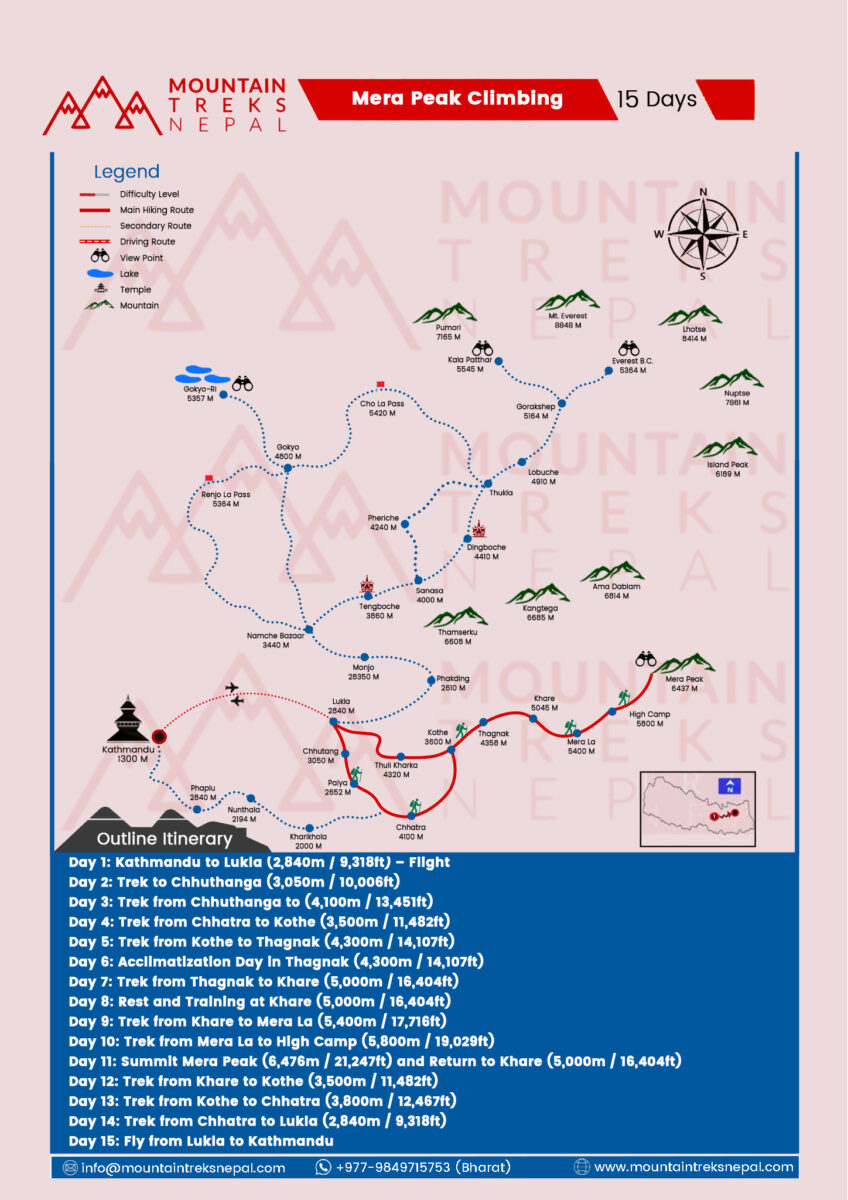
This outline matches common logistics patterns used across modern itineraries without locking into one exact day-by-day script:
1. Arrival in Kathmandu, Transfer to Hotel
Upon landing at Kathmandu’s airport, a representative from Mountain Treks Nepal will meet you and transfer you to your hotel. You can either take a rest at your hotel or explore the cultural heritage and modern charm of the capital city. You can explore the UNESCO World Heritage Sites in the city, such as Pashupatinath Temple and Boudhanath Stupa.
In the evening, you can stroll around the city and taste traditional Nepalese food and local markets in Thamel. Overnight stay at a hotel in Kathmandu.
2. Kathmandu to Lukla (Flight)
On the second day of the Mera Peak Climbing, you will fly to Tenzing Norgay Airport from Kathmandu. A flight of 30 minutes from Kathmandu brings you to Lukla, where the majestic heights of the Himalayas wait to be conquered at 2840 meters. This flight offers to take the traveler in full view and experience the vastness of snow-covered summits, the green valleys and the fascinating farmlands suspended in terraces.
Lukla is a small, busy town whose major purpose is to be the link to the Everest region. In the evening, you will stay at your lodge in Lukla.
3. Trek to Chuttanga (3,050m)
Today, we will trek from Lukla to Chuttanga, which can be completed in around 5 to 6 hours. The trek begins with a smooth approach into the pine and rhododendron forests. The journey goes over a distance of approximately 8 kilometers and an elevation difference of about 200 meters.
You will pass through small Sherpa settlements, where one can observe the traditional way of living by the locals. A transition to tougher terrain signals that one has ascended to greater altitudes on their approach to Chuttanga. Chuttanga is that gentle, serene patch, quietly enveloped by forested hills, perfect for acclimatization.
4. Chuttanga to Chhatra (4,100m)
Day 4 of the Mera Peak Climbing 17 Days will bring you to Chhatra from Chattanga. This section of the trek is a challenging climb through thick alpine forests leading to the Zatrwa La Pass. It’s a very long pass, taking about 6-7 hours. You can see very scenic views of the surrounding peaks, including the Kusum Kanguru highlight of the day’s walk.
Chhatra, the last destination of the trek, generally has a cool evening, and the temperatures even go below freezing at night. The village has superb scenic views of the Hinku Valley and is a very important acclimatization station.
5. Chhatra to Kothe (3,500m)
The journey entails a continuous 6-hour ascend into the enchanting Hinku Valley. The trail stretches through lush alpine meadows, through the rhododendron forests, along the banks of Inkhu Khola. The hike reveals initial views of Mera Peak’s south face and surrounding snow-capped high peaks.
Kothe is a vibrant Sherpa settlement with a Tibetan Buddhism ambiance. The village sits at the bank of the river and provides several spaces for discovery of local traditions. You will stay overnight at a tea house in Kothe.
6. Kothe to Thagnak (4,300m)
Today’s hike is fairly easy, taking about four to five hours. This is a trail that runs on the west bank of the Inkhu Khola and takes you up to the high-altitude zone. It will be offering views of both Kusum Kanguru and the south face of Mera Peak throughout the day. While passing small settlements and grazing pastures, you will also see a monastery hewn in the rock, adding a spiritual aspect to the day.
The village of Thagnak serves as an important acclimatization point, giving you clear views of the Sabai Glacier and the nearby peaks. Overnight stay at Thagnak.
7. Acclimatization Day in Thagnak
The seventh day of the Mera Peak Climbing is set for acclimatization. In the meantime, you can also take a short hike to Sabal Tsho Lake or go to a nearby ridge, which ascends to around 5000m. The lake actually reflects the surrounding peaks, a perfect spot for taking some pictures and relaxing in the sun.
Thagnak ‘s exposure is really good for viewing Kusum Kanguru and other peaks pertaining to the Hinku region. The cold temperature reminds you that you are high up, thus requiring good gear to survive. Take this time to rest and mentally prepare yourself for the more challenging days to come.
8. Thagnak to Khare (5,000m)
Today, you will hike to Khare, which introduces you to glacial terrains. The gradual ascent goes through an open valley with stunning views of the Sabai Glacier and Hinku Nup Glacier’s north faces. Along the way, you will also have beautiful sights of the tranquil Tama Pokhari Lake as you cross some parts of moraine and icy patches.
Khare is the base where you can acclimatize and prepare for Mera Peak. The view here dazzles everyone who comes here as the majestic peak rises above the skyline. Nights here are cold, and temperatures fall way below the freezing point. Today, you will prepare your climbing gear and relax before the final ascent at night.
9. Rest and Training at Khare (5,000m)
It is acclimatization and practice day today, which is planned for the summit. As you prepare and acclimatize, you also enjoy the clear views of Mera Peak and nearby ranges. Here, the climbing guide will demonstrate the basic techniques of using crampons, ice axes, ropes and other climbing gear, which are crucial for Mera Peak Climbing.
Khare has very frosty and crisp weather because night temperatures drop below -10 degrees C. This extra day will not only acclimatize but build confidence into that very grueling climb. Short exploration walks around Khare can be made to experience the beauty of high altitudes.
10. Khare to Mera La (5,400m)
Trek to Mera La is a very steep 4-5 hour trek that passes through glacial terrain. During the journey, the views of the towering peaks such as Everest, Lhotse, and Nuptse become even more stunning.
Mera La gives great views over the snowfields and peaks surrounding it, but it is also pretty unpredictable, with sharp winds and temperatures. Today, you will camp at Mera La and spend the evening preparing for the following day’s climb.
11. Mera La to High Camp (5,800m)
This journey from Mera La to High Camp takes less than 4 hours but is quite challenging. The path begins to steepen while you are going up and gives way to ice paths and rocky ridges. Though climbing requires concentration and endurance, the enchantment of stunning views of Makalu, Kanchenjunga, and Baruntse will fuel your spirit.
High Camp is located on a rocky outcrop and is said to offer one of its best panoramic Himalayan views. The conditions can be harsh, with temperatures that often go as low as -15 degrees or below. You will stay at a tented camp.
12. High Camp to Mera Peak Summit (6,476m) and Back to Khare
The summit day of Mera Peak Climbing commences early in the morning. The headlamps are used to enlighten the way through the icy terrain. Climbing the Mera Peak summit takes around five to six hours. As a summit reward, you can enjoy a 360-degree view of Everest, Makalu, Kanchenjunga, and other giants of the Himalayas.
After relishing the moment, one will revert to High Camp for a quick rest and then proceed to descend to Khare. This is one long day, a challenging trek, but it is highly satisfying. By evening, you’ll be back in Khare, ready for some warm food and a place to rest.
13. Khare to Kothe (3,500m)
Today, we will descend to Kothe from Khare following the same track through glacial terrains and alpine meadows. Descending is much more effortless than ascending, with the drop in altitude. You will cross Hinku Valley once again, and the lower you go, the clearer the view of the surrounding peaks becomes.
It is quite warm in these regions after the difficulties of crossing mountains. It is, in fact, very calming here because of the Inkhu Khola river. You will stay overnight at a tea house enjoying a warm dinner.
14. Kothe to Chhatra (3,800m)
Trek from Kothe to Chatra takes about six hours, going back through the forests of rhododendron and pine. The hike is moderately challenging, with ups and downs, which becomes more scenic as the heights are reached because the views of the Hinku Valley and other tall peaks come back.
Now you are in Chhatra, where the temperature begins to cool again, especially at night. So, here is a good place to reflect on your journey so far: stay in a teahouse and prepare for the final steps of returning to Lukla.
15. Chhatra to Lukla (2,840m)
It’s a long trek from Chhatra to Lukla and at least seven to eight hours long. You will pass through the Zatrwa La Pass one last time and take in the panoramic views of the Dudh Koshi Valley and the peaks like Kusum Kanguru. The trail gradually descends, and it becomes easier as one approaches Lukla.
Lukla is where all trekkers come for the final celebration of their treks. You will spend the evening tasting the local food and resting at a tea house.
16. Fly Back to Kathmandu
Today, we will fly back to Kathmandu from Lukla. The flight takes about 30 minutes, allowing one to have a thrilling feeling. You will reach Kathmandu, and spend the rest of your day relaxing, shopping for souvenirs, or visiting parts of the city you have not yet experienced.
In the evening, you will enjoy a grand farewell dinner organized by Mountain Treks Nepal. Overnight stay at a hotel.
17. Final Depature
On the last day in Nepal, we will transfer you to Tribhuvan International Airport for your flight home. After completing this beautiful Mera Peak expedition, you will bid farewell to the country and Mountain Treks Nepal Team.
How Mountain Treks Nepal fits within an informational search intent?
Mountain Treks Nepal is relevant to Mera Peak Climbing as an operating agency that organizes the standard logistics that make the climb viable: domestic flights, permits, staff, lodging/tents, food systems, and mountain safety protocols. In a human-first context, the practical value of an operator is best measured through:
-
Guide-to-client ratios and high-altitude experience
-
Clear acclimatization structure with contingency days
-
Documented safety systems (first aid, comms, evacuation planning)
-
Transparent inclusions/exclusions and realistic summit decision rules
This approach supports conversion naturally without promotional language: operational quality determines outcomes.
Frequently Asked Questions (direct answers)
What is Mera Peak Climbing?
Mera Peak Climbing is a high-altitude trekking and glacier ascent in Nepal’s Solukhumbu region that culminates on Mera Peak, commonly listed at 6,476 m, with a government profile listing 6,470 m.
How difficult is Mera Peak Climbing?
Mera Peak Climbing is moderate technically but difficult physically due to altitude, cold, and glacier travel above Khare and High Camp.
What is the best time for Mera Peak Climbing?
Spring (March–May) and Autumn (September–November) are most commonly preferred for stability and visibility.
Which permits are required for Mera Peak Climbing?
Mera Peak requires a trekking peak climbing permit/royalty under Nepal’s trekking peak system, with published foreign climber royalty figures of USD 250 (spring), USD 125 (autumn), and USD 70 (winter/summer).
Does Mera Peak Climbing require prior mountaineering experience?
Prior mountaineering experience helps but is not mandatory when proper training days, roped glacier systems, and conservative pacing are built into the plan.
What type of accommodation is typical on Mera Peak Climbing?
Teahouse lodges are typical up to Khare, while tented camps are commonly used for High Camp sections due to limited lodge infrastructure at higher elevations.
How long is a typical Mera Peak Climbing itinerary?
Most itineraries run 15–18 days, with 17 days widely used and also listed in Nepal’s peak profile reference.
What are the biggest risks on Mera Peak Climbing?
Altitude illness, cold injury, storms/whiteouts, and crevasse hazards on the glacier are the primary risks.
Conclusion
Mera Peak Climbing remains one of Nepal’s most balanced high-altitude objectives: remote trekking immersion, manageable technical demands under guided systems, and a summit panorama that rivals far harder peaks. Success depends less on “toughness” and more on preparation quality acclimatization structure, efficient layering and hydration systems, and disciplined decision-making under weather and fatigue. With a well-built itinerary and experienced mountain staff, Mera Peak becomes a realistic summit goal that still feels like a true Himalayan expedition.